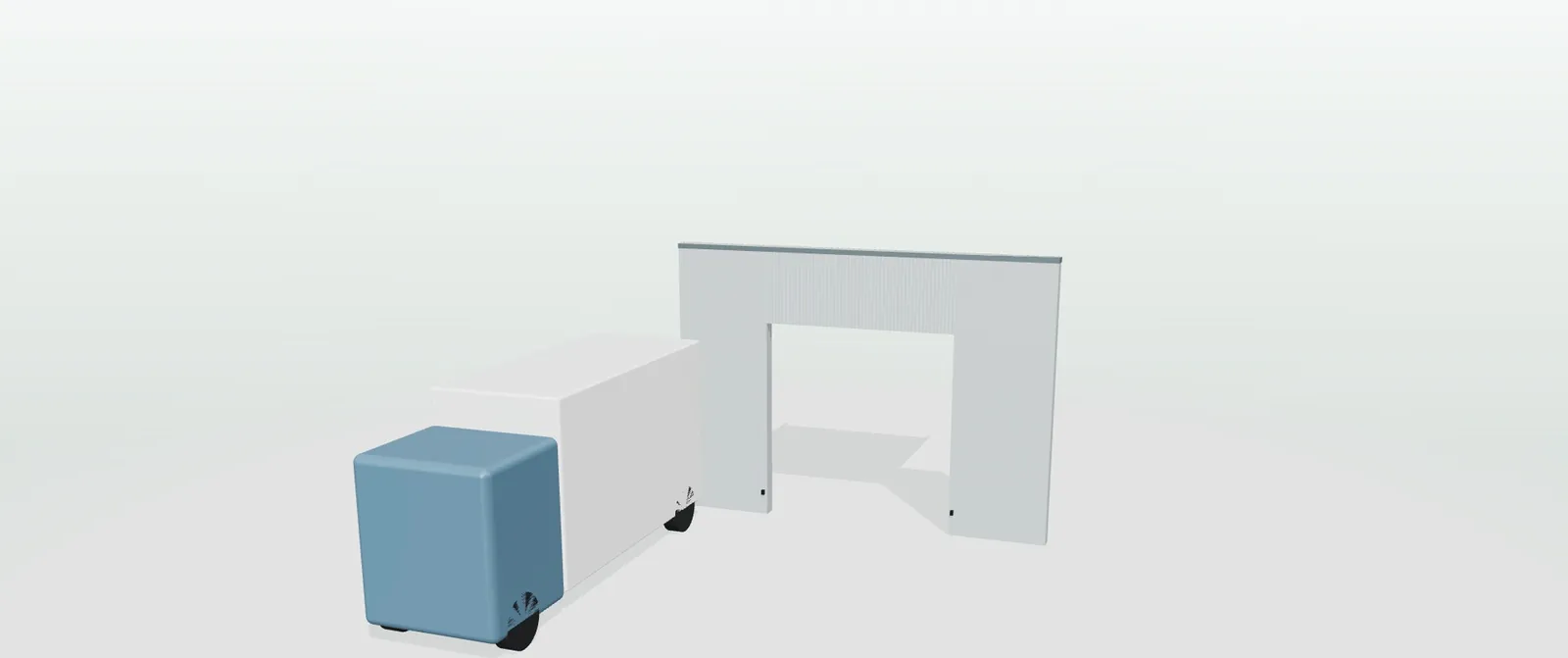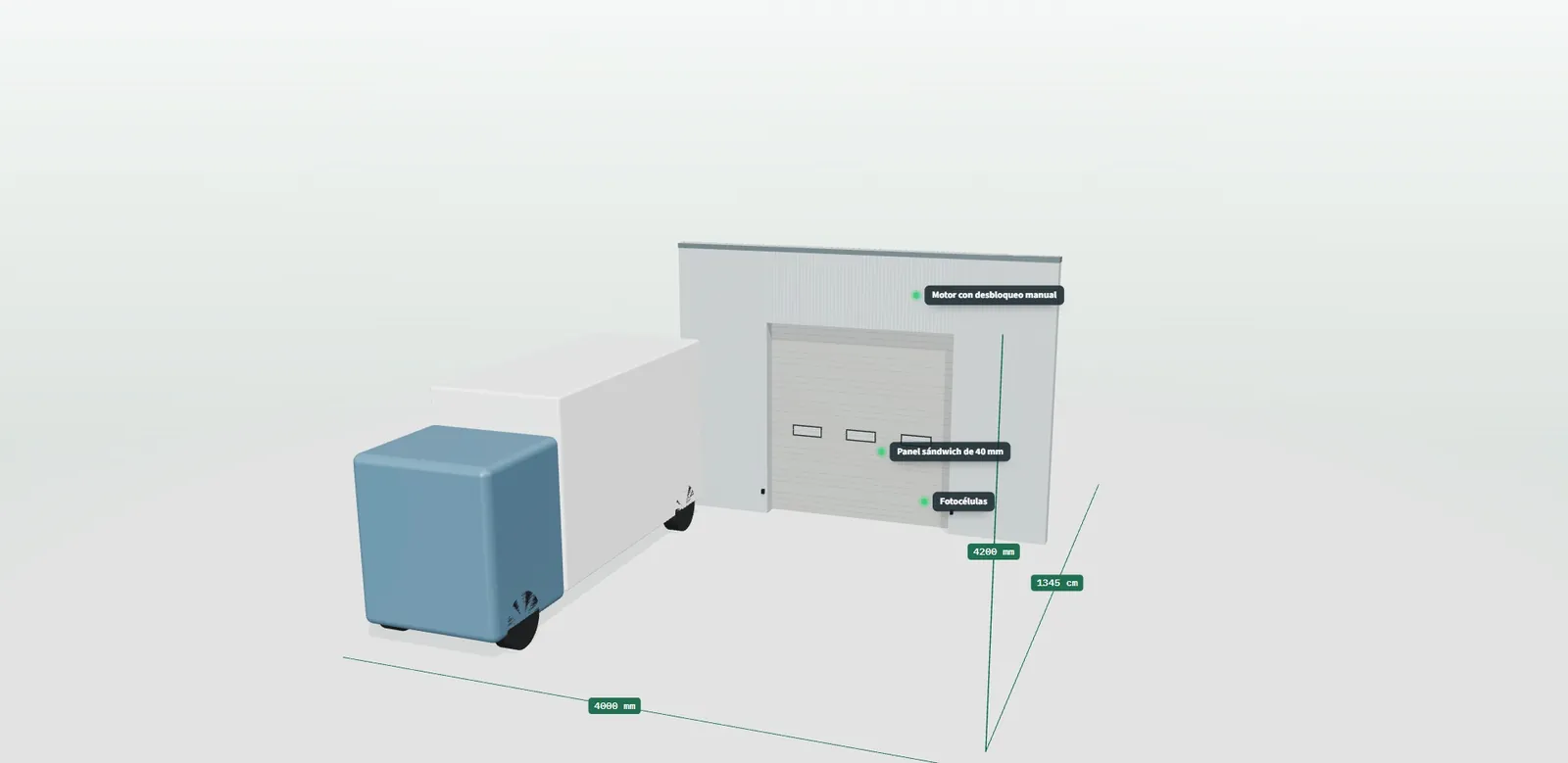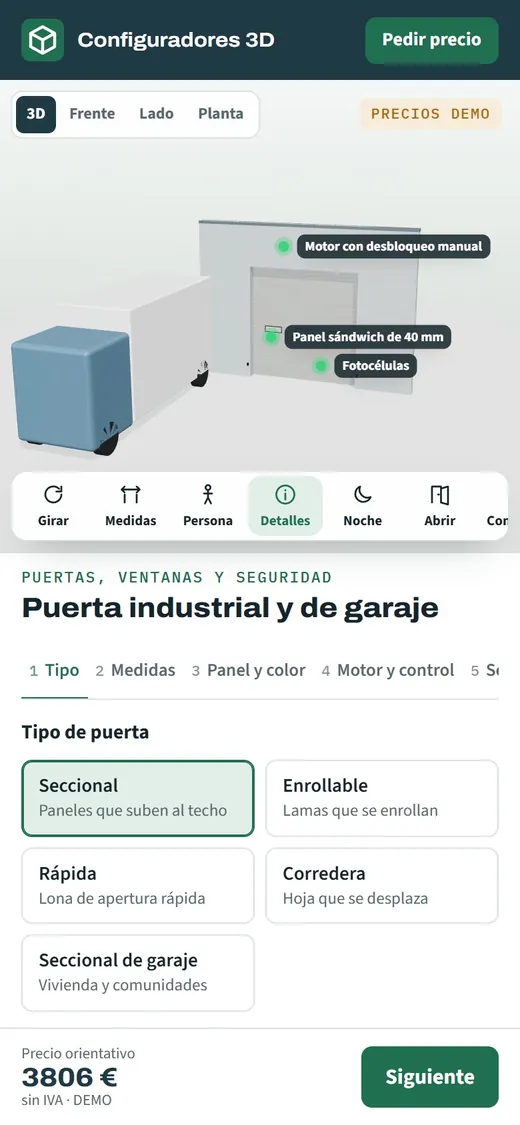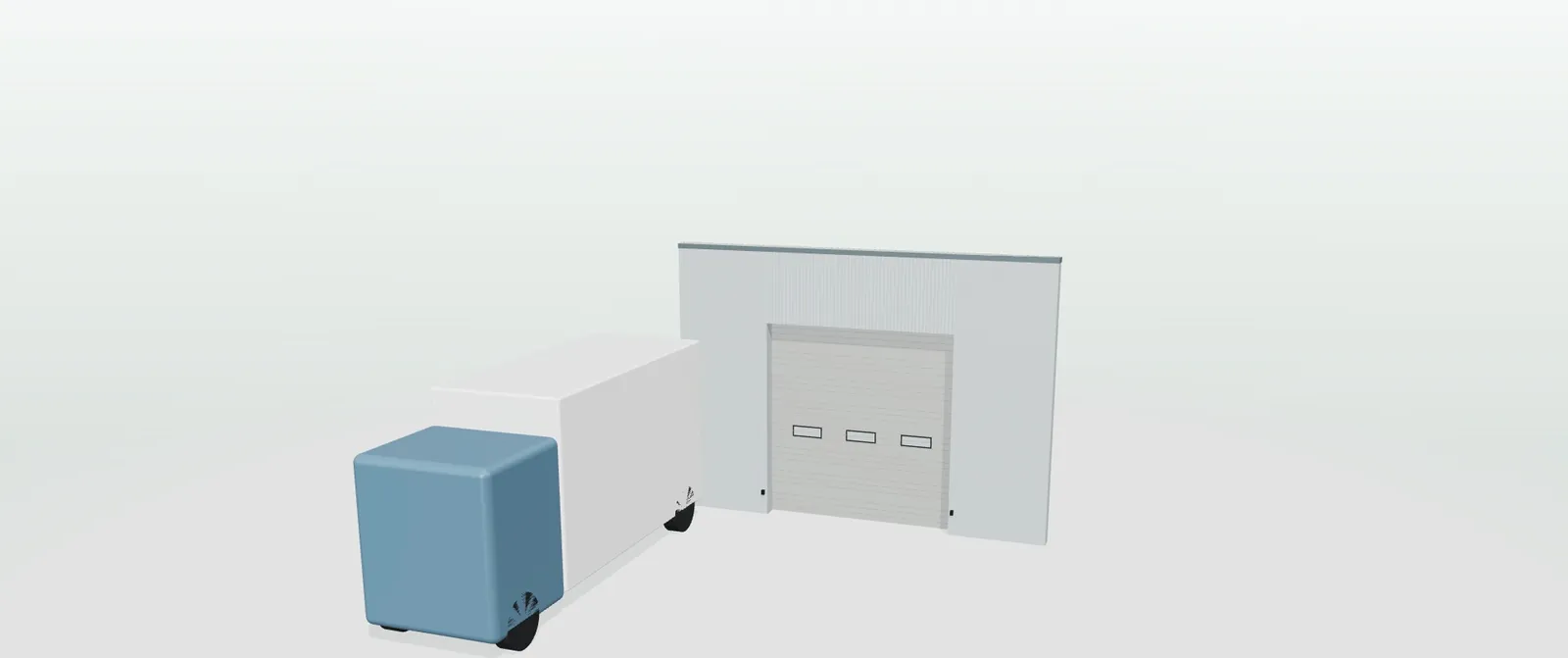
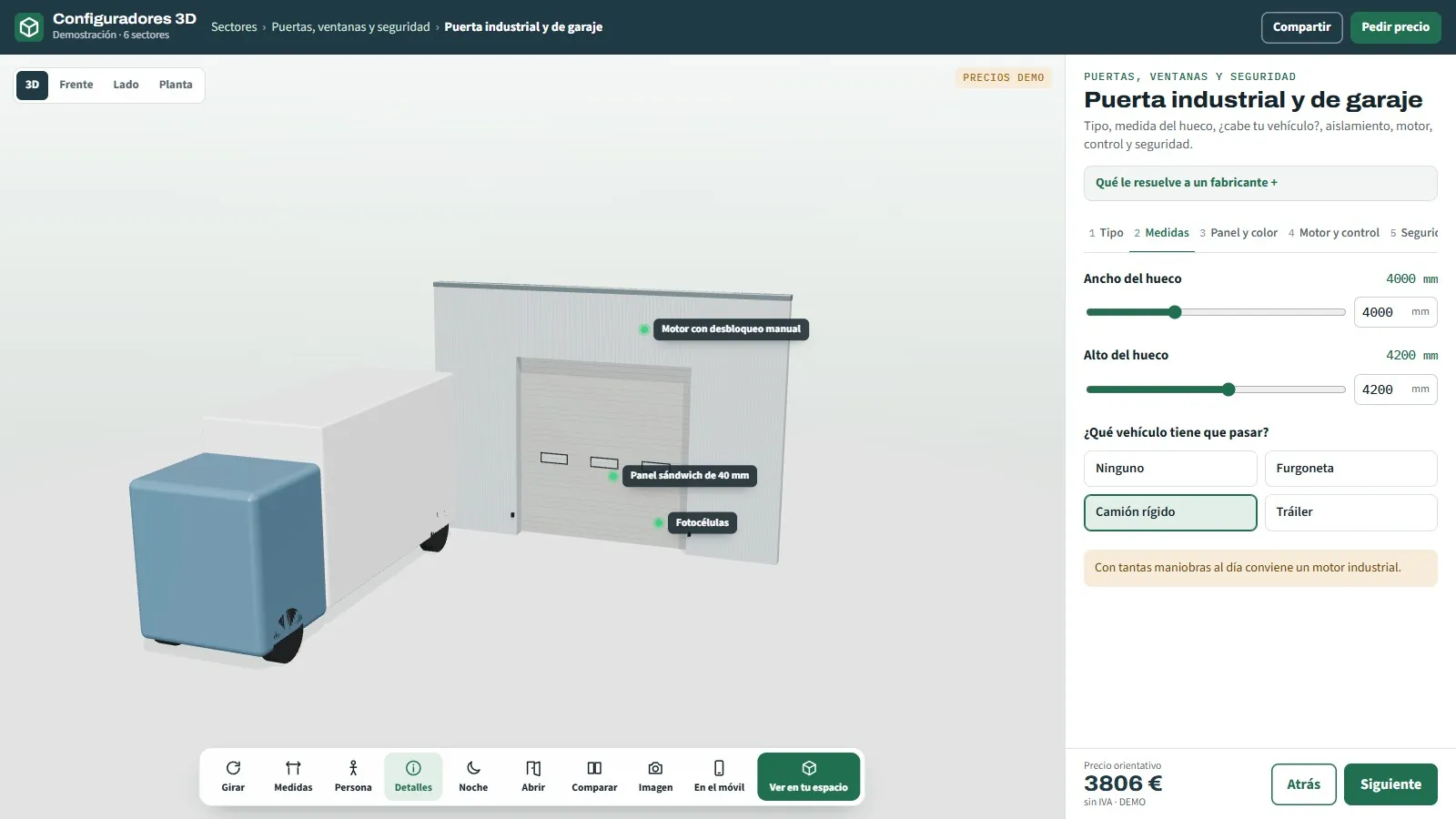
Silver grey industrial sectional door with a rigid lorry to scale in the 3D configurator
DOORS, WINDOWS AND SECURITY · OPEN DEMO
— FOR MANUFACTURERS AND INSTALLERS

3D configurator
for doors
built for industry.

To price a sectional door you need to know the opening, the use, which vehicle goes through and how many cycles a day it will do. That information almost never arrives, and your technician ends up driving to the industrial estate just to measure. The customer can sort all of that out on screen, before calling you.

— WHAT HAPPENS TO YOU

A 280-kilometre
round trip
to look at an opening.

It is ten to seven and the sales engineer is already on the motorway. They are driving 140 kilometres to a logistics platform to measure some loading bays. The maintenance manager called on Friday: six doors need replacing, two of them for articulated lorries, and they want a price “this week”. All they have sent is a photo of the opening with a pallet in front of it and one sentence: “more or less like the one there”. You cannot calculate a door from that, so it is time to get in the car.

Once there, they find out what the phone call did not say: the lintel is lower than expected, one of the doors opens into the cold store and needs 80 millimetres of insulation, and the night shift opens and closes each door more than a hundred times. Industrial motor, photocells, traffic light, dock shelter. None of that was in the photo. They get back to the office mid-afternoon with the tape measure, a notebook full of dimensions and four and a half hours of driving in their legs.

The quote goes out on Thursday. On Friday, the maintenance manager replies that they have received two more and that the cheapest one “looks similar”. It is not: it has a 40 millimetre panel and a motor designed for a residential garage. But on paper they are three PDFs with a price at the bottom, and nobody at the platform has time to compare duty cycles or insulation values. In the end the figure wins, not the door.

— WHERE THE SALE LEAKS AWAY

The bottlenecks
you will recognise
straight away.

“Can you not give me an approximate price over the phone?”

Site visits just to give a price

Without knowing the opening, the use or which vehicle goes through, any price over the phone is a risk. So someone goes out to measure, even though many of those visits end in “we will let you know”. Each one is half a day of a technician who is not installing, plus the vehicle, plus the days the customer spends waiting.

What it costs youTechnicians clocking up miles instead of fitting doors.
“Make it tall, lorries come in”

Does the vehicle fit or not?

The customer knows lorries come in, but not whether they are rigid or articulated, or how much room the driver needs to reverse. If the opening is too tight, the first knock on the lintel comes soon. If it is oversized for no reason, the quote goes above the competition's.

What it costs youA badly sized door gets paid for in damage or in lost orders.

“The wicket door was missing, and the motor was the garage one”

Orders with incomplete information

Vision panels, integrated wicket door, ventilation grille, photocells, traffic light, type of operation, way of opening. If one of these is not written down, the door leaves the factory without it or with whatever someone assumed. Changing it with the door already hung in the warehouse means going back with materials and another crew.

What it costs youSecond visits that were never in the quote.

“They sent me a cheaper one and it is the same”

Comparing on price alone

In a PDF, a 40 millimetre sectional and an 80 millimetre one are two lines of text. So are a motor rated for 150 cycles a day and a garage one. The person buying for a warehouse is not a door specialist: if they cannot see the difference, they compare the final figure and sign the cheapest, even if it was never designed for their use.

What it costs youYour margin goes on discounts to match whoever is selling less door.

“I have to run it past management”

The decision is made far from the technician

The person asking for the quote is the maintenance manager; the person signing is the operations director or the general manager, who has never stood on the loading bay with your technician. What reaches them is an email with three PDFs and one question: “which one do we take?”. Everything explained during the visit does not travel with the quote.

What it costs youThe arguments get lost before they reach whoever decides.

— DO THE MATHS

What it costs you
today, with
your own numbers.

Work out what the visits that only serve to give a price cost you. The values are an example; replace them with yours.

visits
h
€
MONTHLY COST OF DRIVING OUT TO MEASURE FOR A QUOTE 0

€ a month

The values are an example: replace them with yours. The calculation is a simple multiplication and does not come from any study.

— HOW IT IS SOLVED

Every bottleneck,
with its
answer.

Industrial door configurator screen with type, use, opening dimensions, motor and indicative price
Answers · Site visits just to give a price

The customer measures, chooses and sees a price before calling you

Your technician goes to confirm the opening, not to discover it. From their own warehouse, the customer defines door type, use, opening dimensions, panel, insulation, colour, motor and way of opening, and sees an indicative price calculated with your price list. By the time they call, they know what they want and roughly what it will cost.

A guided configuration with an indicative price
Industrial sectional door open in 3D with a rigid lorry to scale going through the dimensioned opening
Answers · Does the vehicle fit or not?

You can see whether the lorry fits before manufacturing

The customer chooses a van, a rigid lorry or an articulated lorry, and the vehicle appears to scale in front of the door, with the dimensions of the opening and whether it fits and with how much clearance. The door goes up and down with a button to check the clearance with the leaf open.

A vehicle to scale, plus open and close in 3D
Summary of the configured industrial door with the order sheet: sectional leaf, tracks, motor, remote and photocells
Answers · Orders with incomplete information

Everything the door includes is written down

Nothing is left hanging between the office and the workshop. Vision panels, wicket door, grille, photocells, traffic light, dock shelter, motor and way of opening all go into the order sheet, with a reference and a quantity for every part: leaf, tracks and brackets, motor and control panel, remote. With your rules loaded, if the use is logistics the standard motor does not even appear.

A factory order sheet with your rules
Close-up of the sectional door in 3D with labels for insulation, cycles per day and recommended motor
Answers · Comparing on price alone

The difference between 40 and 80 millimetres can be seen

The labels on the 3D show the indicative insulation, the expected cycles per day and the motor recommended for that use. If they are hesitating between two or three doors, they see them side by side with the differences highlighted. The buyer understands why your door costs what it costs before putting it next to another one.

Technical labels and a comparison of up to three options
Industrial door configurator on a phone, ready to see the door at real size on the loading bay in augmented reality
Answers · The decision is made far from the technician

Whoever signs sees the same door the technician saw

The maintenance manager forwards a PDF with the configuration and an image of the door, instead of a flat quote. With a phone and the QR code, management can see the door at real size on their own loading bay in augmented reality, with nothing to download.

PDF, image, QR code and augmented reality
— TRY IT NOW

Try it
for
yourselves.

Choose the articulated lorry, lower the height of the opening until it stops fitting and press Open to check the clearance.

An open demo, with no registration, with example products and prices. It is designed for manufacturers, dealers and installers: private customers are welcome to try it, but we do not sell the product.

— INVESTMENT AND NEXT STEP

Show us your door range

In 20 minutes you see the demo with a sectional similar to yours and we talk about which types, uses and rules would have to be loaded so your customers can configure the door themselves.

From €6,500

Most projects for manufacturers fall between €14,500 and €35,000, depending on the catalogue, the manufacturing rules and the integrations. Maintenance and hosting from €190 a month. We start from a base that already works: you are not paying for development from scratch.

  • What is includedThe configurator with your products, your rules and your price list, embedded in your website and in your dealers' sites, with training for the sales team.
  • TimeframeBetween 3 and 16 weeks depending on the scope; the exact date goes in the proposal.
  • Payment terms40% to start, 40% with the test version and 20% at go-live.

Would you rather talk it through? Call 662 061 421 or write to grup3d@grup3d.es.

— FREQUENTLY ASKED QUESTIONS

What we
get asked.

There are more short answers in frequently asked questions about 3D configurators and who we are in 3D configurator company.

Which types of industrial door can be configured?

The demo includes an industrial sectional, a garage sectional, a roller shutter, a high-speed fabric door and a sliding door, with uses ranging from a private garage to a communal garage, a warehouse or logistics. Your configurator would only show the types you manufacture or install, with your panels, thicknesses, colours and motors; whatever you do not sell simply is not there.

How does the configurator know whether a lorry fits?

The customer chooses the vehicle that has to go through and the configurator places it to scale next to the opening they measured, showing whether it fits and with how much clearance. The minimum clearances follow your technical criteria, so the answer matches what your technician would give on site.

Does it work for private and communal garage doors?

Yes. There is a garage sectional for homes and apartment blocks, with ribbed, flat, micro-profiled or wood-effect panels and opening by remote or by phone. A private customer can see the door on their own façade in augmented reality, and a residents' association can compare up to three options with their prices before the meeting.

What does an industrial door configurator cost?

With industrial doors, what weighs most is the number of types you want to offer, the technical rules for clearances and motors that have to be programmed and whether you want a connection to your ERP or an area for installers. Developments start from €6,500 for a visual configurator of one product family; most projects for manufacturers fall between €14,500 and €35,000, depending on the catalogue, the rules and the integrations, plus maintenance from €190 a month. In a 20-minute demo we go through your range and put in writing what is included and what is not.

Can we distribute the enquiries between installers by area?

Yes, as part of the bespoke development. Enquiries that arrive with the door already configured can be assigned to the installer or the branch for each area, and can go into your CRM so the sales rep has the full configuration before calling the customer.

Do we still need to go out and measure?

To confirm the opening before manufacturing, usually yes: the configurator does not replace the final measurement. What changes is that nobody has to drive out just to give a price. The technician goes to a job the customer already understands, with the door, the motor and the extras decided.