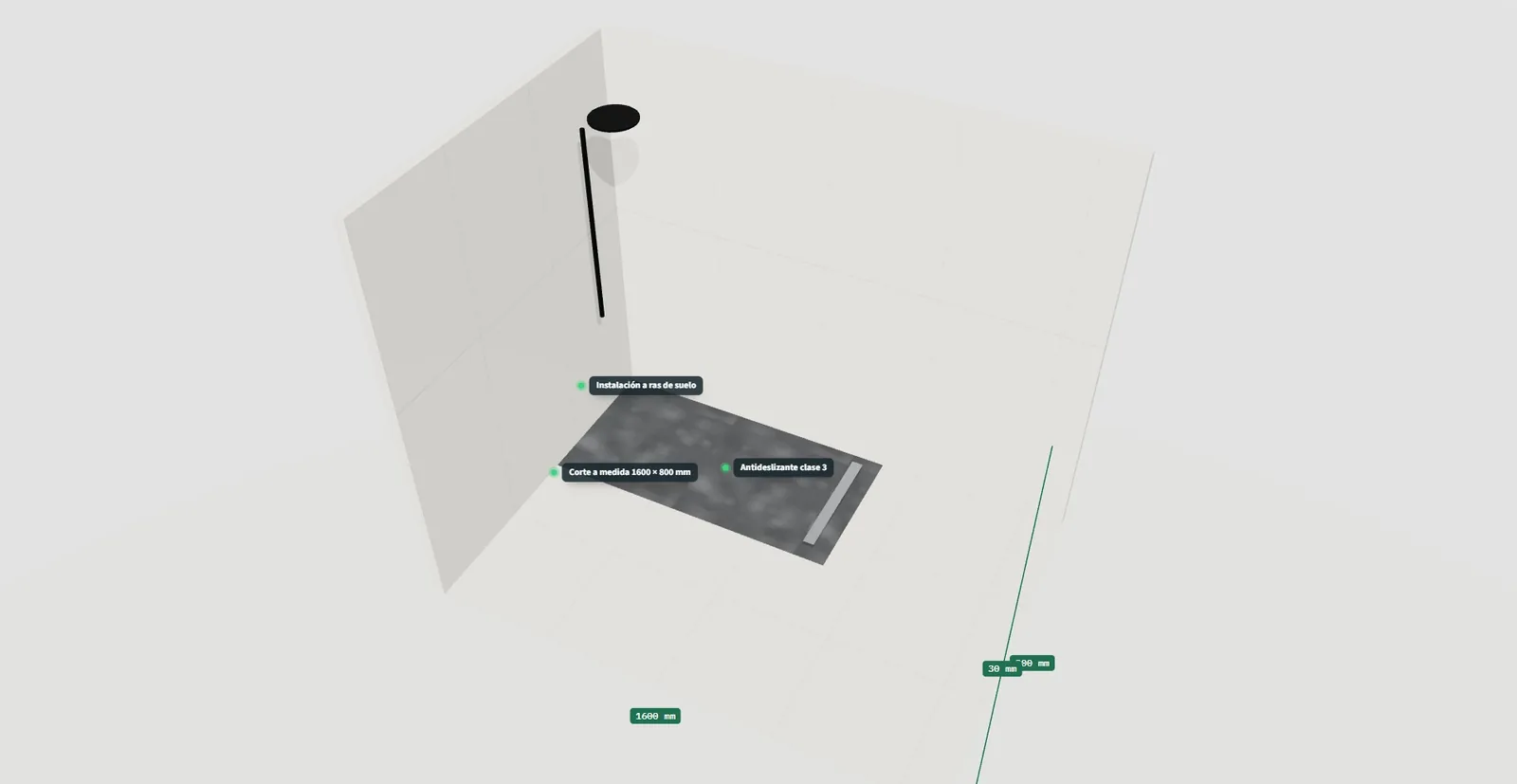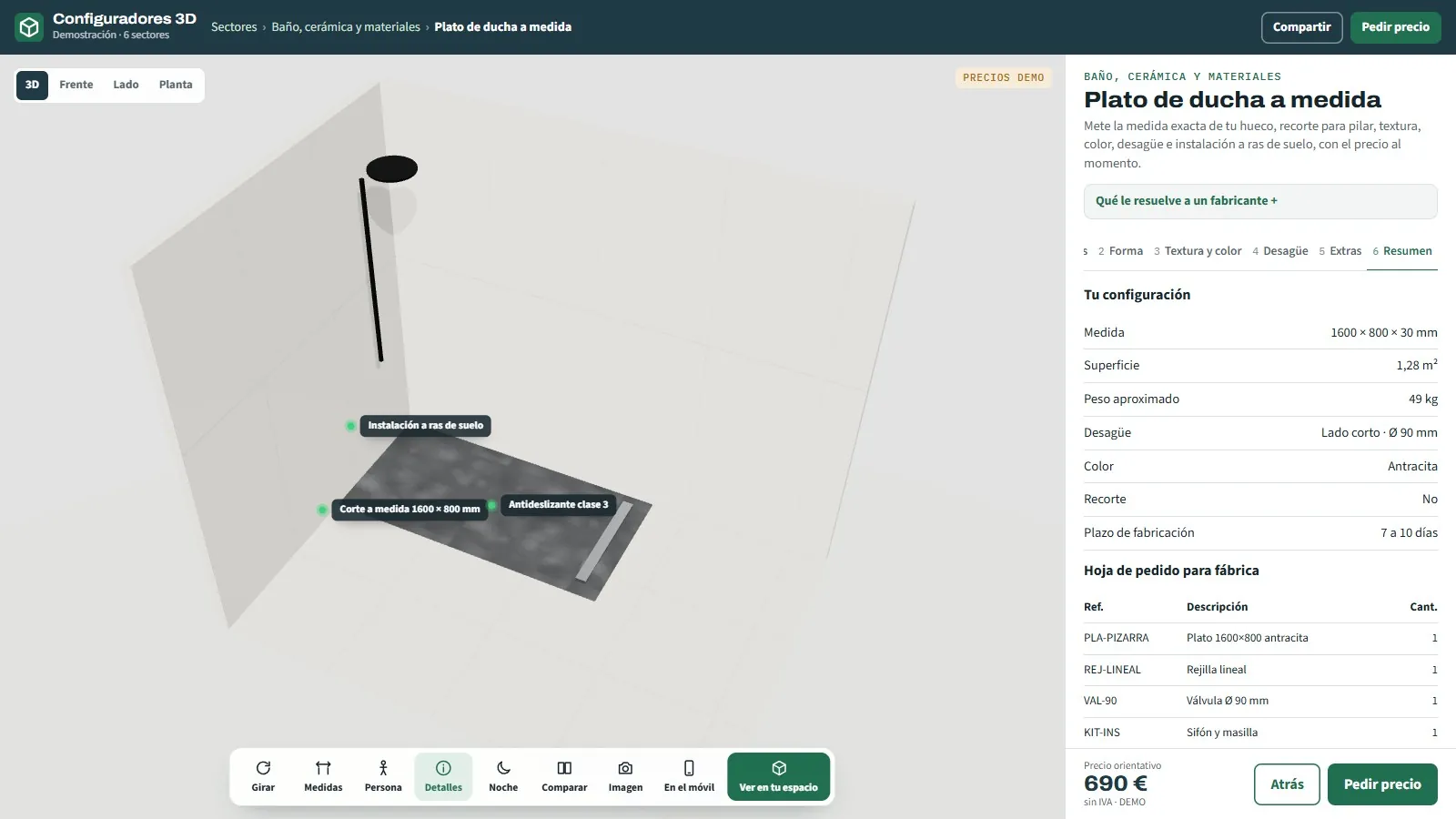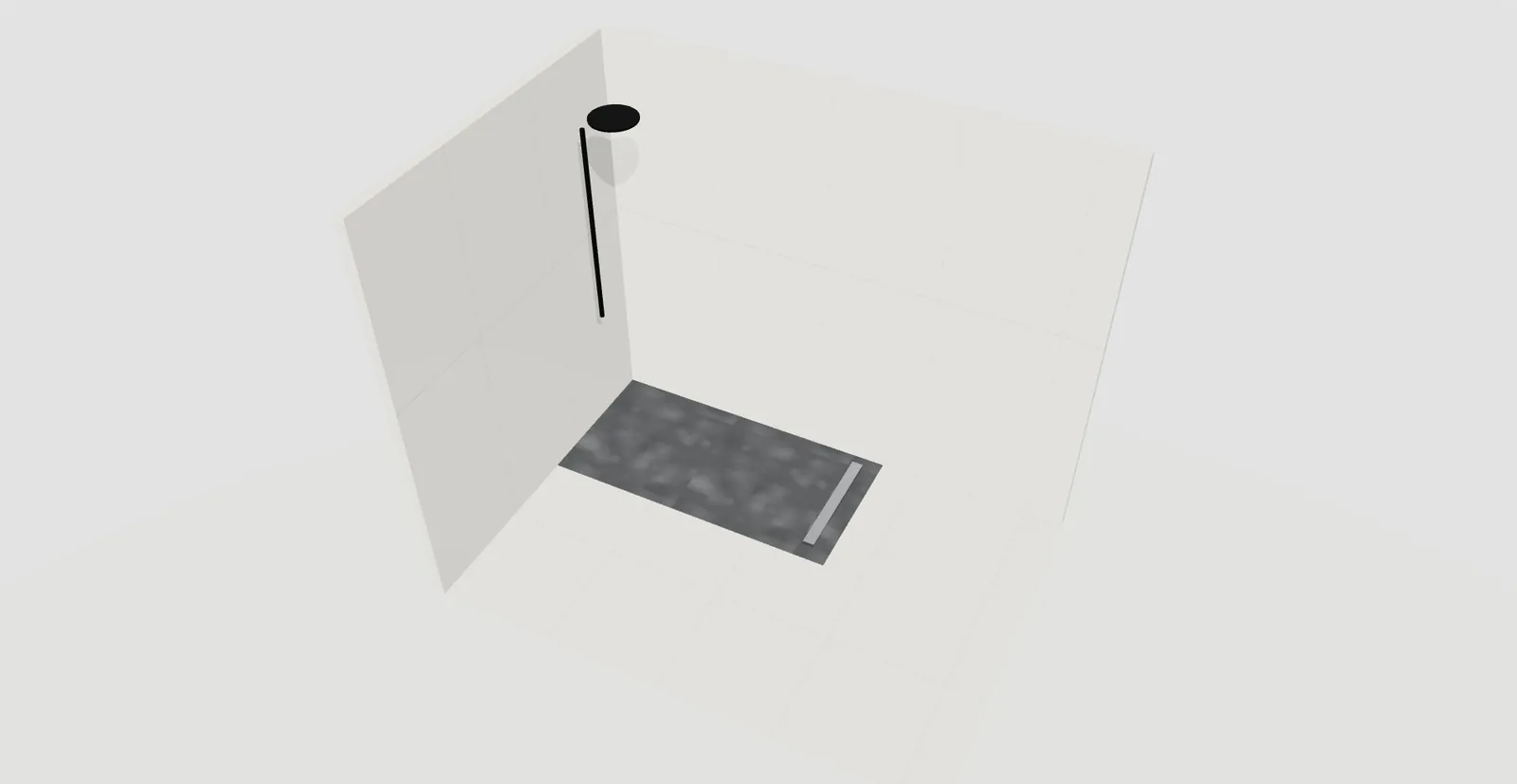
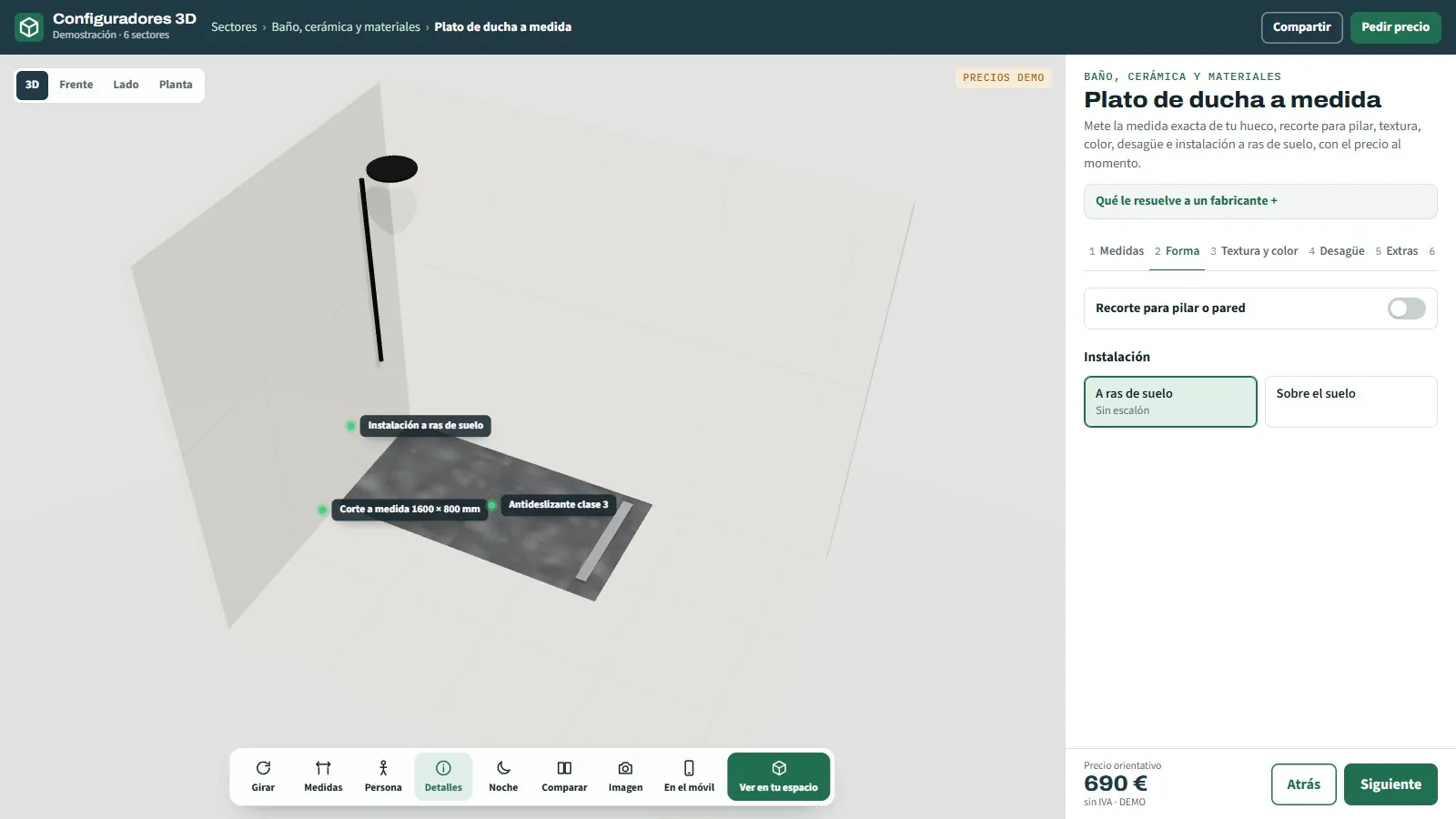
A made-to-measure shower tray, 1600 × 800 mm in anthracite slate texture with a linear grate, seen in 3D in the configurator
BATHROOM, CERAMICS AND MATERIALS · OPEN DEMO
— FOR MADE-TO-MEASURE TRAY MANUFACTURERS

3D configurator
for shower trays
made to measure.

The order arrives as a message on a phone: a photo of a biro sketch, two dimensions, “cut-out for the pillar” and not a word about the waste. You cut the tray, it goes out on the lorry and on site the outlet ends up on the wrong side. A made-to-measure tray that is badly defined is no use to anyone.

— WHAT HAPPENS TO YOU

A photo of a piece of board,
two dimensions
and no sign of the waste

The first photo of the day reaches the orders phone at twelve minutes past eight: a biro sketch on a piece of plasterboard. It says 1583 by 792, there is an arrow pointing at a rectangle with the word “pillar” and, underneath, “dark grey, slate”. It does not say whether the cut-out goes next to the wall or on the screen side, or where the waste outlet is, or whether the tray is flush with the floor. The plumber who sent it is on site and will not pick up the phone until midday.

The person in the technical office spends the morning like this: asking for the missing dimension, explaining the difference between pearl grey and cement, working out a price with a cut-out so the installer can pass it on to their customer, and working it out again because the customer now prefers anthracite. Forty made-to-measure orders a week, each with its own conversation. Meanwhile, three plumbing merchants are waiting for prices on trays they may never actually order.

And then there is the tray that comes back. It was made with a centred waste when the outlet was on the short side, or the cut-out came out mirrored because nobody said which way the drawing was being read. With seven to ten days of manufacturing ahead, the installer has a job at a standstill, the customer a bathroom with no shower and you a 1.28 m² tray cut to a size that fits no other bathroom.

— WHERE THE SALE LEAKS AWAY

The bottlenecks
you will recognise
straight away.

“How much is one at 158 by 79?”

Every measurement is a phone call

The installer does not carry your cutting price list in their head and their customer wants the price before deciding. So they call, send a voice note or write at eleven at night. Every made-to-measure tray takes a conversation to give a price that often does not even become an order. And if the customer changes colour or size, it starts again.

What it costs youA technical office turned into a price switchboard.
“The pillar is on the left, looking from the door.”

Cut-outs and wastes understood the wrong way round

A 250 × 200 cut-out in the wrong corner, a waste on the long side when the outlet is on the short one, a linear grate where the customer wanted the same-colour cover. It is all explained with words and hand drawings, and each person pictures the tray from a different side.

What it costs youA cut tray that cannot be reused and another one that has to be made again.

“Is the anthracite slate very dark?”

Textures and colours that do not show in a photo

Slate, smooth or sand; white, cream, pearl grey, cement, anthracite, black or terracotta. In the catalogue photo several of them look the same, and a ten-centimetre sample does not explain a tray a metre sixty long. The customer hesitates, asks for samples or chooses white to play safe.

What it costs youSamples sent by courier and orders delayed by days.

“Flush or on top of the floor? That is up to the customer.”

Details missing once it has already been cut

Flush or surface installation, anti-slip, installation kit with trap and sealant: details the installer takes for granted and which never appear on any piece of paper at the factory. They get decided on the fly, sometimes when the tray is already packed and on its way to site.

What it costs youWastes and kits sent separately, with their own carriage.

“Send me the price for the merchant, they are asking for it.”

Merchants who sell standard because it is easier

A plumbing merchant finds it hard to sell a made-to-measure tray: they do not know how to work it out, they do not want to get the cut-out wrong and there is no time at the counter for sketches. They sell the nearest standard size and the installer makes do on site with cuts, trims and tiling.

What it costs youYour highest-value product goes unsold at the counter.

— DO THE MATHS

What it costs you
today, with
your own numbers.

Count only the time that goes on giving prices and clarifying measurements by phone and message. The trays made twice, with their material, their carriage and their job at a standstill, are separate.

enquiries
h
€
weeks
MONTHLY COST OF GIVING PRICES AND CLARIFYING SIZES BY HAND 0

€ a month

The values are an example: replace them with yours. The calculation is a simple multiplication and does not come from any study.

— HOW IT IS SOLVED

Every bottleneck,
with its
answer.

Shower tray configurator screen with length and width in millimetres, texture, colour and indicative price
Answers · Every measurement is a phone call

The installer has the price without calling you

They enter the length and width of the opening in millimetres, the texture, the colour and the extras, and see the indicative price from your price list straight away. They can do it on site, from their phone and in front of their customer. The technical office receives the order once it is already decided.

The exact size with an indicative price straight away
Shower tray in 3D with labels pointing out the cut-out for the pillar, the waste position and the linear grate
Answers · Cut-outs and wastes understood the wrong way round

The cut-out and the waste end up drawn, not described

The cut-out for a pillar or a wall is defined with its width and its depth and is shown in 3D on the tray; the waste is placed centred, on the short side or on the long side, with its grate. The labels on the 3D point it all out and everything goes onto the order sheet with dimensions and references.

Cut-out and waste position in 3D
A made-to-measure shower tray, 1600 × 800 mm in slate texture and anthracite colour with a linear grate, seen in 3D
Answers · Textures and colours that do not show in a photo

The colour is chosen looking at the whole tray

Slate, smooth or sand in seven colours, on the complete tray and in bathroom light. The customer turns it round, compares it with two other versions with the differences highlighted and, if they want, sees it at real size on their bathroom floor in augmented reality from their phone.

Textures and colours in 3D, a comparison tool and augmented reality
Shower tray summary with size, area, weight, 90 mm waste, colour, lead time and an order sheet by part
Answers · Details missing once it has already been cut

The order does not go out without what the factory needs

Flush or surface installation, class 3 anti-slip, grate and installation kit are part of the flow, so they are not forgotten. The order sheet carries the size, the area, the approximate weight, the waste with its diameter, the colour and the manufacturing lead time. With your rules, what you do not make cannot be ordered.

A factory order sheet with your rules
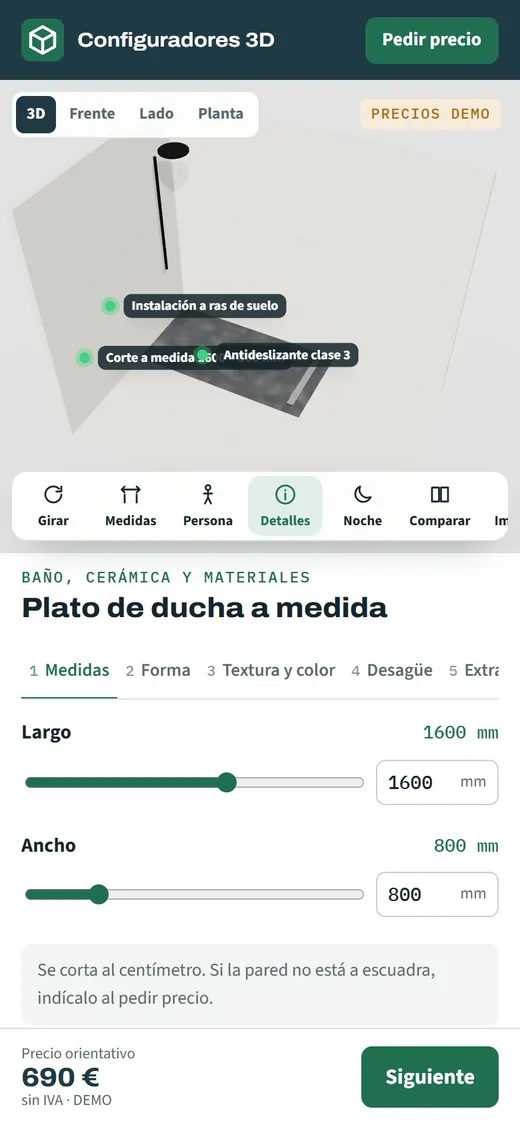
Made-to-measure shower tray configurator open on a phone, with the tray in 3D and the cut-out for the pillar switched on
Answers · Merchants who sell standard because it is easier

The merchant sells made-to-measure as confidently as standard

Each plumbing merchant can log in with their own access, their margin and their logo, and show the configurator at the counter or pass it to the customer's phone with a QR code. Selling a made-to-measure tray stops being a risk for the counter staff, because the order goes out complete and drawn.

A distributor area and opening on a phone with a QR code
— TRY IT NOW

Try it
for
yourselves.

Set an opening of 1600 × 800 mm, switch on the cut-out for the pillar and move the waste to the short side: see how it looks in 3D and how it appears on the order sheet.

An open demo, with no registration, with example products and prices. It is designed for manufacturers, dealers and installers: private customers are welcome to try it, but we do not sell the product.

— INVESTMENT AND NEXT STEP

Send us your cutting price list

With your size table, cut-out surcharges, textures and colours we prepare a 20-minute demo so you can see how orders would reach your technical office.

From €6,500

Most projects for manufacturers fall between €14,500 and €35,000, depending on the catalogue, the manufacturing rules and the integrations. Maintenance and hosting from €190 a month. We start from a base that already works: you are not paying for development from scratch.

  • What is includedThe configurator with your products, your rules and your price list, embedded in your website and in your dealers' sites, with training for the sales team.
  • TimeframeBetween 3 and 16 weeks depending on the scope; the exact date goes in the proposal.
  • Payment terms40% to start, 40% with the test version and 20% at go-live.

Would you rather talk it through? Call 662 061 421 or write to grup3d@grup3d.es.

— FREQUENTLY ASKED QUESTIONS

What we
get asked.

There are more short answers in frequently asked questions about 3D configurators and who we are in 3D configurator company.

Can the tray be ordered to the millimetre?

Yes. The length and width are entered in millimetres within the limits you manufacture; in the demo, from 700 to 2,200 mm long and from 700 to 1,200 mm wide. In your development your own maximums, minimums and size surcharges are set, and the configurator will not allow a size outside the range.

How is the cut-out for a pillar indicated?

The cut-out is switched on and its width and depth are entered; in the demo, between 100 and 500 mm. The tray appears in 3D with the cut-out, so the installer checks it matches their pillar before confirming. The order sheet carries those dimensions, with no interpretation and no hand drawings.

And the waste position?

It is chosen centred, on the short side or on the long side, together with the type of grate: square stainless steel, linear or a cover in the same colour as the tray. The position is seen on the tray in 3D and goes onto the order sheet with the diameter of the waste. If you make other positions or wastes, they are added.

What does a made-to-measure shower tray configurator cost?

The development starts here: developments start from €6,500 for a visual configurator of one product family; most projects for manufacturers fall between €14,500 and €35,000, depending on the catalogue, the rules and the integrations, plus maintenance from €190 a month. What raises that base is how many textures, colours and cutting rules you have, and whether you want plumbing merchants to log in with their own price list or orders to go straight into your ERP. With your cutting table in front of us we tell you what is included and what would stay out.

Can the installer use it from the job?

Yes. It runs in the browser on a phone, with nothing to install. The installer measures the opening, configures the tray in front of their customer, shows them the colour in augmented reality on the floor and saves the PDF with the indicative price. With a trade login they see their price and their margin, not the retail price.

Does it also work for selling to private customers?

Yes. The same configurator can be on your website for private customers, with retail prices, and in a login for installers and merchants with their own price list. Contacts coming from private customers can be assigned to the installer or the merchant for their area, so the tray is fitted by someone from your network.