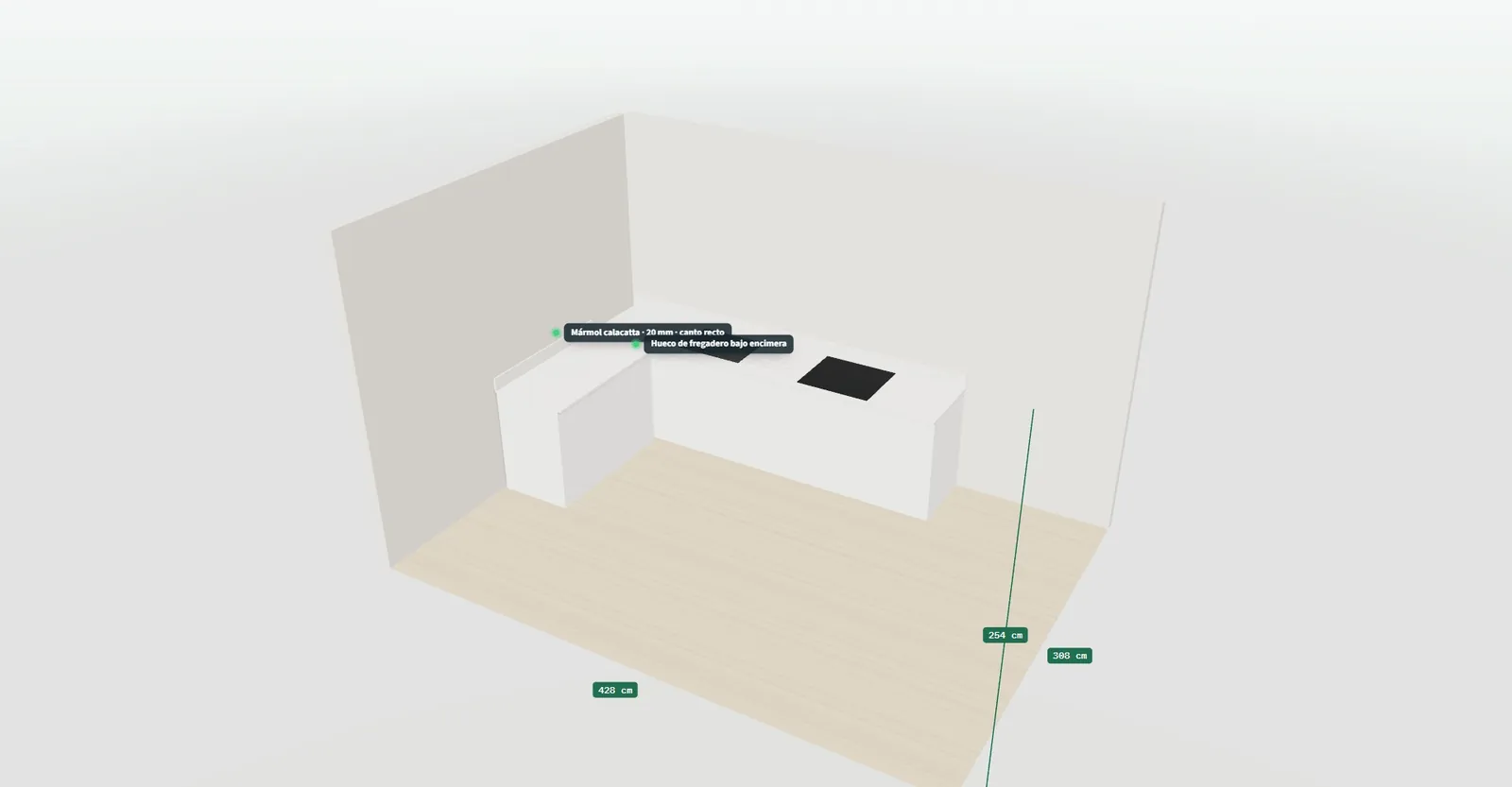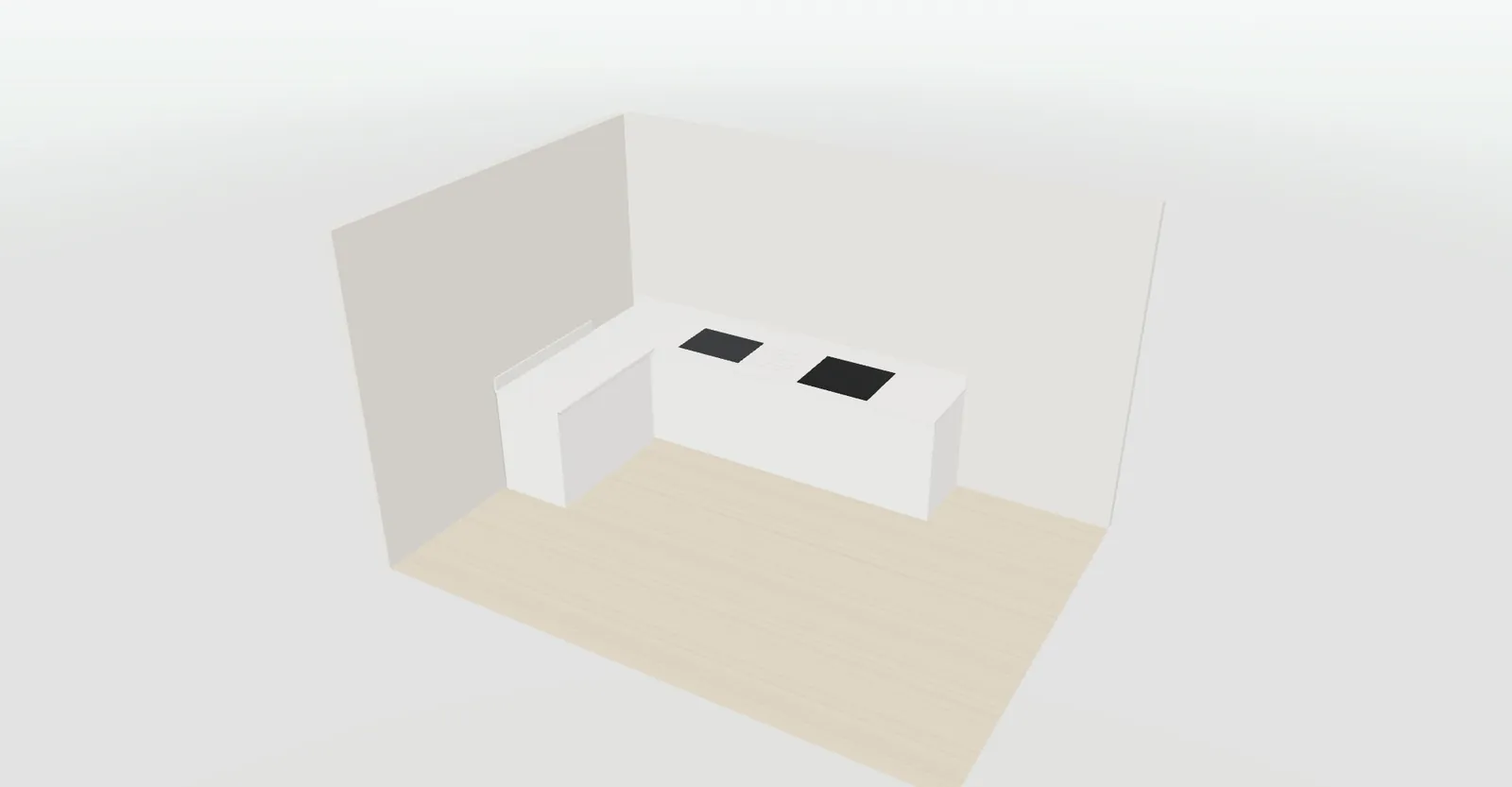
L-shaped calacatta marble worktop, 20 mm with a square edge, sink and hob, seen in 3D in the worktop configurator
BATHROOM, CERAMICS AND MATERIALS · OPEN DEMO
— FOR STONE WORKSHOPS AND FABRICATORS

3D configurator
for worktops
made for stone workshops.

To give a worktop price someone has to go out and template, and to template you have to spend a morning on a customer who may only have wanted to know the cost. Then the calacatta in the photo looks nothing like the slab, and the hob cut-out arrives written on a piece of paper.

— WHAT HAPPENS TO YOU

A worktop
that does not exist yet
and already costs a visit

“And roughly, how much would it be?” “It depends. I would have to come and measure.” It is the third call of the morning with the same question: an L-shaped kitchen, “in quartz or that stuff that looks like marble”, with a sink and a hob. The stone fabricator knows there are many ways for the figure to come out one way or another: thickness, edge, upstand, grooved drainer, splashback. And he knows that, without measuring, any number he gives on the phone will be quoted back at him on invoice day.

So he goes. One morning a week, sometimes two, goes on templating kitchens that have not been decided yet. One of the workshop's two templaters heads out with the tape and the notebook, draws the L, notes the 62 depth and the hob cut-out. He comes back, transfers the sketch to the computer and prepares the quote. Of every four visits, with luck, one ends in an order; the other three take their price to the stone workshop down the road.

And when the customer comes to the workshop to see the material, the conversation gets more complicated. On the display slab the calacatta has a beautiful vein in one corner that will not appear on their worktop, the polished black granite gleams under the fluorescent lights and the cement porcelain makes no sense in a twenty-centimetre sample. The customer chooses, changes their mind at home and calls to ask how much the price changes with a rounded edge.

— WHERE THE SALE LEAKS AWAY

The bottlenecks
you will recognise
straight away.

“Can you not give me an approximate price?”

Templates and visits for every quote

Without measurements there is no price, and without a price the customer will not commit to you coming to measure. The workshop ends up making visits and templates for kitchens that are never ordered, with the templater out and the van on the road. Time spent measuring eats into cutting, polishing and fitting, and the customer who does order waits longer.

What it costs youWhole mornings of templating that never become orders.
“It looked whiter in the photo.”

Materials you cannot appreciate in a photo

White quartz, calacatta marble, black granite, cement porcelain or solid wood; polished, matt or textured. The vein, the shine and the shade change with the light and with the size of the piece. In a small sample or on a phone screen the customer does not see their kitchen: they see a piece of stone.

What it costs youCustomers who hesitate to the last minute or change material after templating.

“Was the drainer not supposed to be grooved?”

Cut-outs and edges badly communicated

Sink cut-out, hob cut-out, grooved drainer, upstand, splashback up to the wall units, square, bevelled or rounded edge. These are decisions discussed verbally during the visit, noted on a sketch and reaching the workshop incomplete. A cut-out in the wrong place on a quartz slab cannot be fixed.

What it costs youA cut slab that is useless and a new material order.

“And with the rounded edge, how much more is it?”

Every change is a new quote

The customer wants to know how much changes from 20 to 30 mm, from square to bevelled, if they add the splashback or drop the upstand. Every variation is recalculated by someone in the workshop, by hand or with a spreadsheet only one person understands. Meanwhile, the kitchen is still not ordered and the customer is still asking elsewhere.

What it costs youQuotes that take days and customers who go cold.

“The kitchen shop needs the price by tomorrow.”

Kitchen shops waiting for your price

Part of the work comes from kitchen shops that sell the units and need the worktop to close the full quote. If your price is slow, they close with another workshop or with a worktop they can calculate themselves. And the kitchen, with its stone, goes elsewhere.

What it costs youWhole kitchens that go to another stone workshop because the price arrived late.

— DO THE MATHS

What it costs you
today, with
your own numbers.

Add up the templating visits that never end in an order. Put in your own figures instead of the example; the slabs cut wrong because of a badly communicated cut-out and the kitchens that go to another workshop are separate.

visits
h
€
MONTHLY COST OF TEMPLATING KITCHENS THAT ARE NEVER ORDERED 0

€ a month

The values are an example: replace them with yours. The calculation is a simple multiplication and does not come from any study.

— HOW IT IS SOLVED

Every bottleneck,
with its
answer.

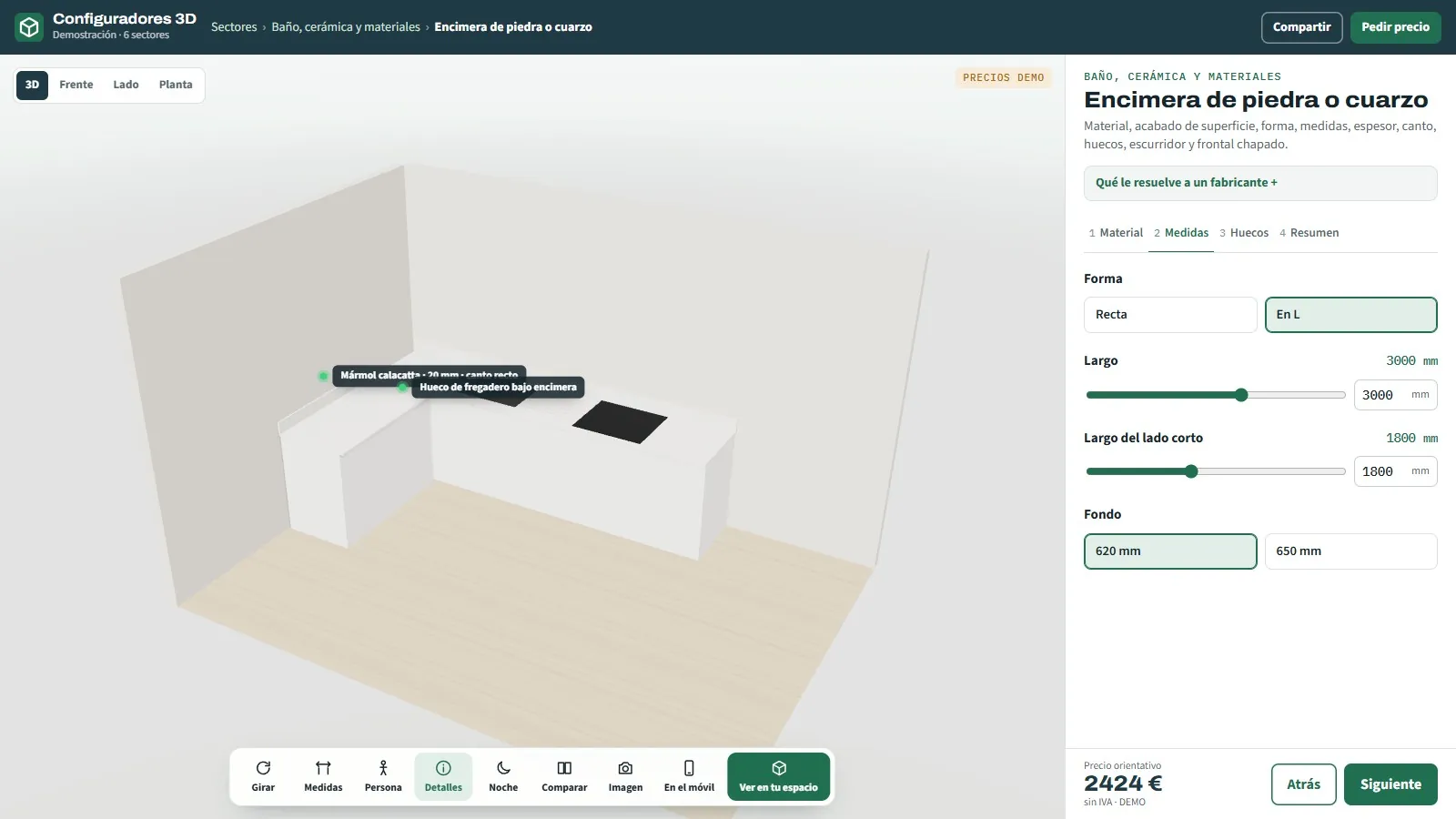
Worktop configurator screen with material, thickness, edge, L shape, lengths, depth and cut-outs step by step
Answers · Templates and visits for every quote

The customer knows the cost before you go out to measure

They enter the shape, straight or L, the lengths, the depth, the material, the thickness and the cut-outs, and see the indicative price instantly with your price list, the linear metres and the approximate weight. By the time they ask for the visit they know the figure, and the templating is done for a kitchen that is going ahead.

Sizes, shape and cut-outs with an indicative price
L-shaped calacatta marble worktop, 20 mm with a square edge, sink cut-out, hob and upstand, seen in 3D
Answers · Materials you cannot appreciate in a photo

The vein and the finish, on their worktop and not on a sample

The material is seen on the whole worktop, with its shape and its thickness, in polished, matt or textured. The customer rotates it, zooms in on the edge, compares white quartz, calacatta and cement porcelain side by side with the differences highlighted and sees it in their own kitchen in augmented reality from their phone.

Materials in 3D, comparison tool and augmented reality
Worktop in 3D with labels pointing to the sink cut-out, the grooved drainer, the hob cut-out and the edge
Answers · Cut-outs and edges badly communicated

Every cut-out and every edge is drawn into the order

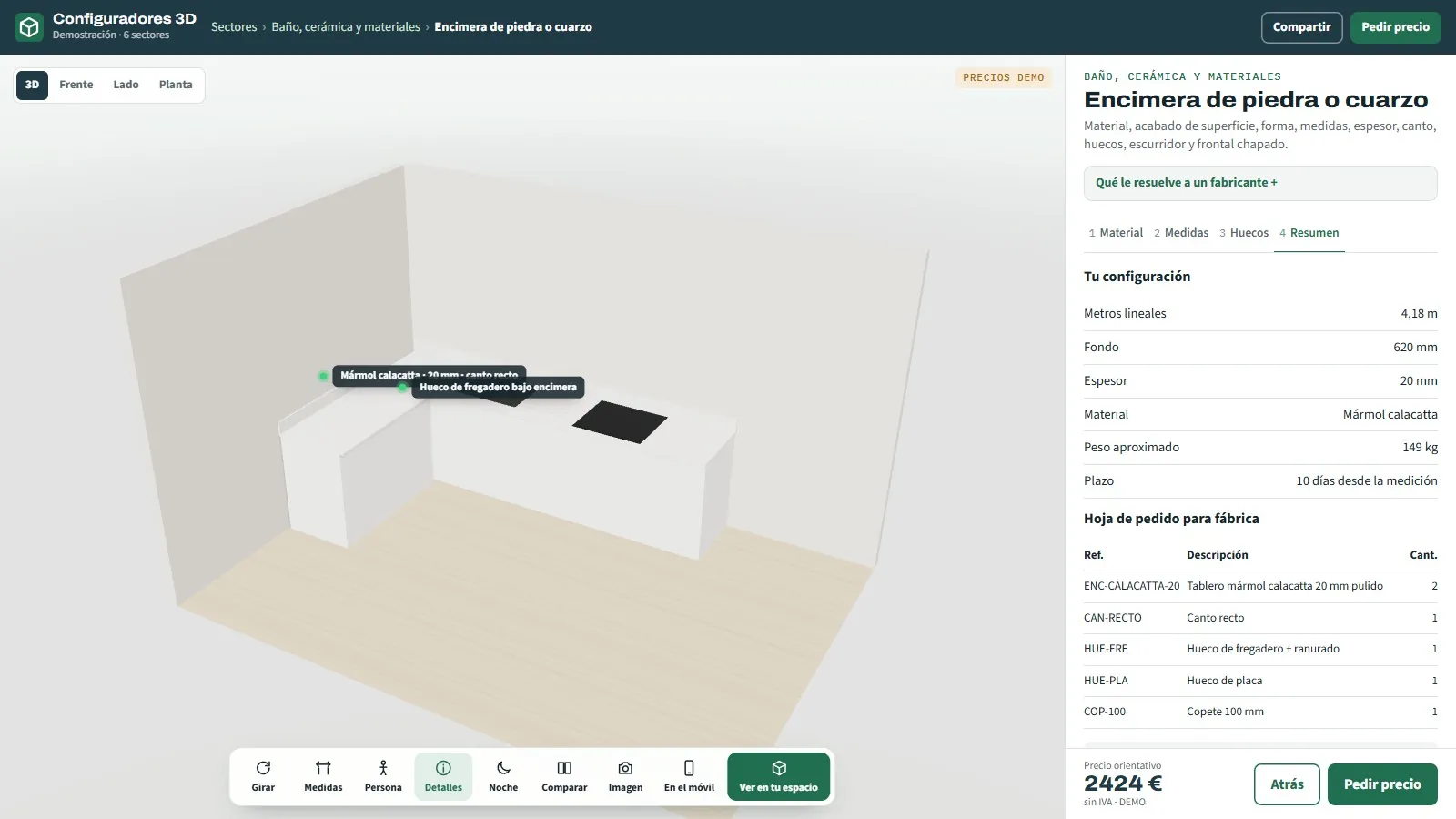
Sink cut-out, hob cut-out, grooved drainer, upstand and splashback are switched on over the 3D and appear marked in place. The order sheet comes out with the slab, the edge, every cut-out and the upstand, with their references. The workshop cuts what the customer has seen, and the final templating confirms the dimensions.

Cut-outs, edge and upstand on the 3D and an order sheet
Worktop summary with linear metres, 620 mm depth, 20 mm thickness, material, approximate weight and lead time
Answers · Every change is a new quote

Changes are recalculated on their own

Going from 20 to 30 mm, from a square edge to a rounded one or dropping the upstand changes the indicative price instantly, with your rules and your prices. The customer tries the options at home without calling you, and calls once they are clear about the worktop they want.

An indicative price that updates with every option
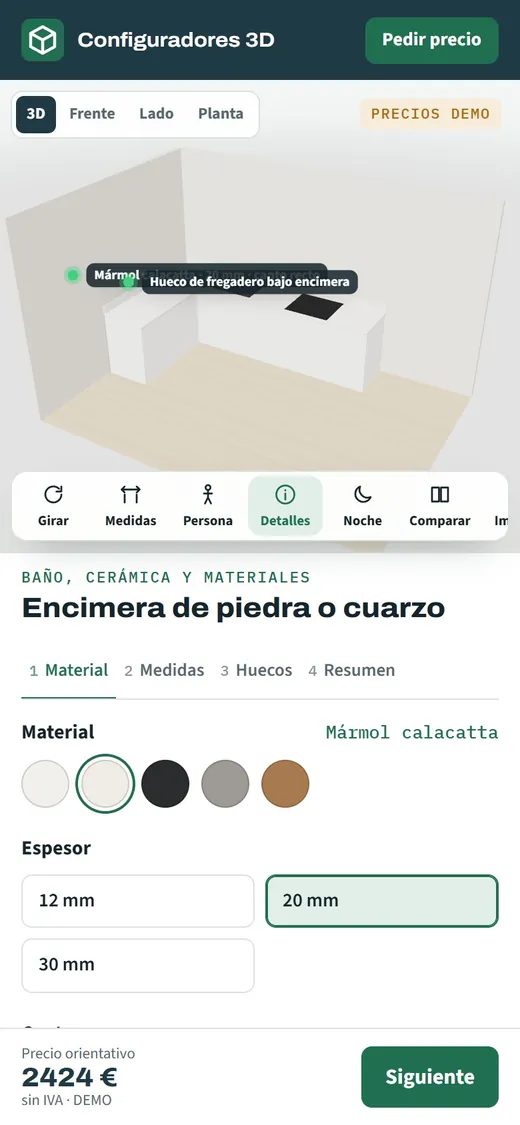
Mobile view of the worktop configurator, with the worktop in 3D and the material and surface finish selector
Answers · Kitchen shops waiting for your price

The kitchen shop works out the worktop price on its own

Every kitchen shop that works with you can log in with their own account, their margin and their logo, and calculate the worktop while closing the units quote. They pass the configuration to the customer with a QR code and send you an order with material, shape, edge and cut-outs defined. All you have to do is go and confirm the measurements.

A dealer area for kitchen shops with their own margin
— TRY IT NOW

Try it
for
yourselves.

Choose an L-shaped calacatta worktop, 20 mm with a square edge, switch on the grooved drainer and the splashback and look in the summary at the linear metres, the approximate weight and the lead time.

An open demo, with no registration, with example products and prices. It is designed for manufacturers, dealers and installers: private customers are welcome to try it, but we do not sell the product.

— INVESTMENT AND NEXT STEP

Let the customer see your stone before you go and measure

Bring your materials, thicknesses and prices for edges and cut-outs. We will spend 20 minutes showing you the demo and how it would look for your workshop and for the kitchen shops you work with.

From €6,500

Most projects for manufacturers fall between €14,500 and €35,000, depending on the catalogue, the manufacturing rules and the integrations. Maintenance and hosting from €190 a month. We start from a base that already works: you are not paying for development from scratch.

  • What is includedThe configurator with your products, your rules and your price list, embedded in your website and in your dealers' sites, with training for the sales team.
  • TimeframeBetween 3 and 16 weeks depending on the scope; the exact date goes in the proposal.
  • Payment terms40% to start, 40% with the test version and 20% at go-live.

Would you rather talk it through? Call 662 061 421 or write to grup3d@grup3d.es.

— FREQUENTLY ASKED QUESTIONS

What we
get asked.

There are more short answers in frequently asked questions about 3D configurators and who we are in 3D configurator company.

Does the price the customer sees replace the templating?

No. The price is indicative and is there so the customer can decide whether to go ahead before you come out to measure. The final templating is still yours and confirms the real dimensions, but it happens on a kitchen with material, shape, edge and cut-outs already chosen, and with a customer who already knows the order of magnitude of the price.

Which materials can be configured?

The demo includes white quartz, calacatta marble, black granite, cement porcelain and solid wood, in 12, 20 or 30 mm and with a polished, matt or textured finish. In your configurator the materials and colours you work with are loaded, with the thicknesses you have available and what each one costs.

Does it work out the linear metres of an L-shaped kitchen?

Yes. From the length, the short side and the depth it works out the linear metres, the approximate weight and the indicative lead time. In the demo, an L of 3,000 by 1,800 mm with a 620 depth gives 4.18 linear metres. In your development your own calculation and manufacturing rules apply.

How much does a worktop configurator cost for a workshop?

For a stone workshop, the base price of the development is this: developments start from €6,500 for a visual configurator of one product family; most projects for manufacturers fall between €14,500 and €35,000, depending on the catalogue, the rules and the integrations, plus maintenance from €190 a month. What makes it vary is how many materials, thicknesses, edges and cut-outs you want loaded with their price, and whether the kitchen shops you work with will have their own login with their margin. With your stone price list in front of us we explain what that figure covers.

Does it work for bathroom worktops too?

Yes, the same flow works for kitchen and bathroom: straight shape, sizes, material, thickness, edge and cut-outs. In your development the bathroom pieces you make can be added, with their rules and their price, so the shop or the customer configures them just like a kitchen worktop.

Can you tell the difference between 12, 20 and 30 mm thickness?

Yes. The customer rotates the worktop, zooms in on the edge and sees the thickness of the slab with a square, bevelled or rounded edge. They can save the 12 mm version and the 30 mm one and compare them together, with the differences between them highlighted and what each one costs. If they want, they place it at real size in their kitchen in augmented reality from their phone.