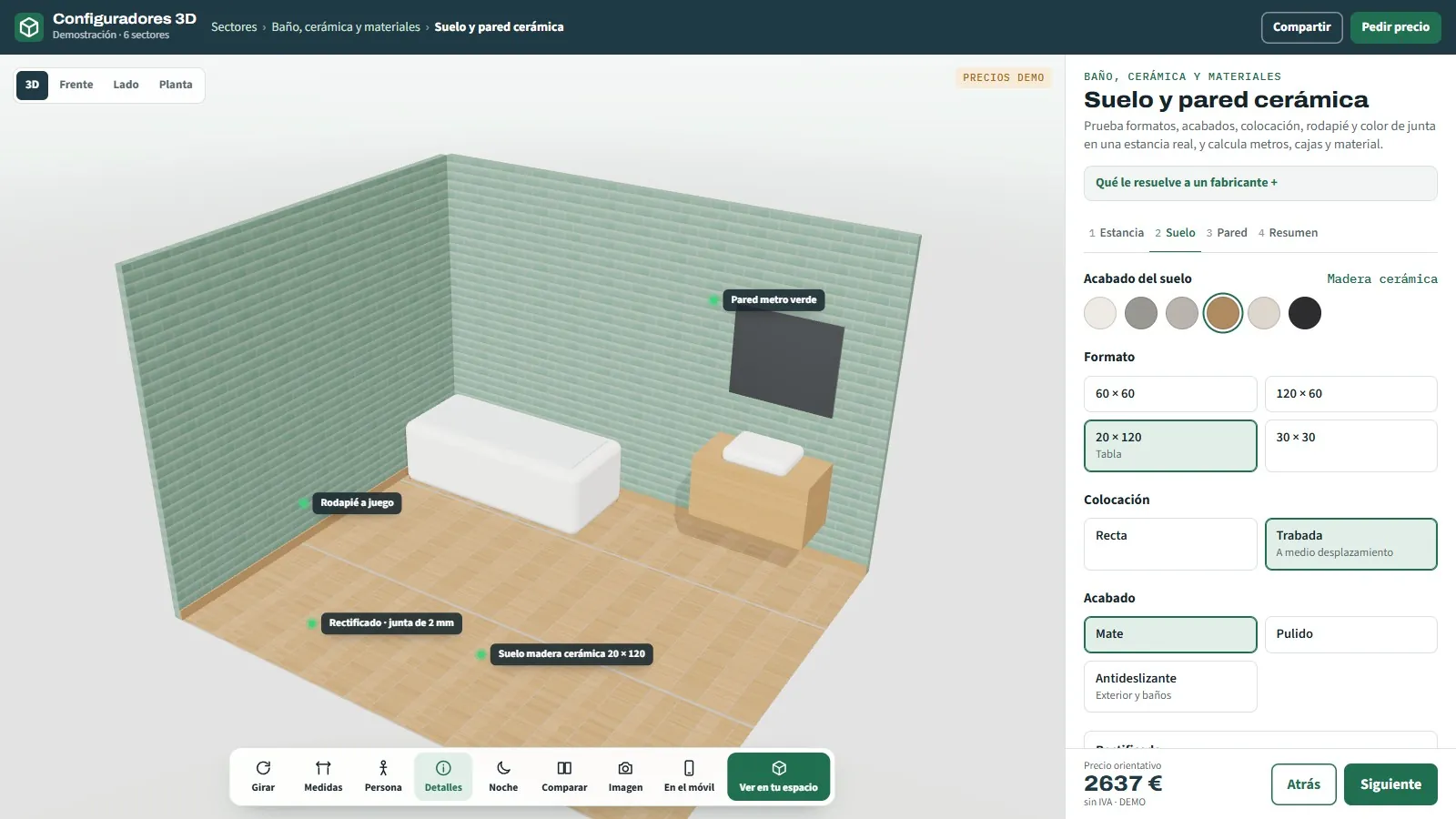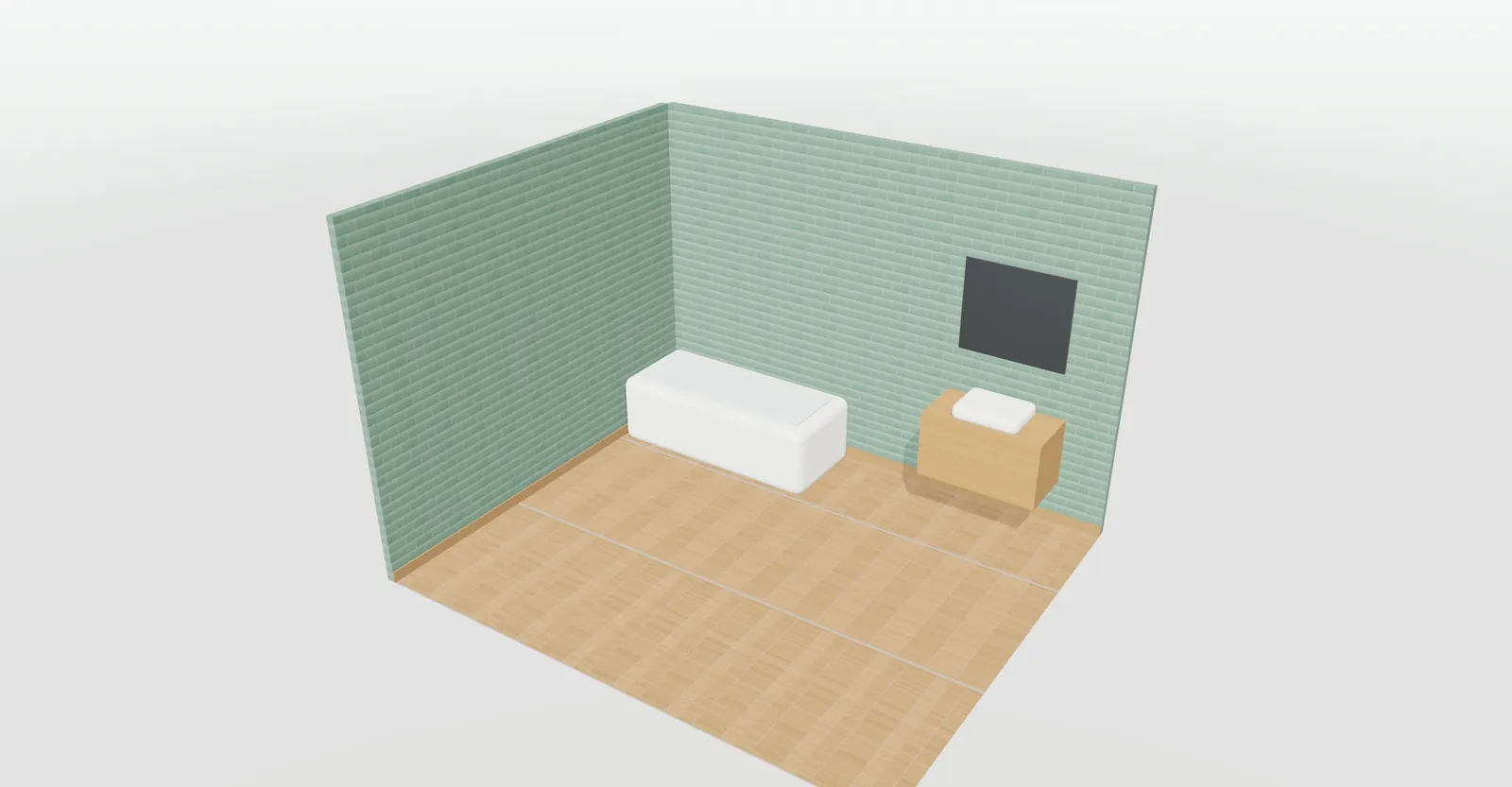
Bathroom in 3D with a 20 × 120 wood-effect floor in brick bond, green metro wall tiles and grey grout in the tile configurator
BATHROOM, CERAMICS AND MATERIALS · OPEN DEMO
— FOR TILE MANUFACTURERS

3D configurator
for ceramic tiles
made for manufacturers.

In your merchants' showrooms the customer chooses a floor holding a single tile, the counter staff work out the boxes on a calculator and, if they come up short, the top-up arrives from another batch in another shade. The problem is not the tile: it is how it is shown and how it is ordered.

— WHAT HAPPENS TO YOU

Three boxes short
and the new batch
is no longer the same shade

Three boxes short. The tiler says so on the phone at half past ten, with half the living room laid in 20 × 120 wood-effect tiles and the last row unfinished. The merchant who sold those boxes orders three more from the factory, but that batch has sold out and the next one came from a different firing. Different shade and calibre. The customer does not want a lighter strip next to the terrace, the tiler does not want to carry on laying, and the merchant calls you looking for a solution.

Behind that call there is a counter. The merchant has twelve display panels for a collection of a hundred and eighty references, so the customer chose holding a loose tile and a room photo that looked nothing like their house. The counter staff worked out the metres from memory, without thinking that the long format and the brick bond need more cuts. Nobody mentioned the matching skirting or the grout colour: they were decided on site, with whatever was to hand.

Multiply that by your network: forty merchants, each with their own way of calculating and their own share of the display up to date. When you launch a new collection, it takes months for them to have the panels, and in the meantime they sell what they can show, which is often last season's or another manufacturer's. The samples you send cost money and end up in a drawer. And every short order sends back a batch problem you did not cause.

— WHERE THE SALE LEAKS AWAY

The bottlenecks
you will recognise
straight away.

“I cannot picture this tile in my living room.”

A loose tile does not show a floor

A 20 × 120 in your hand does not tell you how it looks in brick bond, with grey grout and a matching skirting, in a fourteen-metre living room. The customer needs to see it in their type of room and in the real format. If they cannot, they postpone the decision or choose what they already know, which is not always yours.

What it costs youThe sale is postponed with an “I will come back” and sometimes ends up at another merchant.
“Thirteen metres will be enough, right?”

Boxes worked out by eye at the counter

The counter staff divide the metres by the metres per box and round. They forget the waste, the fact that a long format and a brick bond create more offcuts, or the bathroom wall the customer measured in a hurry. The order comes up short or there is material left over, and neither leaves anyone happy.

What it costs youA top-up from another batch, in another shade and with another delivery charge.

“We do not have that collection on display yet.”

The display is always behind

Every season you launch new formats and finishes, but the merchant has the panels they have and changing one costs money, space and an afternoon's work. Your new collection exists in the catalogue and at the trade fair, but not at the counter where the customer decides which floor to take. The area sales rep explains it with the catalogue open and the merchant nods, but without a panel they do not offer it.

What it costs youThe merchant pushes what they can show, not what you want to sell.

“Send me samples of all six finishes.”

Samples that cost money and get lost

Tiles, boards and sample sets sent to merchants, interior designers and customers who only wanted to compare two colours. Some arrive broken, some end up in a drawer and many never turn into an order. And even then, the sample shows the colour of the tile, but not the finished floor with its format, its grout and its laying pattern.

What it costs youMoney spent on samples and delivery that never becomes metres sold.

“We will decide the grout and the skirting on site.”

What is not decided beforehand sells worse

Matching skirting, grout colour, adhesive or wall tiles get left out of the order because nobody brings them up at the counter. Then the tiler buys whatever is closest. Every extra that does not appear at the moment of choosing is a metre or a bag that does not come out of your catalogue.

What it costs youSmaller orders than they could be and a worse final result.

— DO THE MATHS

What it costs you
today, with
your own numbers.

Put in the figures for your network. This only counts top-ups caused by short orders; postponed sales, samples that never come back and display panels are separate.

orders
€
months
YEARLY COST OF TOPPING UP ORDERS THAT CAME UP SHORT 0

€ a year

The values are an example: replace them with yours. The calculation is a simple multiplication and does not come from any study.

— HOW IT IS SOLVED

Every bottleneck,
with its
answer.

Bathroom in 3D with a 20 × 120 wood-effect floor in brick bond and green metro wall tiles with grey grout
Answers · A loose tile does not show a floor

The customer sees their floor laid before ordering it

They pick bathroom, kitchen, living room or terrace and try the finish, the format, straight or brick bond laying and matt, polished or anti-slip. They add the wall, the grout and the skirting, rotate the room and look at it with a person for reference to understand the size of the tile.

Room, tile, format, laying pattern and grout in 3D
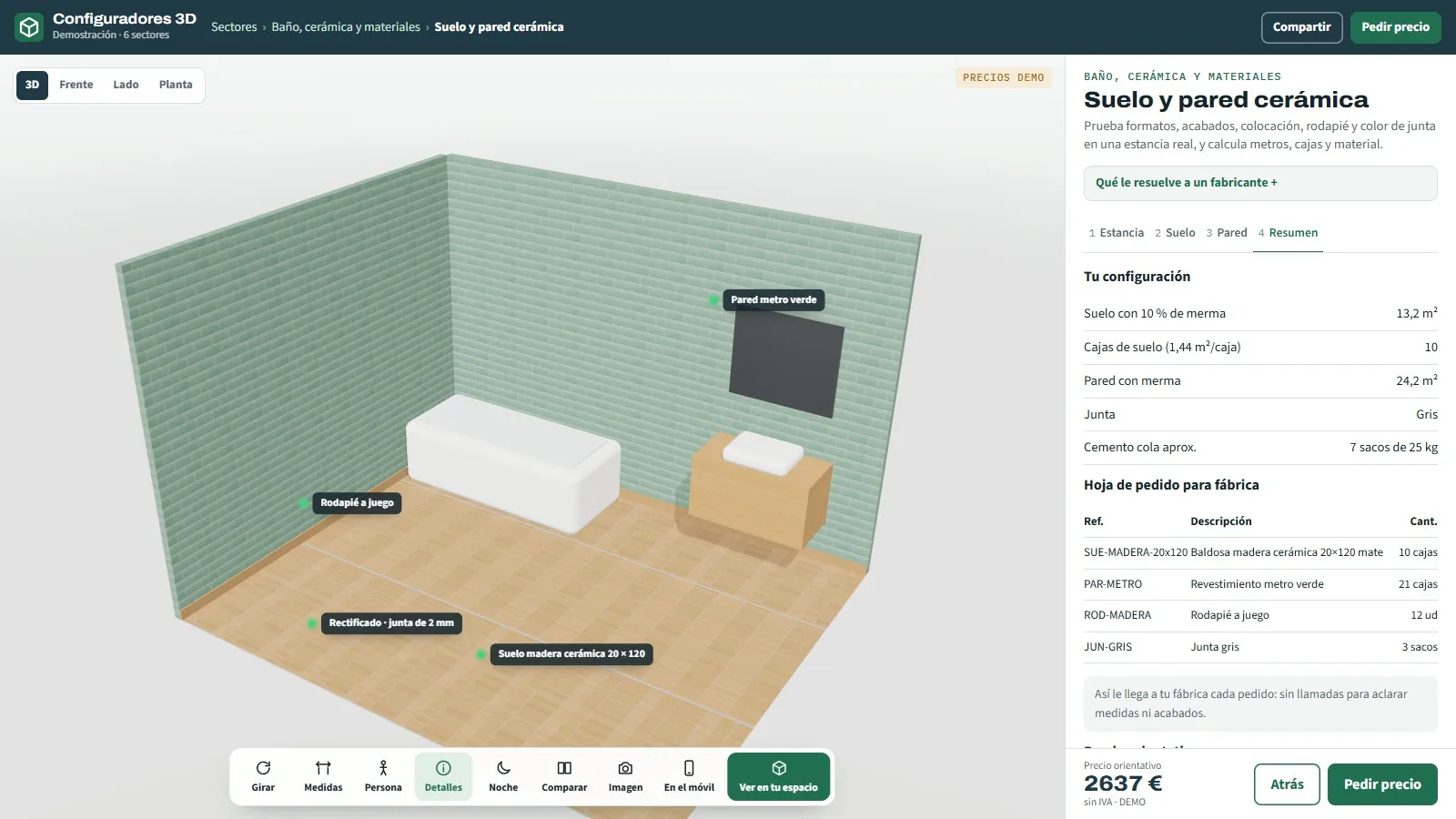
Tile configurator summary with floor metres including waste, number of boxes, grout and bags of adhesive
Answers · Boxes worked out by eye at the counter

The boxes come out on their own, with the waste included

The customer enters the floor and wall metres, and the configurator works out the area with waste, the boxes based on the metres per box, the skirting, the grout and the approximate bags of adhesive. In your development, the waste and the metres per box are yours, reference by reference.

Calculation of metres, waste, boxes and materials
Phone with the tile configurator: the room in 3D above and the floor and wall finish selector below
Answers · The display is always behind

The new collection reaches the counter the day you launch it

The whole collection can be tried in 3D on the merchant's screen or on the customer's phone, which they open with a QR code with nothing to install. The merchant does not need new panels to sell what is new, and each one can have their own dealer area with their margin and their brand.

The full collection in 3D and opened on a phone with a QR code
Tile configurator screen with the room, floor and wall steps and the finish and format options
Answers · Samples that cost money and get lost

They compare finishes without asking for a box of samples

Wood-effect against cement or terrazzo, grey grout against anthracite: up to three versions of the same room side by side, with the differences highlighted. The customer reaches the physical sample knowing which one they want to see, and the one you send is the one with a chance of ending in an order.

Comparison of up to 3 options
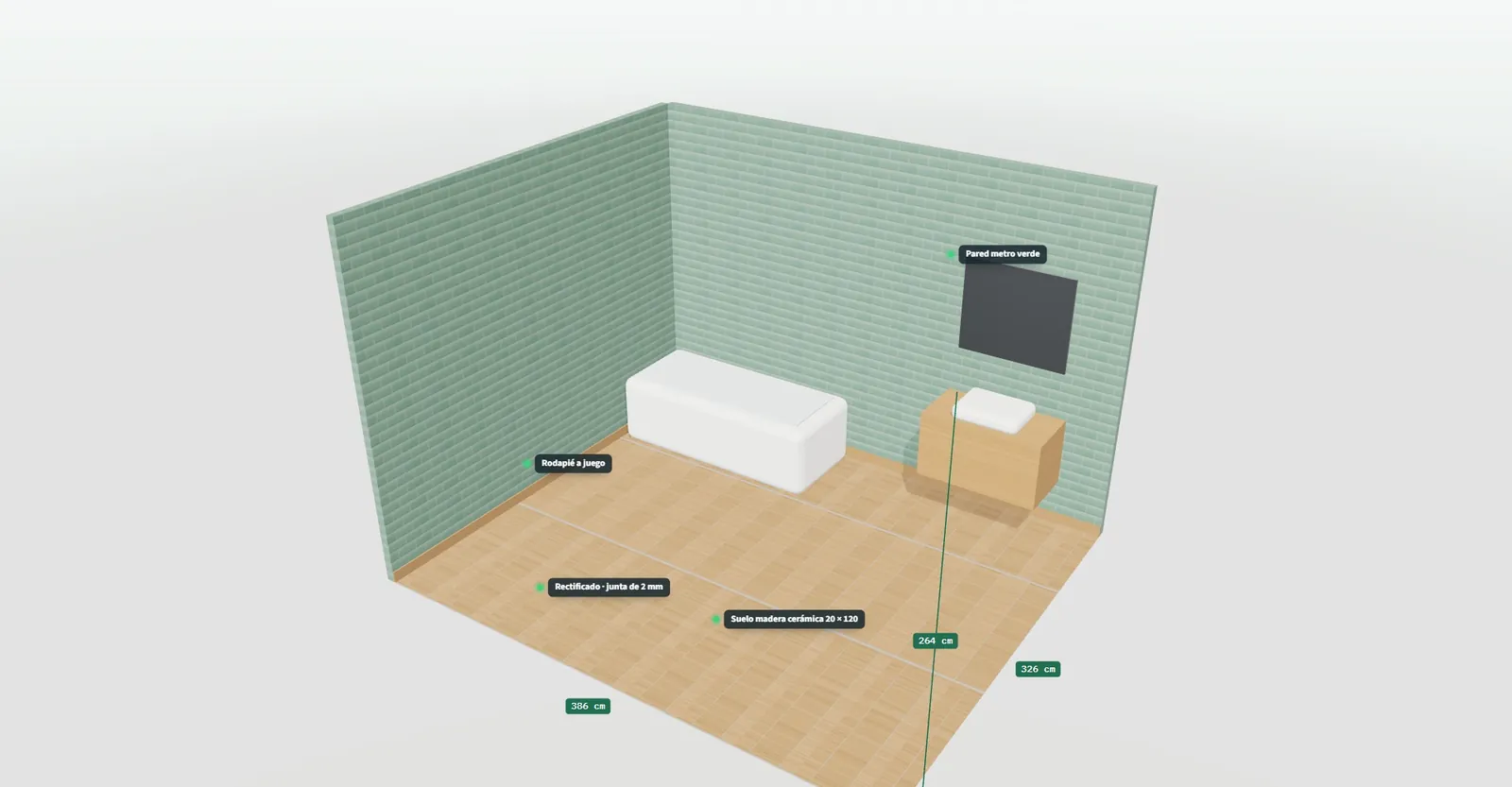
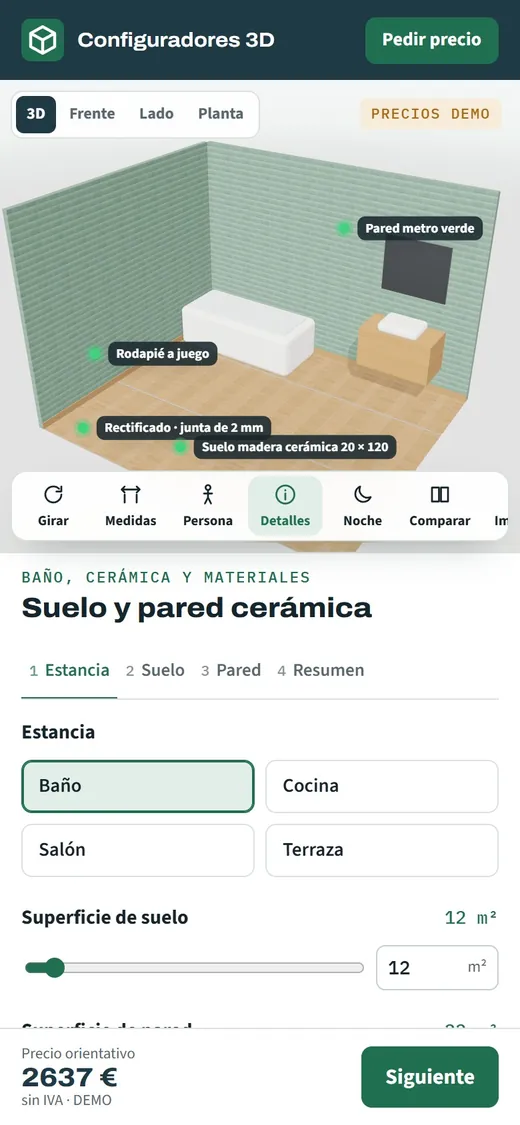
Room in 3D with labels on the floor, the wall, the grout and the skirting showing each material chosen
Answers · What is not decided beforehand sells worse

Skirting, grout and materials go in the same order

The flow asks about the matching skirting, the grout colour and the laying pattern, and the labels on the 3D point out each material. The factory order sheet comes out with every reference and its quantity: tile, wall covering, skirting and grout. The merchant does not have to remember to offer it.

Labels on the 3D and an order sheet with references
— TRY IT NOW

Try it
for
yourselves.

Pick a living room, set the wood-effect tile to 20 × 120 in brick bond with grey grout and open the summary to see the boxes, the waste and the adhesive.

An open demo, with no registration, with example products and prices. It is designed for manufacturers, dealers and installers: private customers are welcome to try it, but we do not sell the product.

— INVESTMENT AND NEXT STEP

Show us a collection and you will see it in a room

Send us a range with its formats, finishes and metres per box: in a 20-minute demo you will see how it would look and what it would take for your network to sell with it.

From €6,500

Most projects for manufacturers fall between €14,500 and €35,000, depending on the catalogue, the manufacturing rules and the integrations. Maintenance and hosting from €190 a month. We start from a base that already works: you are not paying for development from scratch.

  • What is includedThe configurator with your products, your rules and your price list, embedded in your website and in your dealers' sites, with training for the sales team.
  • TimeframeBetween 3 and 16 weeks depending on the scope; the exact date goes in the proposal.
  • Payment terms40% to start, 40% with the test version and 20% at go-live.

Would you rather talk it through? Call 662 061 421 or write to grup3d@grup3d.es.

— FREQUENTLY ASKED QUESTIONS

What we
get asked.

There are more short answers in frequently asked questions about 3D configurators and who we are in 3D configurator company.

Can all our collections and formats be loaded?

Yes. The configurator is developed with your ranges, formats, finishes, special pieces and metres per box. If a collection has 180 references, all 180 are loaded, and when you launch a new season it is added without changing panels in any merchant. What the demo shows with six generic finishes is, in yours, your own tiles with their name and their reference.

How does it work out the boxes and the waste?

It takes the floor and wall metres the customer enters, applies the waste and divides by the metres per box, rounding up. The demo uses 10% waste and 1.44 m² per box as an example; in your development your own rules per format are used. It also gives the skirting, the grout and an estimate of the bags of adhesive.

Does it avoid the shade and calibre problem between batches?

It does not change how a firing comes out, but it tackles a frequent cause of the problem: the short order that forces a top-up weeks later. If the boxes are worked out properly from the start and the order goes out complete, it is far easier for everything to come from the same batch. The order sheet records metres, waste and boxes in case what was ordered needs checking.

How much does a tile configurator cost?

For a network of merchants, the starting point is this: developments start from €6,500 for a visual configurator of one product family; most projects for manufacturers fall between €14,500 and €35,000, depending on the catalogue, the rules and the integrations, plus maintenance from €190 a month. From there, what moves the figure is the collections and rooms you load, your calculation rules per format and whether each merchant will have their own price list or you want it linked to your ERP. We review your catalogue before closing anything and tell you what is in and what is out.

Can our merchants use it with their own brand?

Yes, as part of the bespoke development: each merchant has their own login, with their margin and their logo, and the contacts coming from their area are assigned to them. The customer sees the configurator of the merchant they buy from, with your collections inside, and the merchant sells your product without having to display all of it.

Can the customer take it home on their phone?

Yes. From the merchant's screen they open it on their phone with a QR code, with no app to install, and take their configured floor away to show their partner or the tiler. They can also save an image or the PDF with the configuration and the calculated quantities.