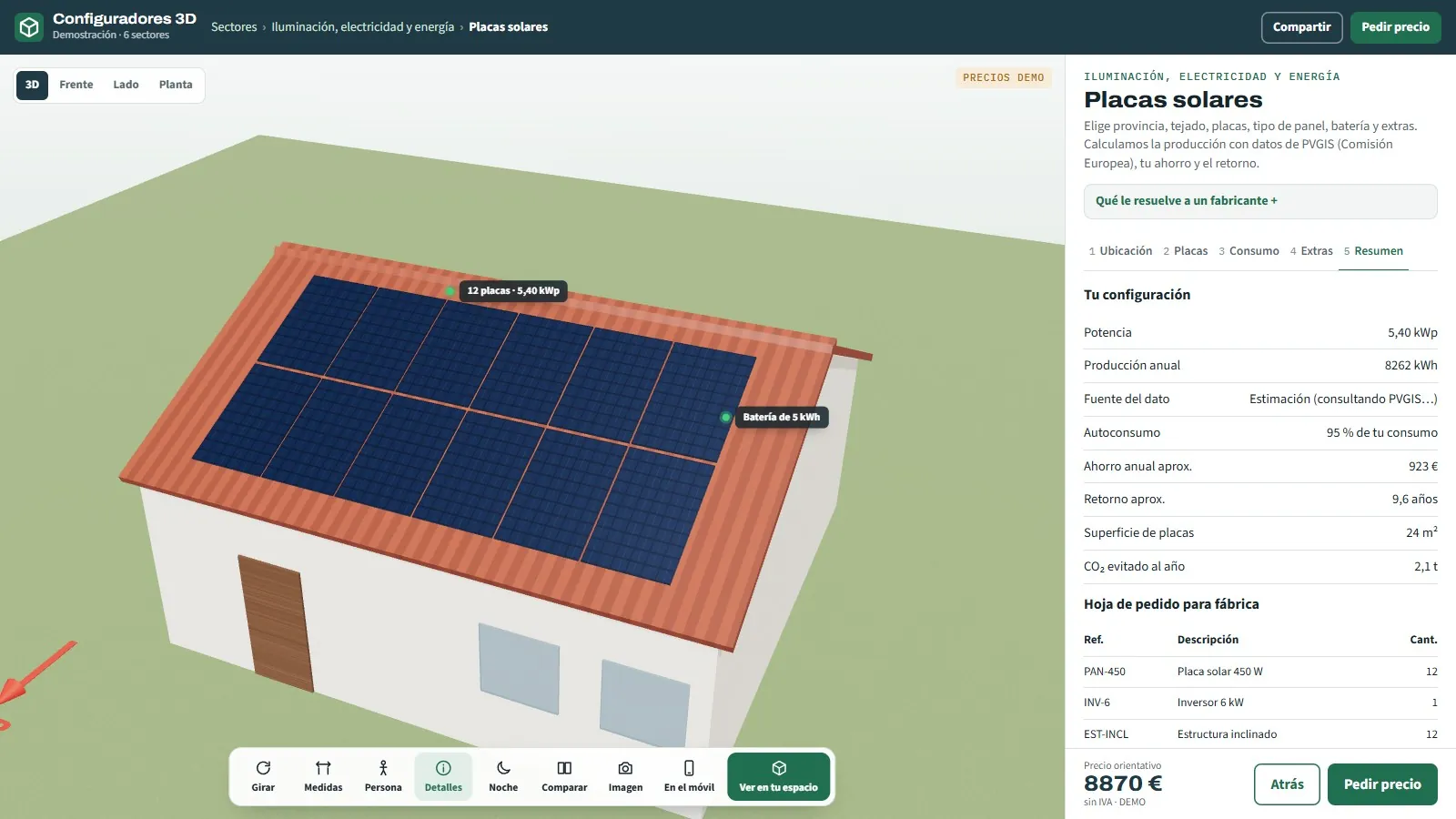
A 3D solar panel configurator on a pitched roof with twelve panels and output and savings figures
LIGHTING, ELECTRICAL AND ENERGY · OPEN DEMO
— FOR SELF-CONSUMPTION INSTALLERS

3D configurator
for solar panels
that filters out visits.

Requests for a free survey come in through the website with no bill, no photos of the roof and no way of knowing whether the customer is serious. Your sales rep drives for an hour to look at a roof, works out the output and the payback that same night and, a week later, the customer is still “thinking about it”.

— WHAT HAPPENS TO YOU

Fourteen free surveys
on Monday.
How many get signed?

You install self-consumption systems with two crews and one sales rep who doubles as the technician. On Monday morning, the inbox has fourteen “free survey” requests that came in over the weekend. Six do not leave a full phone number, four have no idea how much they consume and two live more than eighty kilometres away. All of them have to be called anyway, because nobody knows which one will end up signing.

On Tuesday, the sales rep sets off at nine towards a house with a pitched roof facing south-west. The owner cannot find the bill, asks whether twelve panels would be enough for the air conditioning and whether the battery is really worth it. The sales rep takes measurements, takes photos and promises the survey for Thursday. He is back at the office at two, with another 140 kilometres on the van and no commitment.

On Thursday the survey goes out: estimated output, savings and payback, with and without a battery. The customer replies that he has a cheaper quote and that he will look at it after the summer. Meanwhile, the two crews have gaps in next week's calendar and nobody knows what to fill them with. The technical work was done well; the problem is that it was done before knowing whether there was a decision at the other end.

— WHERE THE SALE LEAKS AWAY

The bottlenecks
you will recognise
straight away.

“I only wanted a rough price.”

Free surveys that never convert

Many website requests are curiosity: someone who has heard their neighbour talking and wants a figure. But giving them a serious figure means knowing the region, the roof, the orientation and the consumption, and that takes a call, a visit or several rounds of emails. The survey costs the same whether the customer signs or not.

What it costs youTechnical hours given away to someone who has decided nothing yet.
“Does it produce as much here as it does further south?”

Doubts about how much it produces

The customer has read output figures on forums and in adverts and does not trust any of them. In the north they fear it will not pay off; in the south they suspect you are inflating the numbers. Without a figure for their own region, orientation and pitch that they can check for themselves, every number you give sounds like a sales pitch.

What it costs youDistrust that drags the decision out for weeks.

“And what do I want the battery for?”

Batteries and chargers that never get sold

The battery, the car charger or the monitoring are what leave the most margin and what is hardest to explain in a forty-minute visit. If the customer cannot see how their self-consumption, their savings and their payback change when those are added, they take them out to bring the price down. And offering them again after signing sounds like a hard sell.

What it costs youInstallations sold without the part that carries the most margin.

“How many panels fit up there?”

A roof cannot be pictured from the sofa

Twelve panels are about twenty-four square metres, but the owner does not know how they will look on their roof, whether they will be visible from the street or whether many more would fit on their business premises. Until they can see it, they ask for someone to come and look, and that is another visit and another morning of a sales rep's time.

What it costs youVisits whose only purpose is to show how it would look.

“I have a cheaper quote.”

They compare prices without comparing like with like

The quote next to yours has fewer panels, does not include a battery or fits a different module, and the customer only looks at the total. Explaining why your proposal produces more or covers their consumption better means sitting down with them, paper in hand. If there is no chance to do that, the lowest figure wins, even when that installation will not fix their bill.

What it costs youThe job is lost because totals are compared, not installations.

— DO THE MATHS

What it costs you
today, with
your own numbers.

Count only the visits that do not end in a contract. Replace the example values with your own.

visits
h
€
MONTHLY COST OF SURVEYS THAT NEVER GET SIGNED 0

€ a month

The values are an example: replace them with yours. The calculation is a simple multiplication and does not come from any study.

— HOW IT IS SOLVED

Every bottleneck,
with its
answer.

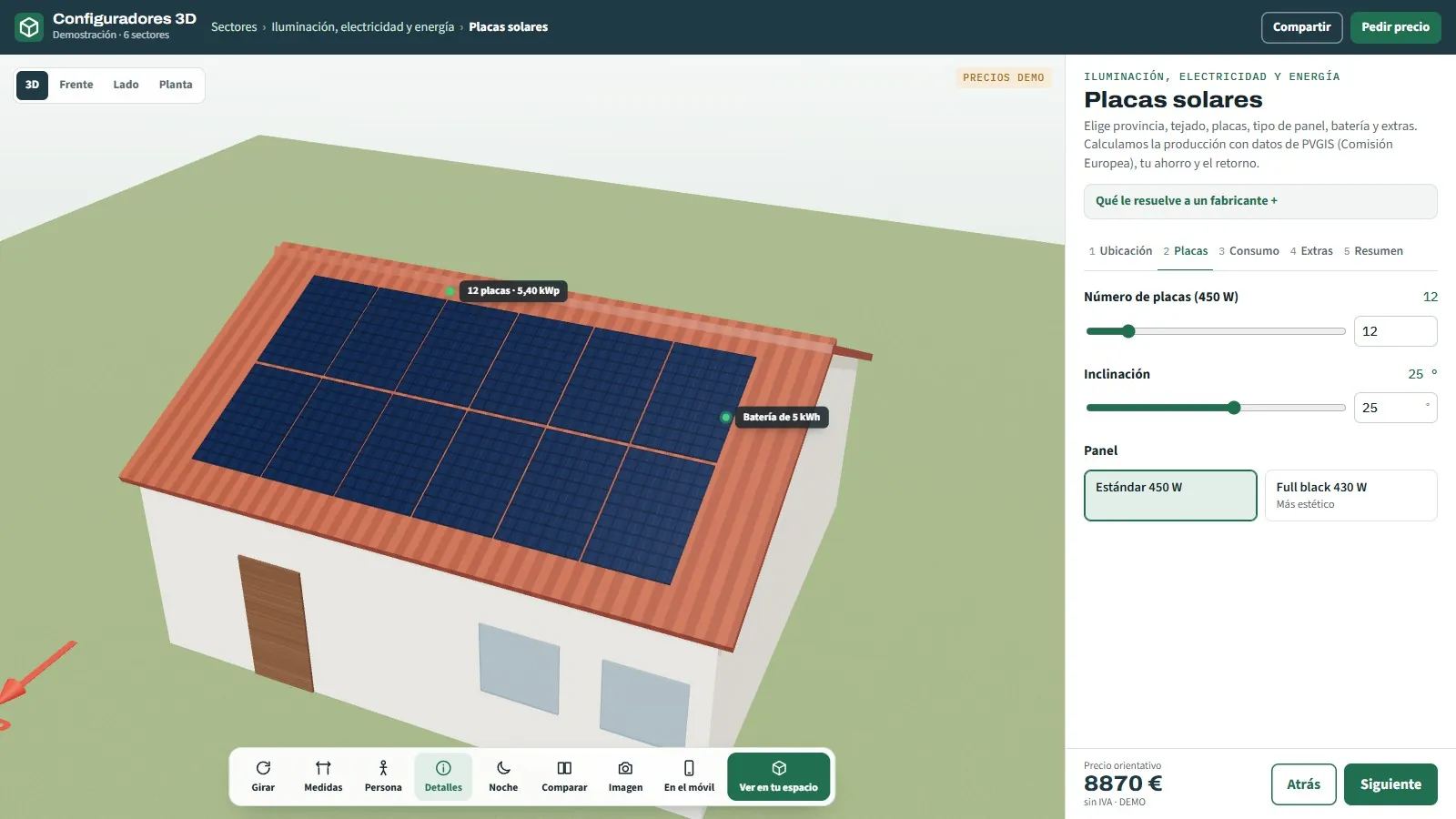
Solar panel configurator screen with the chosen region, roof type, orientation and number of panels
Answers · Free surveys that never convert

The customer does their own first survey

They choose the region, the roof type, the orientation, the number of panels and the annual consumption, and see the approximate output, savings and payback. When they write to you, the enquiry arrives with that configuration: roof, consumption and chosen extras. The visit is made to someone who has already taken the step, and the sales rep knows what they are going for.

An indicative survey and an enquiry with their configuration
Summary with installed power, annual output, self-consumption, yearly savings, payback and CO₂ avoided
Answers · Doubts about how much it produces

Output based on data for their own region

The output is estimated from the solar radiation data the European Commission publishes for their region, combined with their orientation and their pitch. It is not a figure of yours, it is public data they can check, and they see for themselves how much it changes when the panels face south or east-west.

Estimated output by region
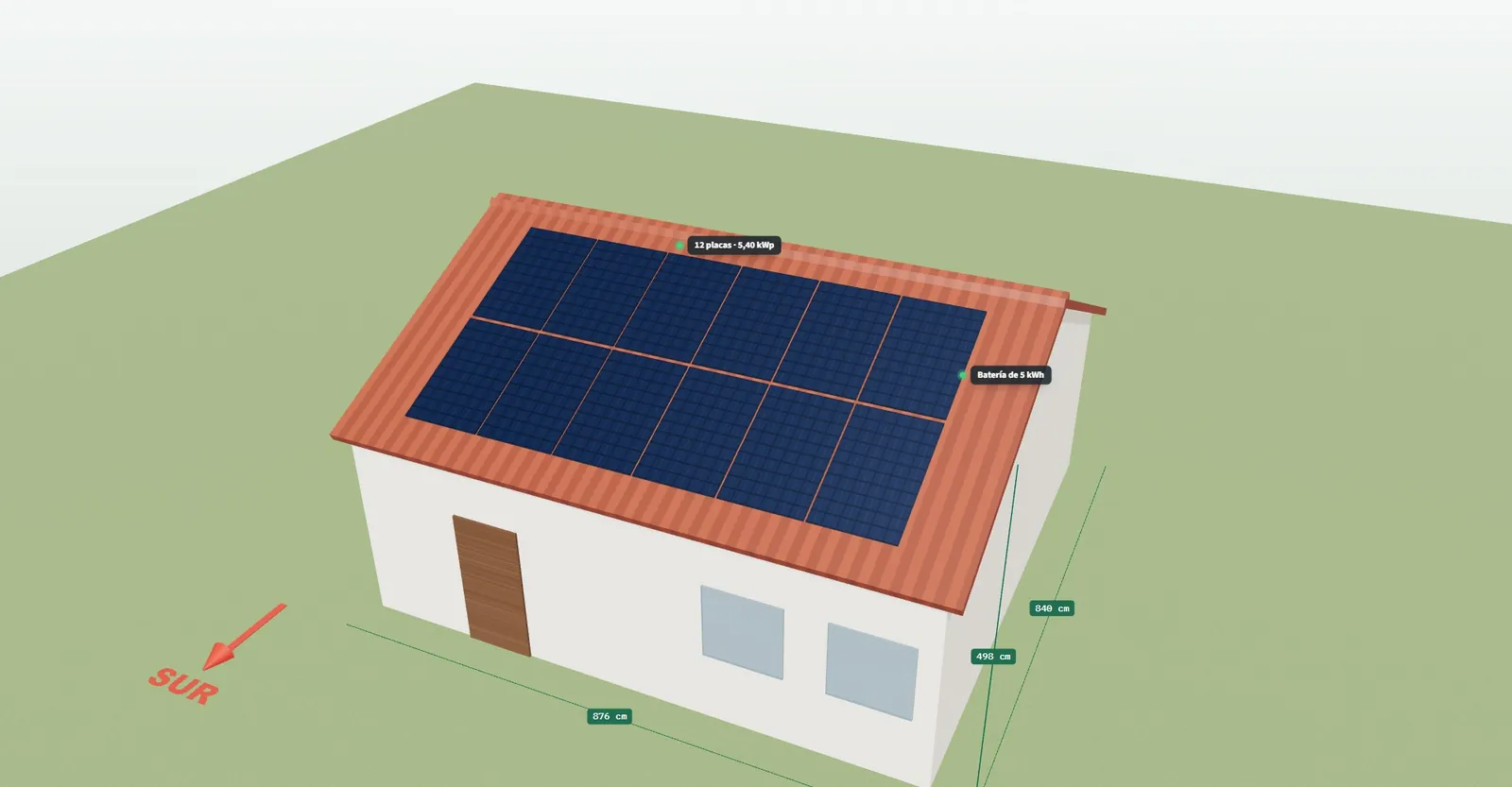
Solar panels in 3D on a pitched roof, with detail labels on the panels and the installation
Answers · Batteries and chargers that never get sold

The battery makes sense once you add it

Going from no battery to 5 or 10 kWh, or switching on the car charger and the optimisers, recalculates the self-consumption, the savings and the payback on screen. If they want to think it over, they compare up to three versions with the differences highlighted and decide on numbers, not on your word.

Extras with recalculated savings and a comparison tool
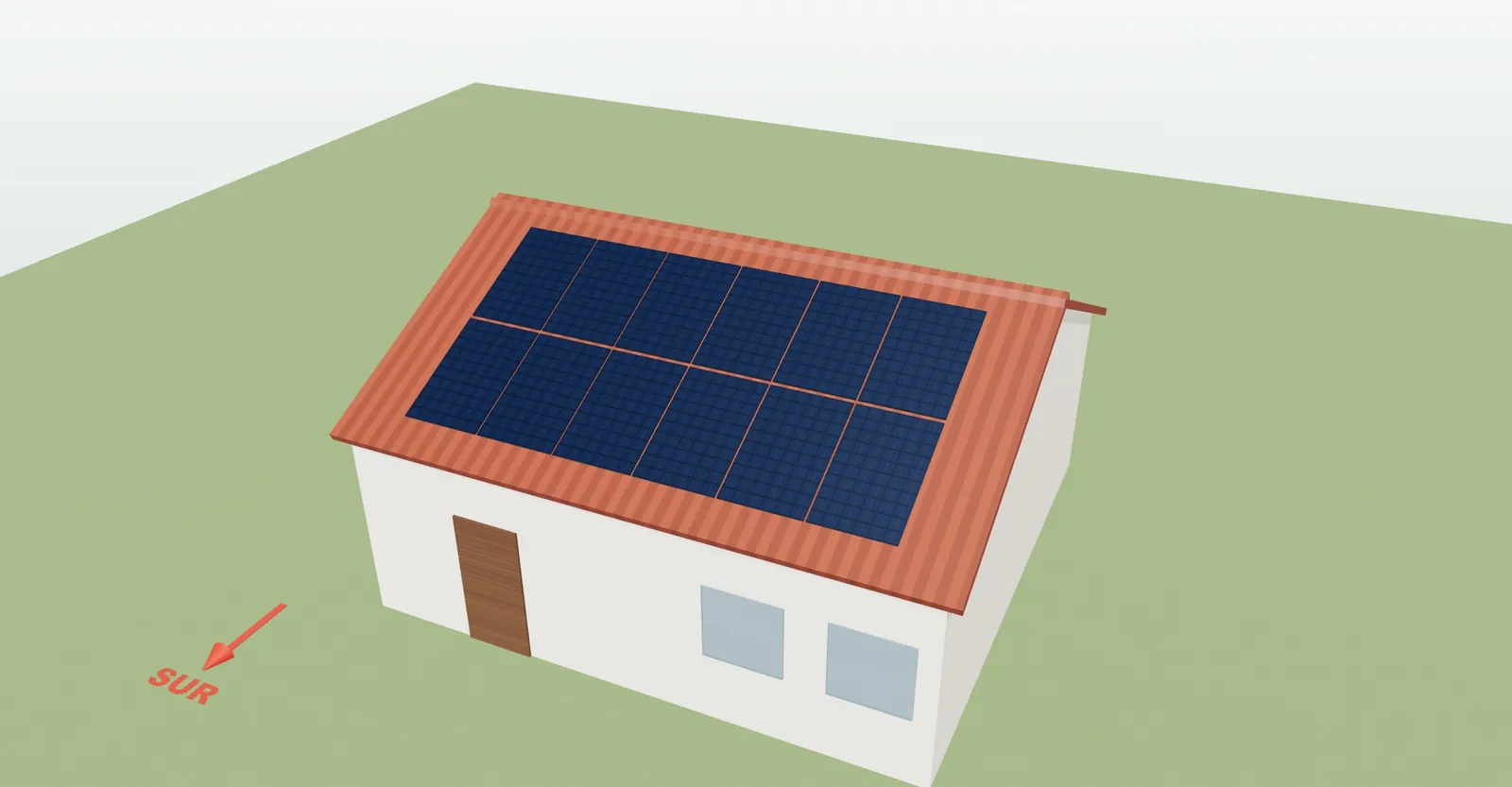
A house in 3D with twelve 450 W solar panels on a south-facing pitched roof, in the configurator
Answers · A roof cannot be pictured from the sofa

Their panels on their own type of roof

Pitched roof, flat roof or industrial unit: the panels appear in 3D with their number, their pitch and the standard or full black module. They turn it round, open it on their phone with a QR code and show it at home. The technical visit is left for measuring and checking shading, not for persuading.

A 3D view of the roof on a phone
Solar panel configurator open on a phone with the yearly savings and the approximate payback of the installation
Answers · They compare prices without comparing like with like

A PDF that says what yours includes

Panels, inverter, mounting, battery and monitoring come out in a PDF with the indicative price from your price list and the estimated output. When someone else's quote arrives, your customer has in front of them what yours includes and how much it produces. And enquiries can be assigned by area to each sales rep.

PDF with an indicative price
— TRY IT NOW

Try it
for
yourselves.

Put the same installation in the north and in the south and then add the 10 kWh battery: watch how the savings and the payback change.

An open demo, with no registration, with example products and prices. It is designed for manufacturers, dealers and installers: private customers are welcome to try it, but we do not sell the product.

— INVESTMENT AND NEXT STEP

Make the visit the moment you sign

Bring us your price list for panels, inverters and batteries and we will show you how the configurator would look on your website, with enquiries already arriving shared out by area.

From €6,500

Most projects for manufacturers fall between €14,500 and €35,000, depending on the catalogue, the manufacturing rules and the integrations. Maintenance and hosting from €190 a month. We start from a base that already works: you are not paying for development from scratch.

  • What is includedThe configurator with your products, your rules and your price list, embedded in your website and in your dealers' sites, with training for the sales team.
  • TimeframeBetween 3 and 16 weeks depending on the scope; the exact date goes in the proposal.
  • Payment terms40% to start, 40% with the test version and 20% at go-live.

Would you rather talk it through? Call 662 061 421 or write to grup3d@grup3d.es.

— FREQUENTLY ASKED QUESTIONS

What we
get asked.

There are more short answers in frequently asked questions about 3D configurators and who we are in 3D configurator company.

Where does the solar panel configurator get its output figures from?

From the solar radiation data the European Commission publishes for each location, combined with the chosen orientation, pitch and power. It is an estimate: the definitive survey is still done by your technician with the real measurements and shading of the roof. The demo works with 20 regions; your version can cover the areas where you install.

Are the savings and the payback it shows reliable?

They are indicative. They come from the estimated output, the annual consumption and the electricity price the customer enters themselves; if the price per kWh changes, the payback changes with it. They are there so they understand the order of magnitude before asking you to visit. The figure they sign is the one in your survey, with your prices and your terms.

How much does having your own solar configurator cost?

For an installer, the figure goes up or down with three things: how many panels, inverters, mounting systems and extras you want to offer, whether the sizing follows your own rules and whether enquiries have to go straight into your CRM. Developments start from €6,500 for a visual configurator of one product family; most projects for manufacturers fall between €14,500 and €35,000, depending on the catalogue, the rules and the integrations, plus maintenance from €190 a month. With your price list in front of us we tell you what would go into the first version and what would stay out.

Does it also work for flat roofs and company premises?

Yes. The demo has three roof types, pitched, flat and industrial unit, takes up to 60 panels and consumption of up to 60,000 kWh a year. A small business, a workshop or a farm can see how many panels they would get, how much surface they take up and how much they save before asking you for the technical visit.

Can we share enquiries out between sales reps by area?

Yes, it is one of the pieces added in your version. Every enquiry arrives with the configuration the customer made and is assigned to the sales rep or installer for their area. If you work with a CRM, it can be connected so the enquiry goes straight in, with no data copied by hand and no requests lost in the inbox.

What if the person who decides is not in front of the computer?

The customer opens it on their phone with a QR code, with nothing to install, and can save the image or the PDF to show at home. When the decision is made as a couple or between partners, everyone seeing the same panels and the same figures saves the second visit that only exists to explain it all again.