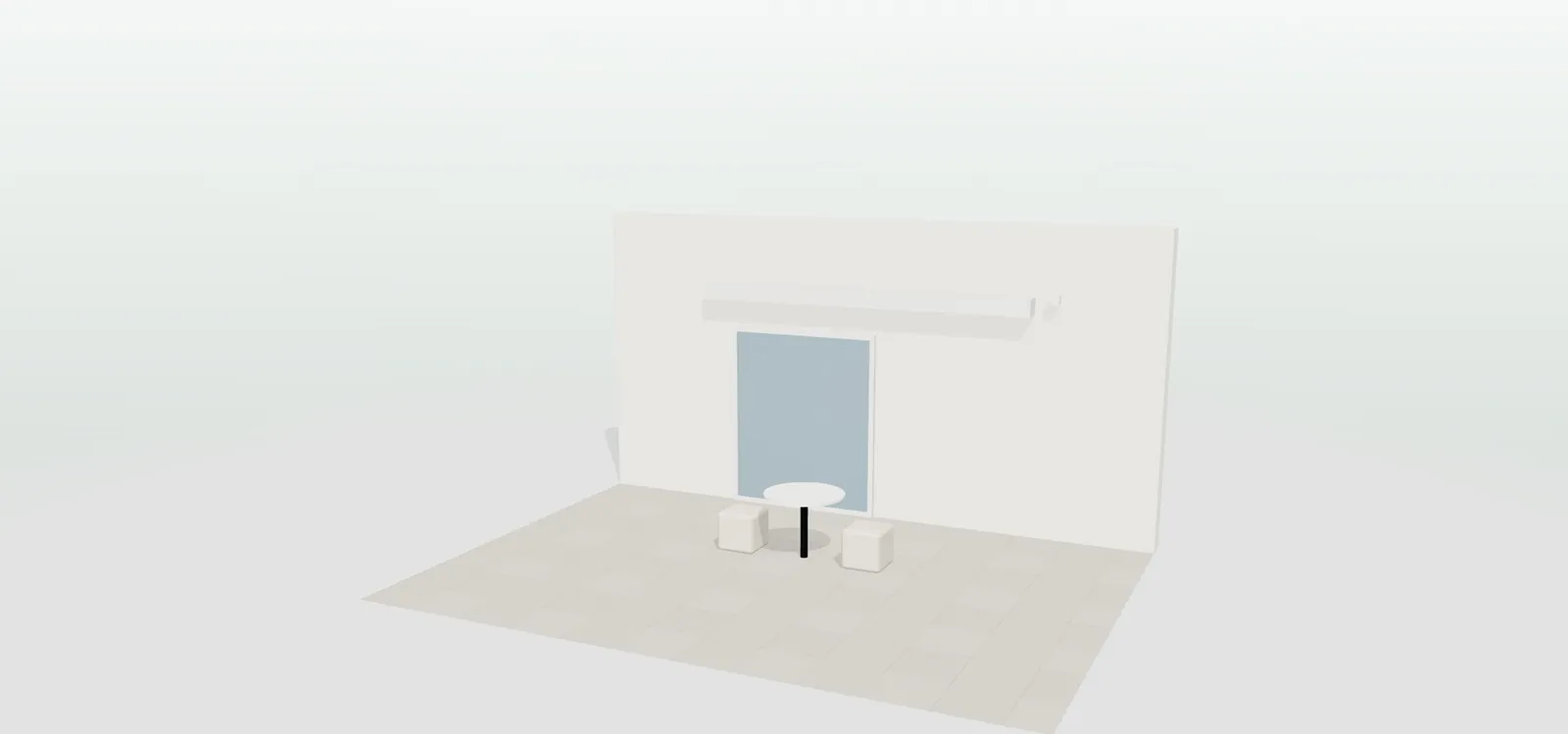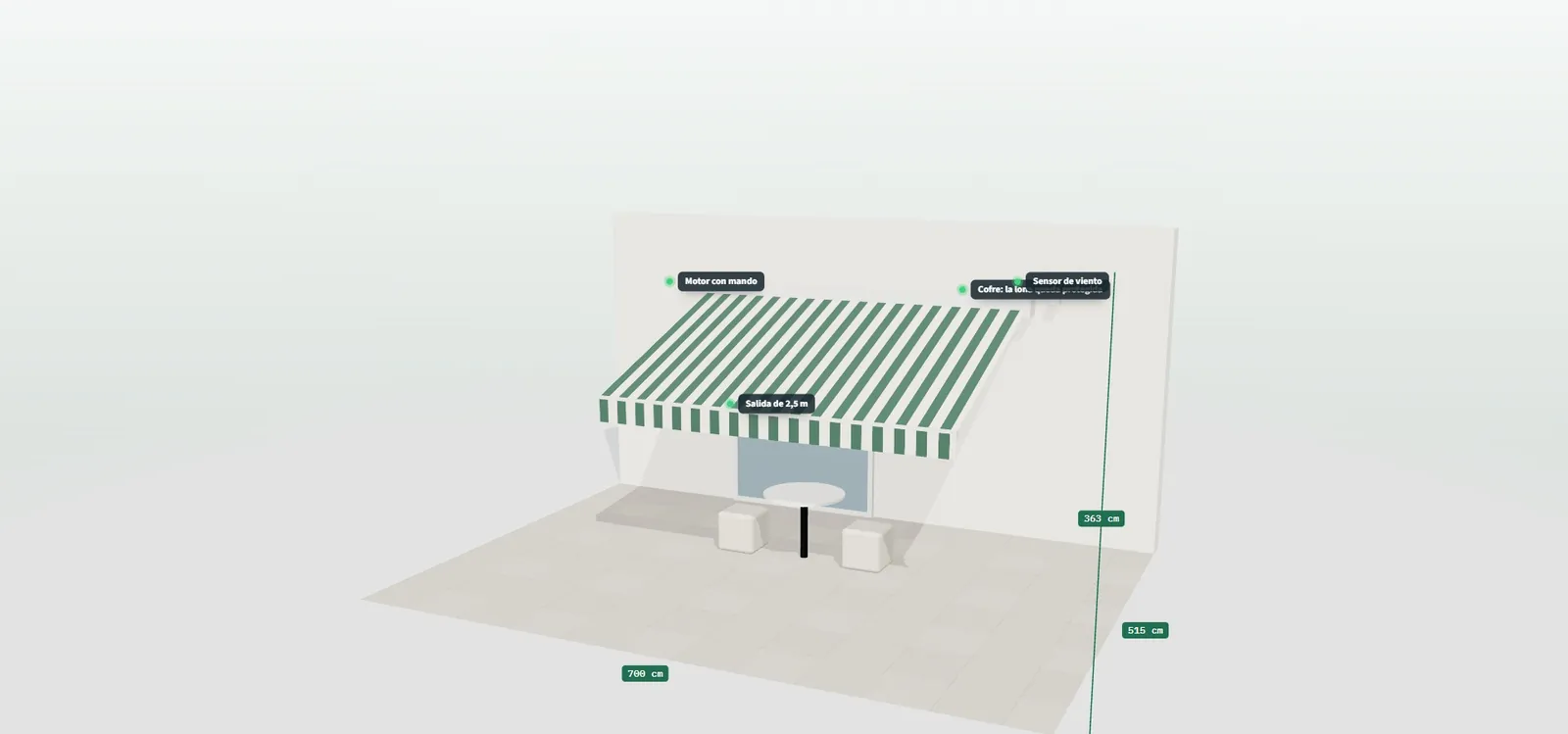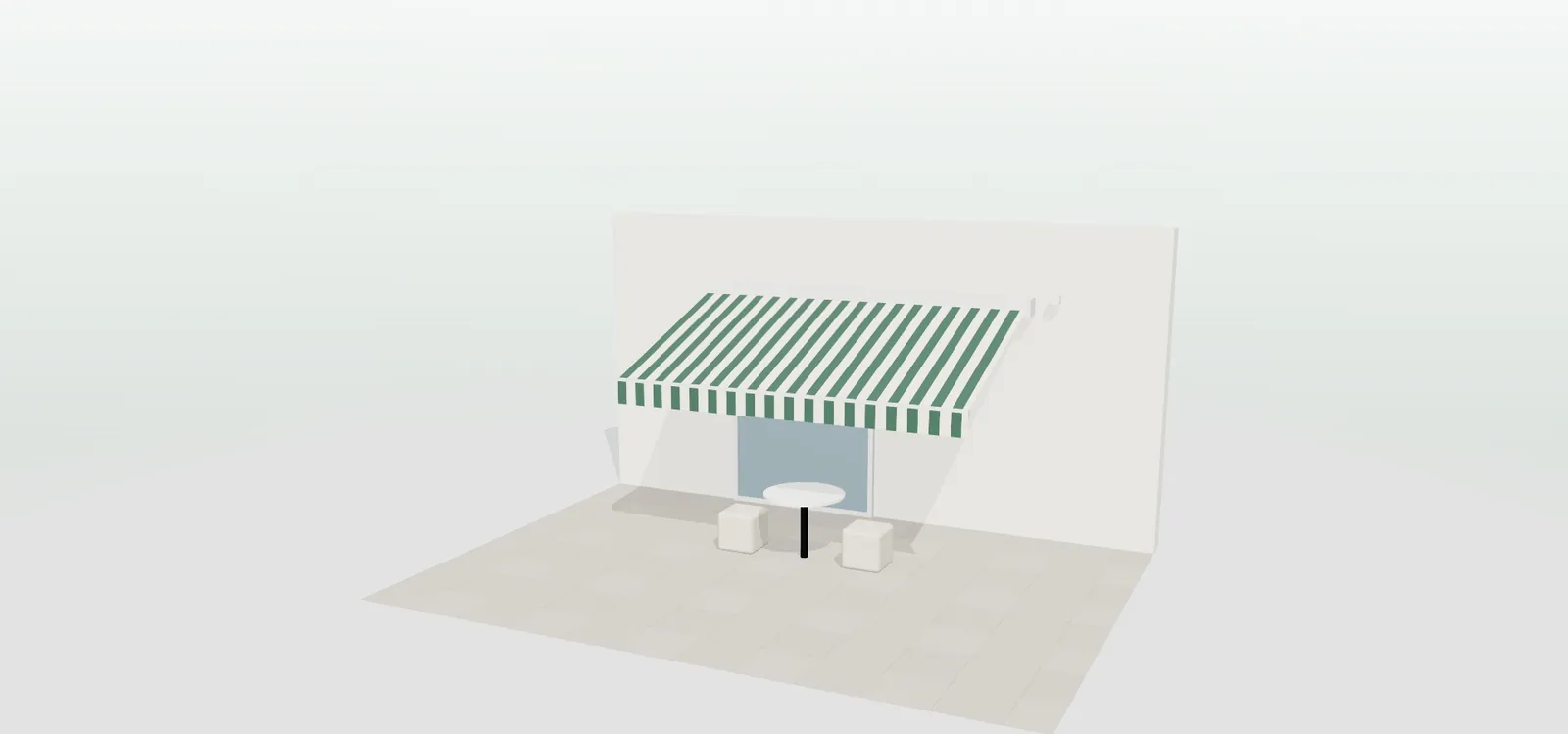
A 4-metre cassette awning extended with a green striped fabric in the 3D awning configurator
OUTDOOR, METAL AND STREET FURNITURE · OPEN DEMO
— FOR AWNING INSTALLERS AND SHOPS

3D configurator
for awnings
made for installers.

A swatch book with three hundred fabrics on the counter and a customer who cannot picture a single one against their façade. They take three samples home, come back two weeks later and the wind sensor gets left out. With the configurator, they see their awning extended, with their fabric and their projection, before asking you to visit.

— WHAT HAPPENS TO YOU

Three hundred fabrics
on the counter
and not one on their façade

First week of April in an awning shop with two installation teams. At ten a couple come in with a photo of their balcony on a phone: fourth floor, four metres wide, afternoon sun. You open the swatch book and they start turning pages. She wants green stripes; he wants plain grey so as not to tire of it. Neither of them can see the fabric against their brick façade, or how much shade two and a half metres of projection will give at six in the evening. They take away three folded samples and say they will talk about it.

In the afternoon there is a house to measure. The customer has already decided he wants a folding-arm awning because that is what his neighbour has, but his terrace has no overhang to protect the fabric and a cassette would suit him better. Explaining that takes half an hour and two brochures. Then the motor: remote, yes. Wind sensor? “We will see about that later on.” Nobody has shown him what happens to an extended awning when a strong gust arrives and there is nobody at home.

In June, with installations booked up to July, the phone rings: the couple with the stripes have finally made up their minds, but the residents' association wants the same colour as the rest of the façade and it all starts again with the swatch book. And the customer with the house calls about a bent arm and a torn fabric after a windy afternoon. The season is short, and every repeated visit takes the slot of an installation that will now not happen this summer.

— WHERE THE SALE LEAKS AWAY

The bottlenecks
you will recognise
straight away.

“Let me take a few samples and we will talk about it at home.”

Huge swatch books that decide nothing

A ten-centimetre piece of fabric is nothing like four metres of awning hanging from a façade. The stripes that looked cheerful in the shop look like a beach bar at home; the grey that looked smart looks drab. The customer hesitates, takes samples away and comes back another day, or does not come back and buys it wherever it was shown to them better.

What it costs youA sale that closes on the second or third visit, if it closes at all.
“The wind sensor, we will see about that later on.”

Awnings that break in the wind

The wind sensor retracts the awning by itself when it blows hard, but in the quote it is one more line that raises the total and it is the first to be crossed off. Months later the call comes: bent arm, torn fabric, angry customer. You end up doing the repair yourselves, often to nobody's satisfaction, and right in the middle of the installation season.

What it costs youYou lose the extra when selling and the team's time when repairing.

“I thought it would cover more.”

Sizes and projections chosen wrong

The customer asks for the maximum projection because more always seems better, or the minimum because it is cheaper, without knowing what shade each one gives on their terrace. With the awning installed they find out it does not cover the table or that it blocks the way past. Changing the projection after installation means another fabric, other arms and another visit nobody wants to pay for.

What it costs youAn unhappy customer with an awning that is perfectly well made.

“Arms or cassette? My neighbour's has arms.”

Awning types the customer cannot tell apart

Folding arm, cassette, vertical or straight drop: to you they are four different solutions; to the customer, four names. They choose by what the neighbour has or by price, and the salesperson spends half of every visit with brochures and hand gestures explaining where the fabric is stored or why a balcony calls for a straight drop.

What it costs youAwnings chosen wrong and visits that take twice as long.

“I have to show it to the residents' association before signing.”

Decisions that depend on other people

In a flat, the awning is decided by the couple, approved by the residents' association and sometimes requested in writing by the managing agent with the exact colour. In a bar, the owner decides after talking it over with their partner. They all want to see it before saying yes, and the only thing there is to show them is a folded sample and a quote full of references.

What it costs youWeeks of waiting that eat up the best part of the summer.

— DO THE MATHS

What it costs you
today, with
your own numbers.

In season, every repeated visit to show fabrics again takes the slot of an installation. Put in your own numbers and see what it costs.

visits
h
€
MONTHLY COST OF REPEATED VISITS 0

€ a month

The values are an example: replace them with yours. The calculation is a simple multiplication and does not come from any study.

— HOW IT IS SOLVED

Every bottleneck,
with its
answer.

A cassette awning extended in 3D with a green striped fabric and a straight valance, next to a person for scale
Answers · Huge swatch books that decide nothing

They see the fabric on a whole awning, not on an offcut

Natural, grey, green or striped; acrylic, polyester or micro-perforated; straight, scalloped or no valance. The customer tries each fabric on the awning in 3D and compares up to three versions side by side, with the differences highlighted. By the time they walk into the shop, they have already ruled out most of the swatch book.

Fabrics, weaves and valances in 3D with a comparison tool
Summary of a 4000 by 2500 mm awning with fabric, motor, wind sensor, indicative price and order sheet
Answers · Awnings that break in the wind

The wind sensor appears with its benefit and its price

Motor with remote, wind sensor and LEDs in the arms are switched on in the automation step: the customer sees how much each one adds to the indicative price and a label on the awning in 3D shows where the sensor goes. It stops being the line that gets crossed off at the end and becomes a decision they make at home, unhurried.

Automation with an indicative price
An awning in 3D half extended from its cassette, with the extend-and-retract control and the projection in millimetres
Answers · Sizes and projections chosen wrong

They know how much shade they will have before signing

The customer moves the width and the projection, extends and retracts the awning with a button and reads the shaded area in the technical data. With the dimensions switched on and the person for scale, they understand whether it covers the table or blocks the way past, and the order reaches you with the sizes already thought through.

Extend and retract with width, projection and shaded area
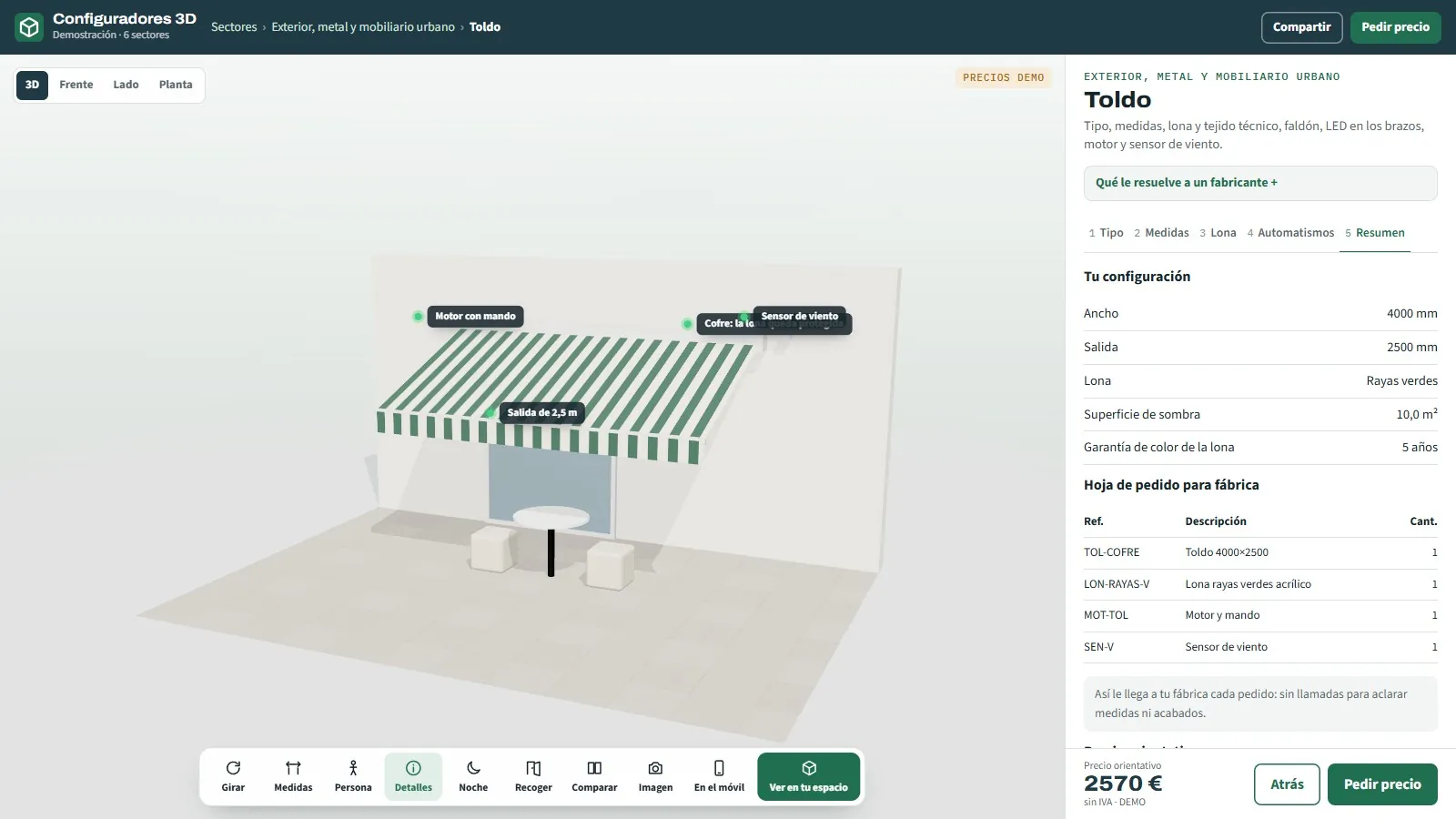
Labels on the awning in 3D pointing out the motor, the wind sensor, the projection and the cassette that protects the fabric
Answers · Awning types the customer cannot tell apart

Arms, cassette, vertical or straight drop, explained on the awning

The customer changes the type and the 3D changes with them; the labels on the model point out each part, and they see with their own eyes that the cassette keeps the fabric protected while the folding-arm awning leaves it exposed. What used to be half an hour of brochures is understood by turning the awning on a phone or computer screen.

Details and labels over the 3D
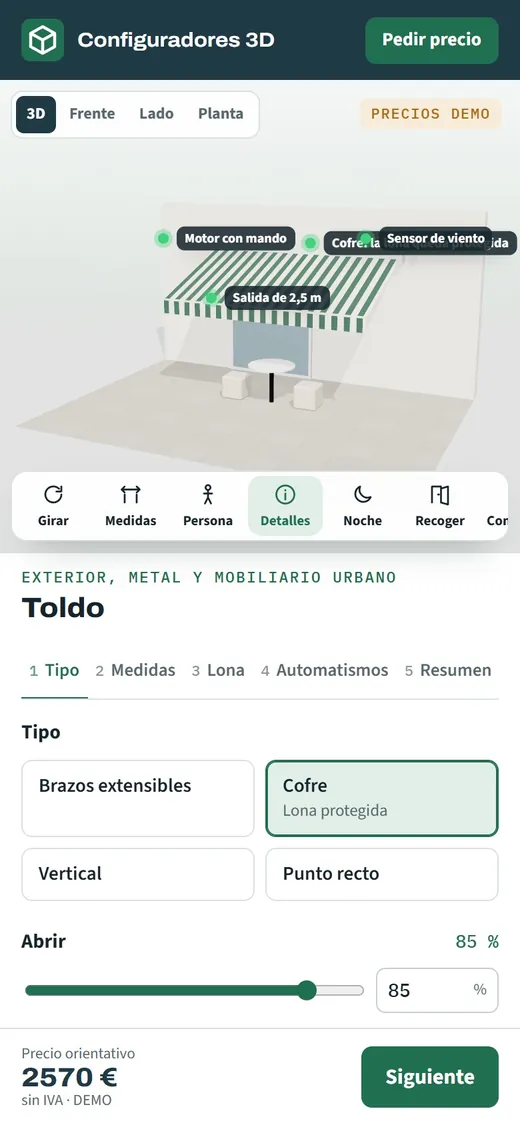
The awning in 3D with the chosen fabric and its indicative price, as the customer sees it on their phone screen
Answers · Decisions that depend on other people

The residents' association sees it on the phone of whoever is asking

The customer saves an image of their awning, downloads the PDF with the price or shares the link with a QR code so their business partner, their partner or the managing agent can open it on their phone. And if anyone is unsure about the projection, they point the phone at the terrace and see the awning at real size in augmented reality.

Share by image, PDF or QR code
— TRY IT NOW

Try it
for
yourselves.

With the cassette awning, bring the projection down from 2,500 to 1,500 mm and press “Extend”: the shaded area in the technical data goes from 10 to 6 m².

An open demo, with no registration, with example products and prices. It is designed for manufacturers, dealers and installers: private customers are welcome to try it, but we do not sell the product.

— INVESTMENT AND NEXT STEP

Reach next spring with the swatch book on your website

Send us the fabric chart and the price list for motors and sensors: we load them into the configurator and you will see how your customer would decide before setting foot in the shop.

From €6,500

Most projects for manufacturers fall between €14,500 and €35,000, depending on the catalogue, the manufacturing rules and the integrations. Maintenance and hosting from €190 a month. We start from a base that already works: you are not paying for development from scratch.

  • What is includedThe configurator with your products, your rules and your price list, embedded in your website and in your dealers' sites, with training for the sales team.
  • TimeframeBetween 3 and 16 weeks depending on the scope; the exact date goes in the proposal.
  • Payment terms40% to start, 40% with the test version and 20% at go-live.

Would you rather talk it through? Call 662 061 421 or write to grup3d@grup3d.es.

— FREQUENTLY ASKED QUESTIONS

What we
get asked.

There are more short answers in frequently asked questions about 3D configurators and who we are in 3D configurator company.

Can the customer see the awning extended and retracted?

Yes. The awning extends and retracts with a button and can also be left half open with a slider. That way the customer sees the cassette closed on the façade, the awning at full extension and everything in between, with the fabric and the valance they have chosen.

Which awning types and sizes does it take?

The demo includes folding-arm, cassette, vertical and straight-drop awnings, with widths from 2 to 6 metres and projections from 1.5 to 3.5 metres. In your version your manufacturing rules apply: maximum projections by type and by width, available arms and combinations you do not make.

How much does a 3D awning configurator cost?

As a guide: developments start from €6,500 for a visual configurator of one product family; most projects for manufacturers fall between €14,500 and €35,000, depending on the catalogue, the rules and the integrations, plus maintenance from €190 a month. What changes the figure most is how many awning types and how many fabrics you want to load, whether you sell through shops with their own area and margin, and whether the order has to go into your ERP. We give you a fixed figure after seeing your price list.

We are a manufacturer and sell through installer shops, is it any use to us?

Yes. Each shop can have its area with its brand and its margin, and the contacts coming in through your website are assigned to the shop for their area. The shop shows the awning in 3D at the counter or at the customer's home, and your factory receives the order sheet with references.

How does it help sell the wind sensor and the motor?

The customer switches them on in the automation step, sees them added to the indicative price and pointed out with a label on the awning in 3D. It is the same conversation you have in the shop, but the customer has it unhurried, at home, before deciding, and the extra stops looking like a last-minute add-on.

Can you see how the awning looks on the customer's façade?

With their phone, the customer can see the awning at real size on their terrace in augmented reality, with no app to download. They can also turn it in 3D, switch on the dimensions and the figure for scale, and save an image to show the residents' association or the managing agent.