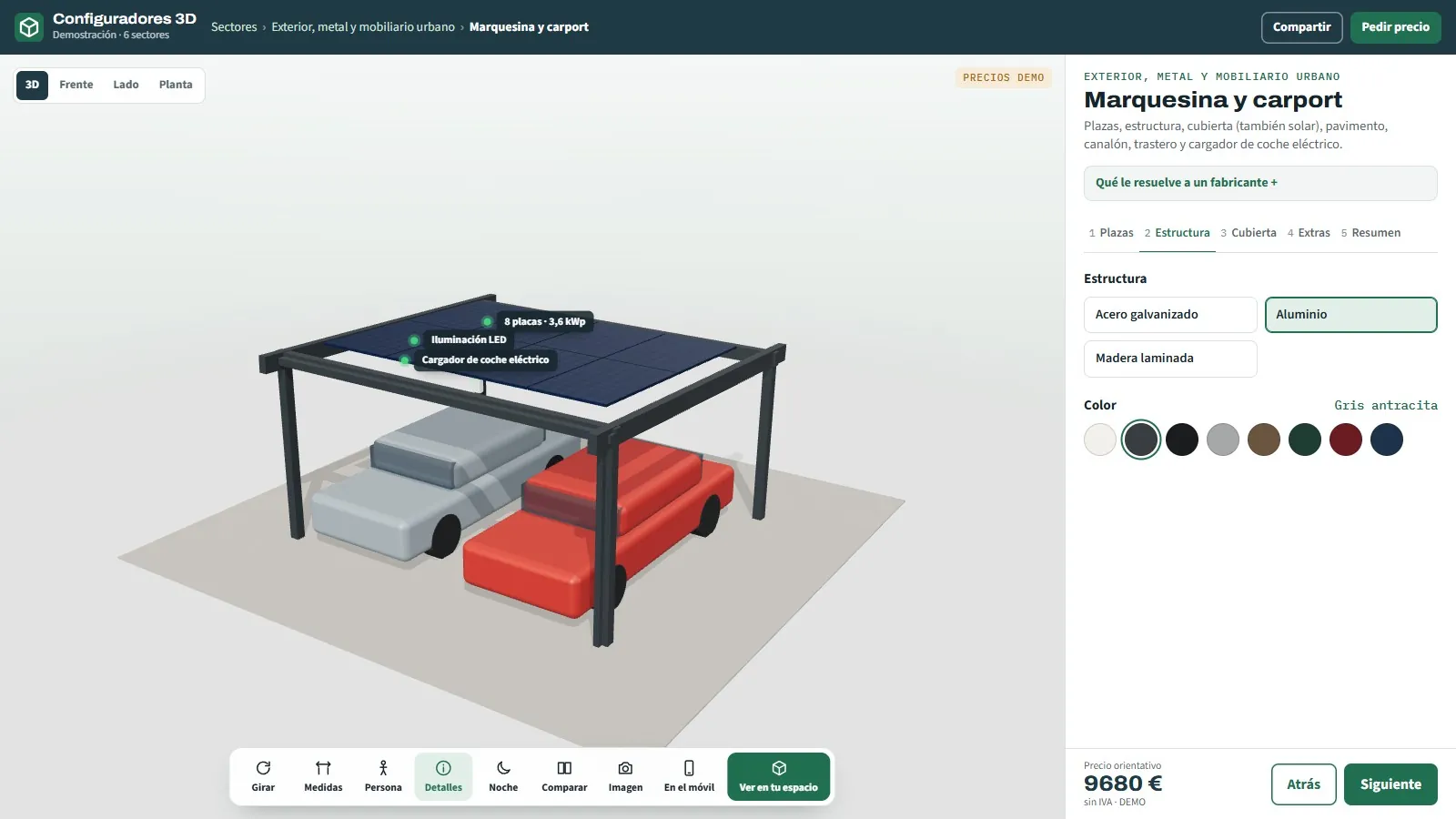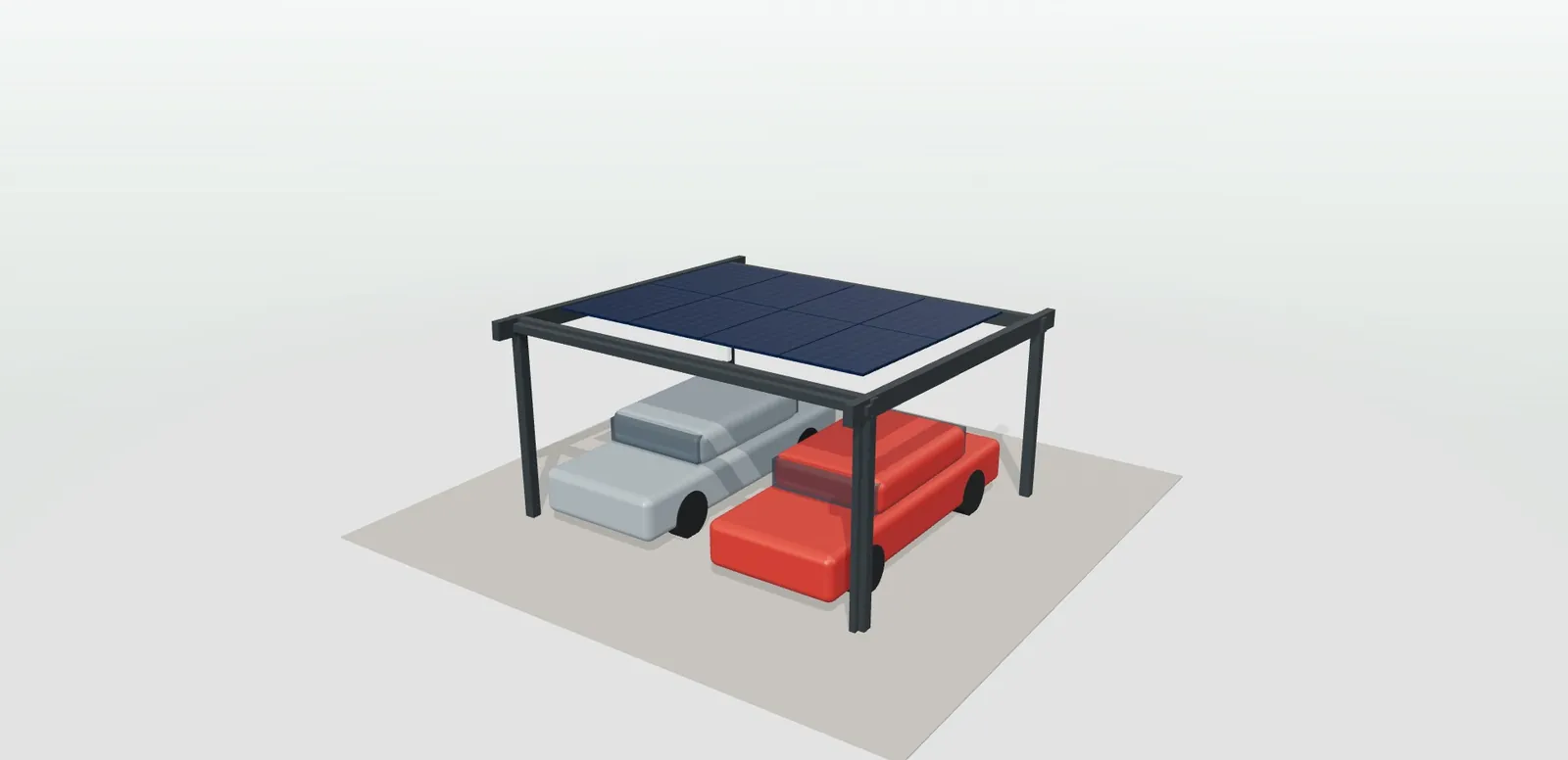
Aluminium solar carport for two cars with panels on the roof and an electric charger in the 3D configurator
OUTDOOR, METAL AND STREET FURNITURE · OPEN DEMO
— FOR SELF-CONSUMPTION INSTALLERS

3D configurator
for canopies
and solar carports.

Three documents for a single canopy: your output study, the structure from one workshop and the charger from another supplier. And the customer still does not know how many panels fit over their six spaces or how much their car would charge. In the configurator they choose spaces, roof and extras and see it all in one price.

— WHAT HAPPENS TO YOU

Six spaces,
three suppliers
and no answer

The management car park of a distribution company on the outskirts: six spaces in full sun and two electric cars already in the fleet. The manager wants shade in summer, to charge the cars with their own energy and for the installation to look presentable to visitors. The sales rep of the self-consumption installer knows panels, inverters and consumption curves inside out; the structure is made by a metalwork shop, and the charger is ordered from another supplier.

The manager's first question is always the same: how many panels fit and how much do they produce. The second, whether the structure is steel or aluminium and what colour it looks next to the warehouse. The third comes from the finance director a week later, by email: how many electric car kilometres that output gives per year. Every answer comes from a different sheet, and the sketch of the canopy is a freehand drawing over an aerial photo of the site.

Three weeks pass until the manager has three stapled documents on his desk: structure, solar installation and charging point. They do not add up to what was discussed, because the gutter and the lighting were in one and not the other, and nobody knows whether the paving was included. The committee leaves it until after the summer. Meanwhile, a residents' association with an outdoor car park and two houses with two spaces each are waiting for the same visit, the same questions and the same sketch.

— WHERE THE SALE LEAKS AWAY

The bottlenecks
you will recognise
straight away.

“Fine, but how many panels fit on top?”

Customers who do not know how many panels fit

A company or a residents' association knows how many spaces it has, not how many kilowatt-peak fit over them. To answer, your technician has to go out, measure, draw the canopy and work out the output before any talk of money. Meanwhile, the customer asks two other installers and compares figures nobody has explained to them.

What it costs youTechnical visits spent on customers who only wanted a figure to start with.
“I will send you the structure separately, a workshop makes it.”

Projects that mix structure, energy and charging

A solar canopy is three trades: the steel, aluminium or laminated timber structure; the panels and the inverter; and the electric car charger. If each part goes in its own quote, the customer receives three documents with different criteria, extras that overlap and others that appear in none of them, such as the gutter, the lighting or the paving.

What it costs youThe customer distrusts a total they cannot add up.

“We will look at it in committee after the summer.”

Decisions that drag on

In a company the manager decides, but the committee approves; in a residents' association, the meeting. Every meeting asks for a new version: with polycarbonate instead of panels, with side cladding, with a storage unit, without a charger. Every version is another three-way quote, and every week that passes the proposal cools and the building season gets shorter.

What it costs youProjects postponed a year for lack of a timely comparison.

“And how much is that in kilometres?”

Energy figures the customer does not understand

Kilowatt-peak, kilowatt-hours per year, inverter power: these are the figures you work with, but the finance director thinks in litres of diesel and the resident in what it costs to charge the car. Translating it into something understandable takes another spreadsheet and another email explanation, customer by customer.

What it costs youThe best reason to buy stays hidden in a technical table.

“I cannot picture how it looks next to the warehouse.”

A structure nobody can picture on their site

Six covered spaces are a big structure next to a company's façade or in the garden of a house. The customer wants to know whether it blocks the entrance, whether the van can get past, how it looks in anthracite against the white of the warehouse. A drawing over an aerial photo answers none of those doubts.

What it costs youAn aesthetic doubt that stalls a decision that was already profitable.

— DO THE MATHS

What it costs you
today, with
your own numbers.

Until there is a total, a canopy quoted by hand involves three suppliers, several visits and many technician hours. Try it with your own figures.

quotes
h
€
MONTHLY COST OF PUTTING EVERY PROPOSAL TOGETHER BY HAND 0

€ a month

The values are an example: replace them with yours. The calculation is a simple multiplication and does not come from any study.

— HOW IT IS SOLVED

Every bottleneck,
with its
answer.

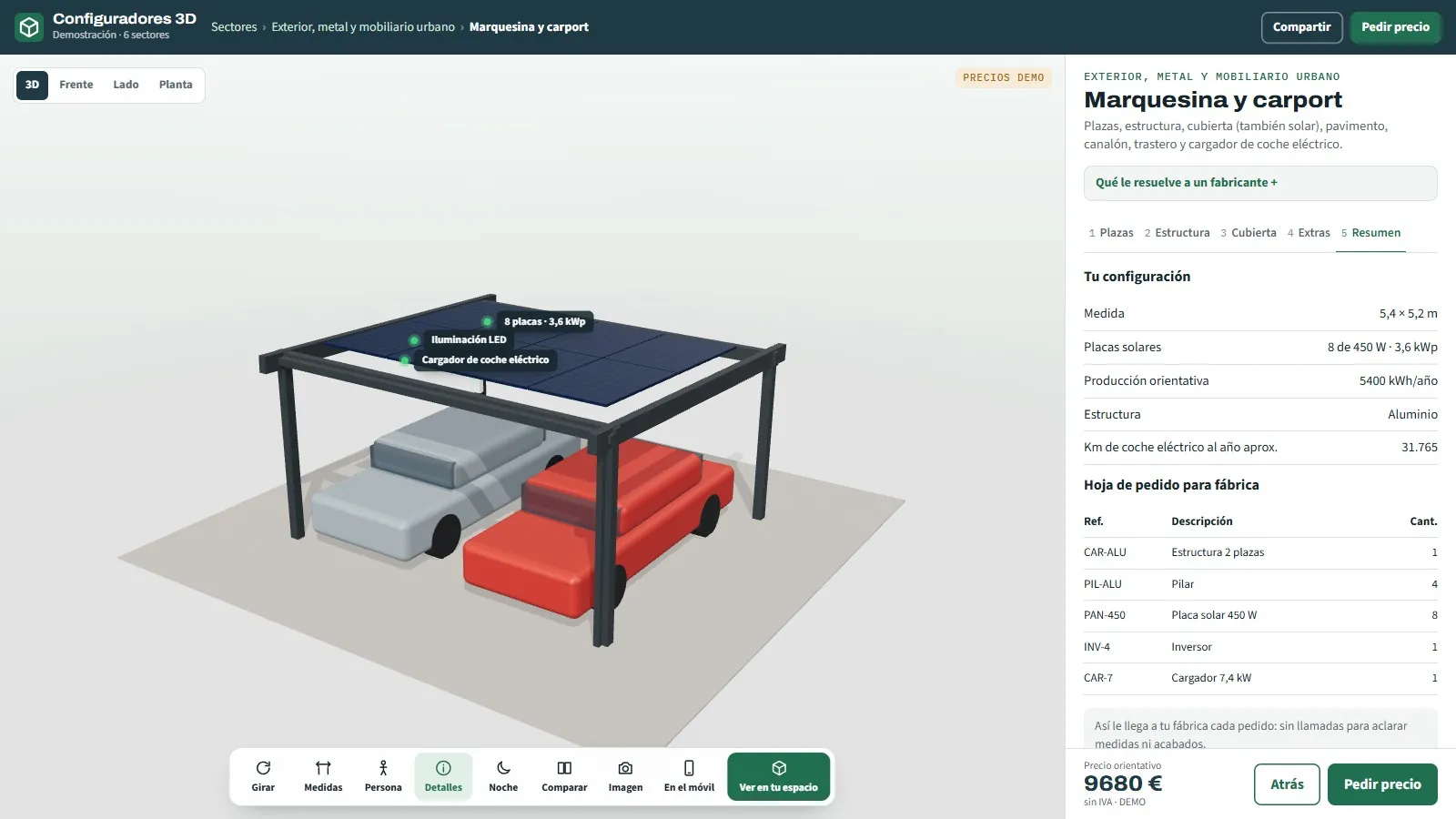
Summary of a two-space solar carport with panels, power, yearly output, indicative price and order sheet
Answers · Customers who do not know how many panels fit

The customer picks the spaces and sees how many panels go on top

They move the number of spaces and the canopy grows in 3D with its panels. The technical data shows the size, the number of panels, the power and the indicative yearly output. The technician no longer goes out to give the first figure: they go to confirm on site a proposal the customer has already understood.

Panels, power and output according to the spaces
Canopy configurator screen with spaces, structure, solar panel roof and selected extras
Answers · Projects that mix structure, energy and charging

Structure, panels and charger in a single quote

Structure, roof, electric car charger, LED lighting, gutter, side cladding, storage unit and paving are all chosen in the same configurator and add up to a single indicative price. The order sheet separates posts, panels, inverter and charger with your references, so each part reaches whoever makes or installs it.

A single indicative price and order sheet
Anthracite aluminium canopy with a solar panel roof and an electric car charger in 3D, with a figure for scale
Answers · Decisions that drag on

The committee compares three versions on the same screen

Solar panels against sandwich panel or polycarbonate, aluminium against galvanised steel, with or without a charger: up to three versions side by side, with the differences between them highlighted. The manager takes them to the meeting as a PDF or an image and the committee decides on something they can see, not on three stapled quotes.

Compare up to 3 options
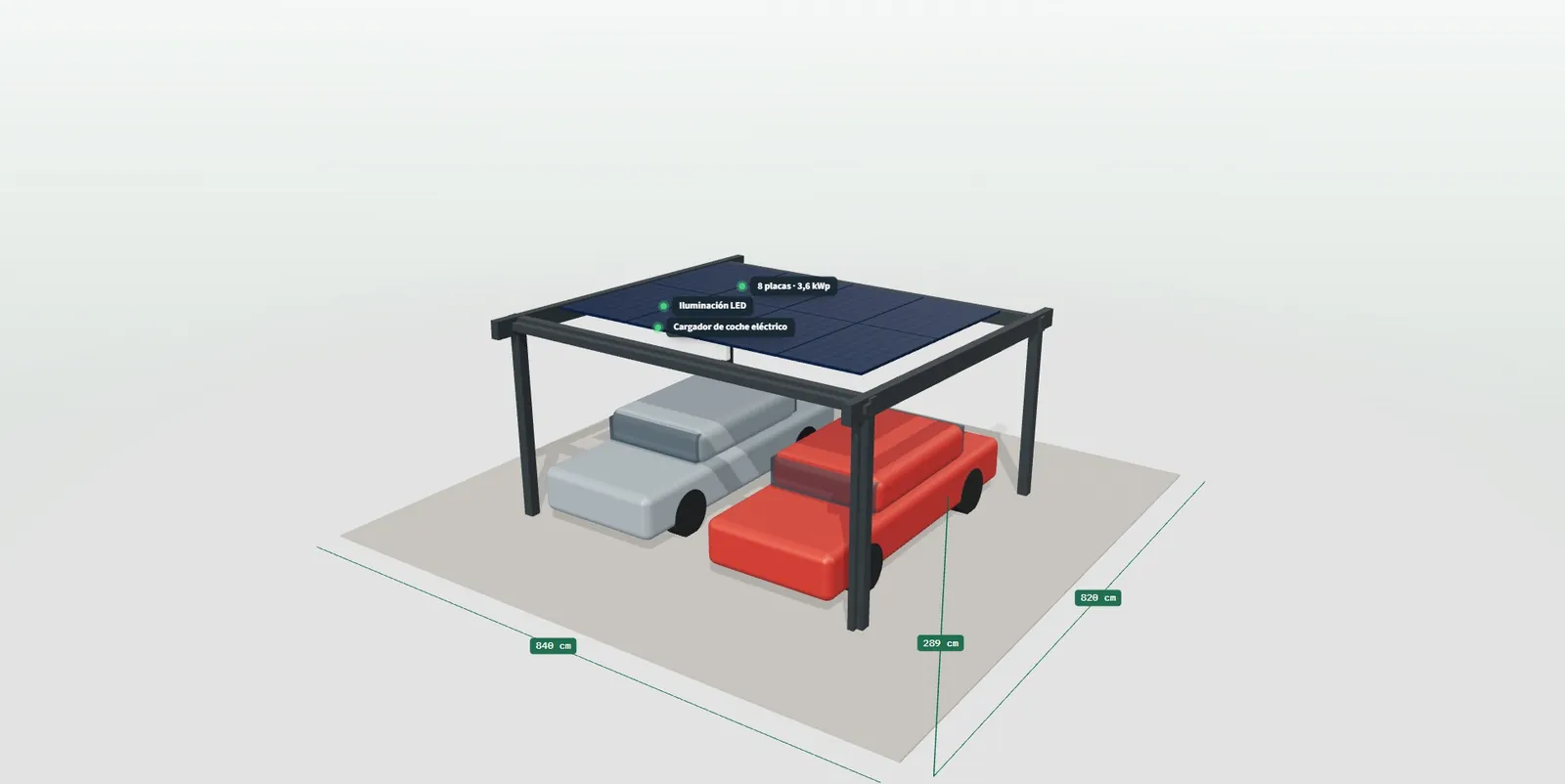
Labels on the canopy in 3D with the number of panels, the power, the LED lighting and the car charger
Answers · Energy figures the customer does not understand

The output is translated into electric car kilometres

Alongside the kilowatt-peak and the kilowatt-hours per year, the technical data shows the approximate electric car kilometres that output gives. It is the figure the finance director understands and the one the resident remembers, and it appears without anyone having to open a spreadsheet.

Technical data with output and kilometres per year
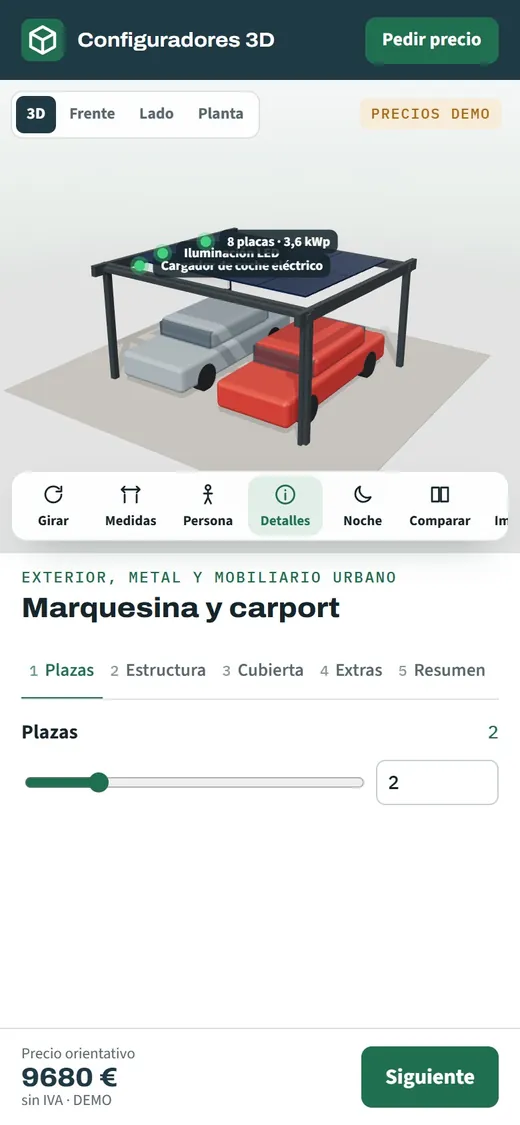
Phone with the canopy and carport configurator open: solar canopy in 3D and indicative price on screen
Answers · A structure nobody can picture on their site

They see it at real size next to the warehouse

From their phone, scanning a QR code and installing nothing, the customer places the canopy at real size in their car park in augmented reality. They check whether it leaves the entrance clear and, back in the 3D, try another structure colour and switch on the dimensions to see the clear height.

Augmented reality from a phone
— TRY IT NOW

Try it
for
yourselves.

Leave the solar panel roof and go from 2 to 6 spaces: the panels go from 8 to 28 and the output and the kilometres per year are recalculated; then compare it with polycarbonate.

An open demo, with no registration, with example products and prices. It is designed for manufacturers, dealers and installers: private customers are welcome to try it, but we do not sell the product.

— INVESTMENT AND NEXT STEP

Bring structure, panels and charger together in one proposal

Pick a canopy you have in the pipeline right now and we will show it to you solved in the configurator, with your panels, your structures and your price list.

From €6,500

Most projects for manufacturers fall between €14,500 and €35,000, depending on the catalogue, the manufacturing rules and the integrations. Maintenance and hosting from €190 a month. We start from a base that already works: you are not paying for development from scratch.

  • What is includedThe configurator with your products, your rules and your price list, embedded in your website and in your dealers' sites, with training for the sales team.
  • TimeframeBetween 3 and 16 weeks depending on the scope; the exact date goes in the proposal.
  • Payment terms40% to start, 40% with the test version and 20% at go-live.

Would you rather talk it through? Call 662 061 421 or write to grup3d@grup3d.es.

— FREQUENTLY ASKED QUESTIONS

What we
get asked.

There are more short answers in frequently asked questions about 3D configurators and who we are in 3D configurator company.

How does it work out how many panels fit on a canopy?

From the number of spaces: the canopy is sized and the configurator places the panels that fit on its roof. In the demo, two spaces give a canopy of 5.4 × 5.2 metres with 8 panels of 450 W, 3.6 kWp and around 5,400 kWh a year as a guide. In your version, with your module and your calculation rules.

Are the output and the kilometres exact?

No, they are indicative, and they are presented that way to the customer. They are there so they understand the order of magnitude and compare versions before the visit. The final output depends on the orientation, the tilt and the shading of the site, and you still calculate it in the technical study, as you do now.

How much does a solar canopy configurator cost?

To start doing the sums: developments start from €6,500 for a visual configurator of one product family; most projects for manufacturers fall between €14,500 and €35,000, depending on the catalogue, the rules and the integrations, plus maintenance from €190 a month. Three things move the figure: how many structures, roofs and extras you want to offer, what your rule for calculating panels and output is like, and whether your installers or distributors will have their own area, with their margin and their brand. With your price list in front of us, we give you the fixed figure.

Does it work for houses and for company car parks?

Yes. The demo goes from one to six spaces, which covers everything from a carport at a house to a company's management car park or a residents' association's outdoor parking. In your version the limits are adjusted to what you make and install, and the contacts are shared out by area between your sales reps.

Which structures, roofs and extras can the customer choose?

A galvanised steel, aluminium or laminated timber structure, in eight colours; a sandwich panel, polycarbonate or solar panel roof; and as extras, an electric car charger, LED lighting, side cladding, gutter and downpipe, side storage unit and concrete, block or reinforced grass paving.

Does a solar canopy need planning permission?

It depends on each council. In many it is handled as minor works or a prior notification, in addition to registering the self-consumption installation. The configurator does not handle that paperwork, but the PDF with dimensions, panels and power gives the customer and your technician a clear basis to start preparing the documentation.