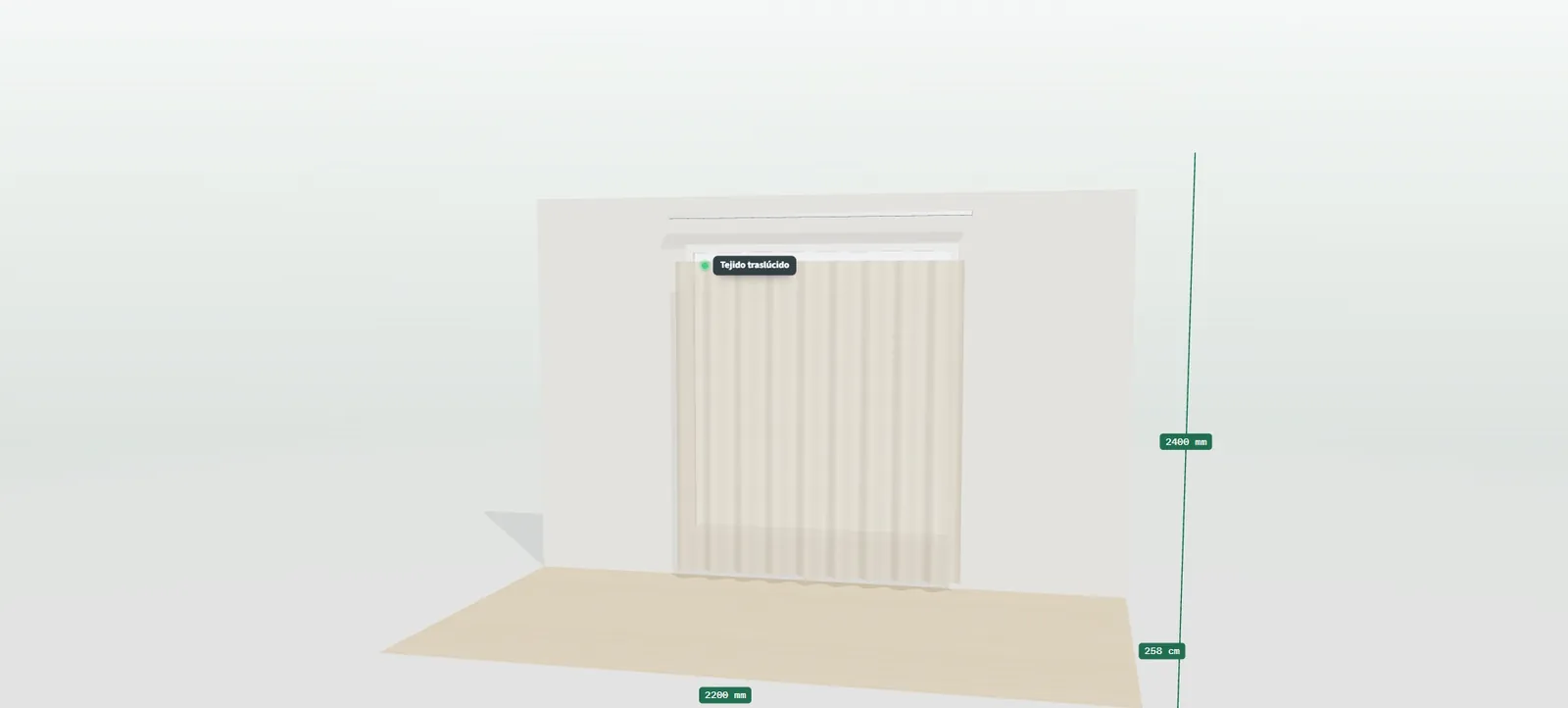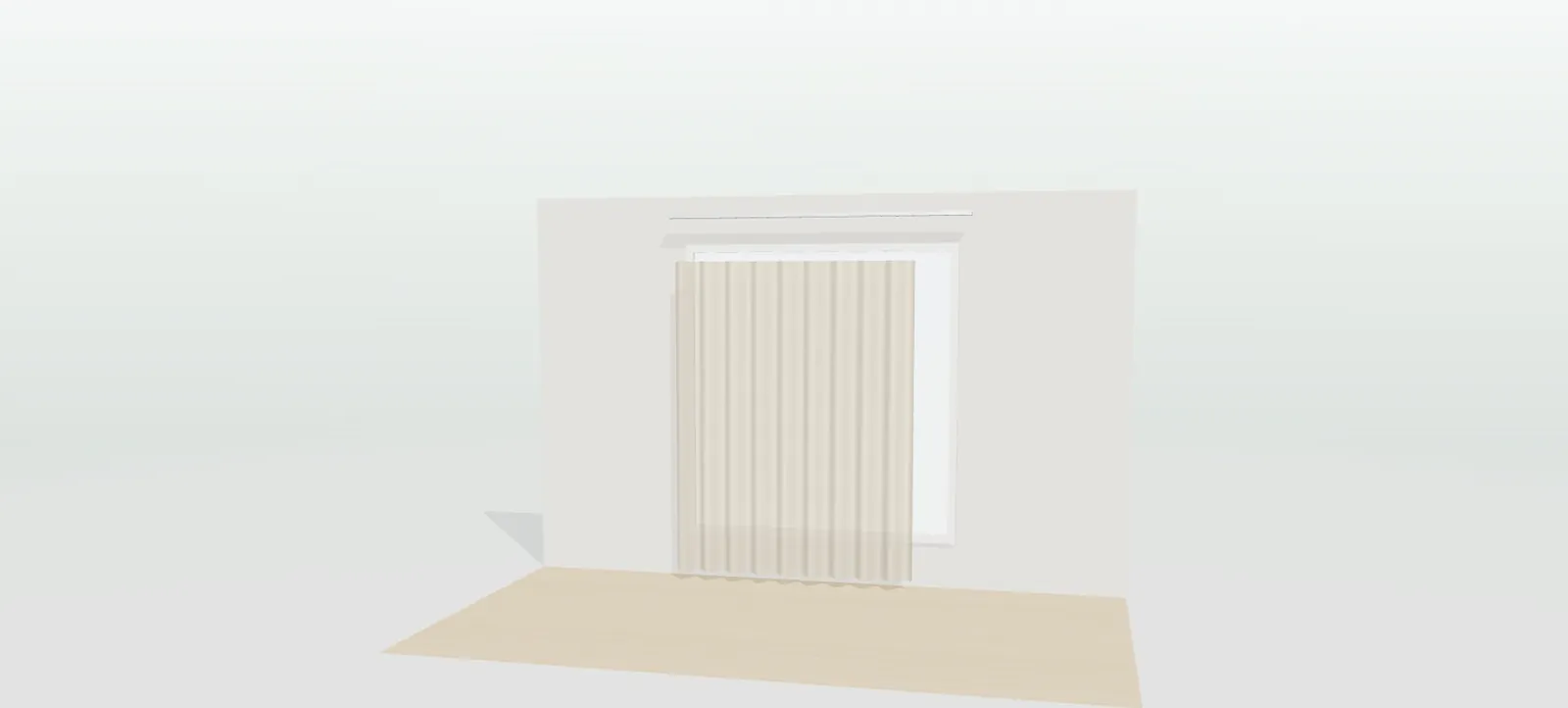
Wave curtain in translucent sand linen fabric over a large window in the 3D configurator
FURNITURE, WOOD AND TEXTILES · OPEN DEMO
— FOR INSTALLERS AND MAKERS

3D configurator
for blinds
and curtains.

A twenty-centimetre sample says nothing about how a 2.20 metre blind filters the light. Your adviser holds it against the glass, the customer hesitates between translucent and screen fabric, the gathering of the wave is worked out in a notebook and the motor with schedules, as usual, never even gets offered.

— WHAT HAPPENS TO YOU

Five in the afternoon
and the sun coming in
sideways through the window

The visit is at five, when the customer finishes work. The living room has a 2,200 by 2,400 millimetre window facing west and a television you cannot watch in the afternoon because of the reflections. Your adviser measures, opens the case and spreads out samples of translucent, screen and blackout fabric in several colours. She holds them against the glass one by one, but the seven o'clock sun on a whole panel does not fit in a sample case.

She likes the wave curtain, but asks how much fabric it needs and whether the sand linen will be see-through from the street at night. The adviser works out the width with the gathering in his notebook, the area and an approximate price, and promises to send the quote the next day. When he mentions the motor with schedules, she rules it out as expensive before knowing what it costs. He does not push either: he has another visit at half past seven on the other side of the city.

The next day, at the workshop, someone writes up the notes: width, height, fabric, colour, headrail and pelmet. If the notebook said 2,200 and that was the width of the opening and not of the blind, the mistake is discovered on installation day. The quote goes out by email three days later, when another shop has already sent theirs. The customer takes the samples out of the envelope again, but the afternoon sun is no longer there to help her decide.

— WHERE THE SALE LEAKS AWAY

The bottlenecks
you will recognise
straight away.

“I cannot get an idea from the sample”

Fabric sample books that do not convince

Against the glass, a scrap of fabric changes with the hour and with whatever cloud passes. What it does not show is how the whole panel will look or the real difference between translucent, screen and blackout with the afternoon sun. The customer keeps the samples to think about it and decides weeks later, or compares only the price with the first quote that arrives.

What it costs youDecisions that get postponed and sales that go to the fastest quote.
“How much fabric does the wave use?”

Sizes and gathers calculated wrong

Width of the opening or width of the blind, height to the floor or to the sill, fabric needed for the gathering of a wave curtain: it is all worked out in a notebook, at the customer's home and in a hurry. A number written down wrong is a curtain that does not cover or a blind that drags on the floor, and it is discovered on installation day.

What it costs youItems that have to be remade and second visits nobody charges for.

“The motor, maybe later on”

The motor almost never gets sold

Motorising with schedules and voice control is the option that most changes the customer's day-to-day, but it gets explained verbally at the end of the visit and sounds like an expense. Without seeing it on their window or knowing its exact price, the customer rules it out. And that “later on”, in practice, almost never comes.

What it costs youYou lose the extra that adds the most value to every window.

“I will send you the quote tomorrow”

Quotes that arrive late

After the visit the notes have to be written up, the areas calculated, the headrail, the pelmet and the making-up added, and the quote sent. Between visits and installations it takes a day or two, sometimes more. In that time the customer has asked for two more quotes and no longer remembers which sample they liked.

What it costs youVisits that never become orders because the price arrived late.

“There are fourteen windows, all the same”

Repeat orders for offices and whole homes

An office or a whole home is many windows with the same fabric, headrail and pelmet. Every unit is written down, calculated and made up from the same notes, and one mistake gets multiplied by the number of windows. On a job with fourteen blinds, a colour copied wrong means fourteen blinds to remake.

What it costs youOne single ordering mistake, paid for many times over.

— DO THE MATHS

What it costs you
today, with
your own numbers.

Every visit that does not end in an order costs travel and adviser hours. Replace the values with yours.

visits
h
€
MONTHLY COST OF VISITS THAT DO NOT SELL 0

€ a month

The values are an example: replace them with yours. The calculation is a simple multiplication and does not come from any study.

— HOW IT IS SOLVED

Every bottleneck,
with its
answer.

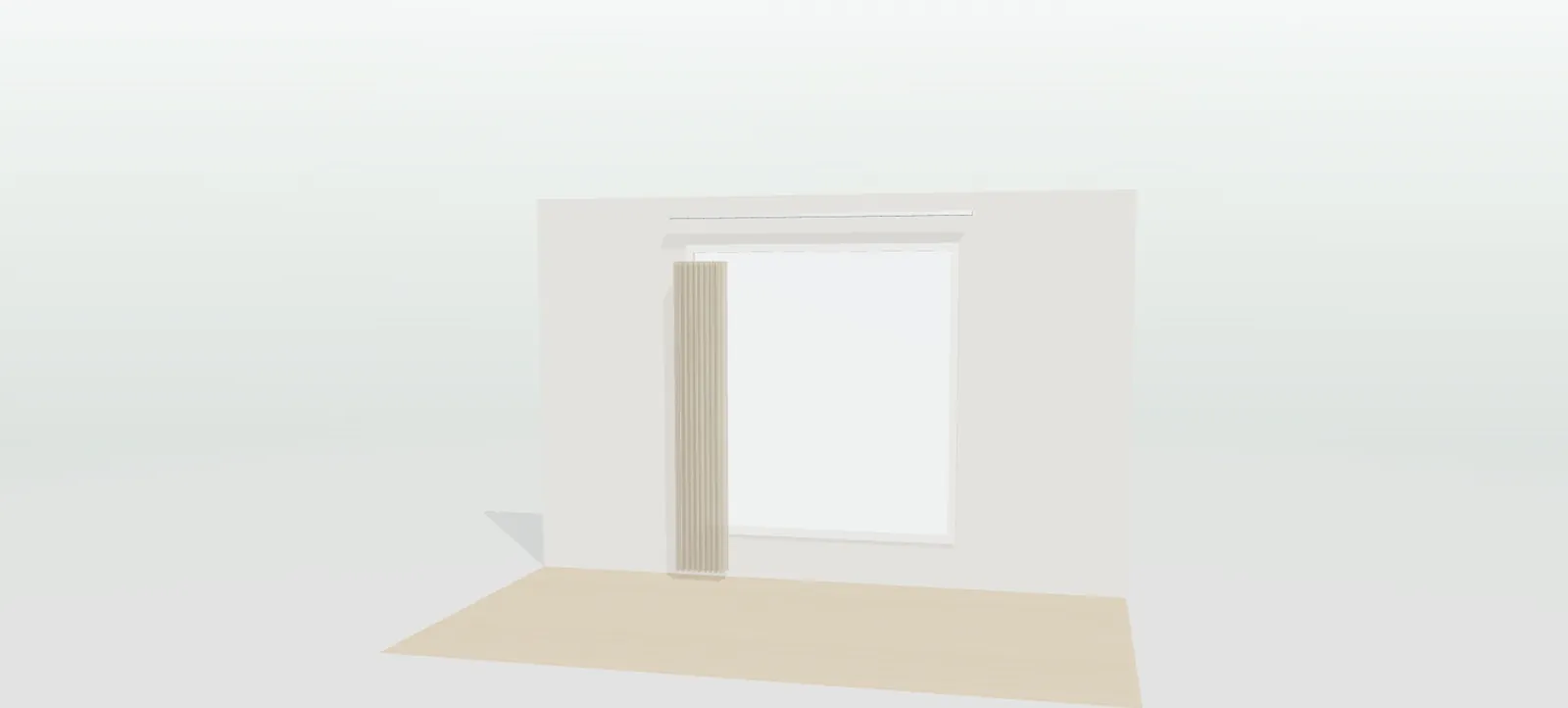
Wave curtain in translucent sand linen fabric, half open over a large window, seen in 3D
Answers · Fabric sample books that do not convince

The fabric is seen on their window, open and closed

The customer switches between translucent, screen and blackout and between seven colours, and sees the blind or curtain at their size in 3D. They open and close it and, in augmented reality, place it on their own window from their phone, in the light of their living room. They decide during the visit, not with the samples in a drawer.

Open and close in 3D and augmented reality
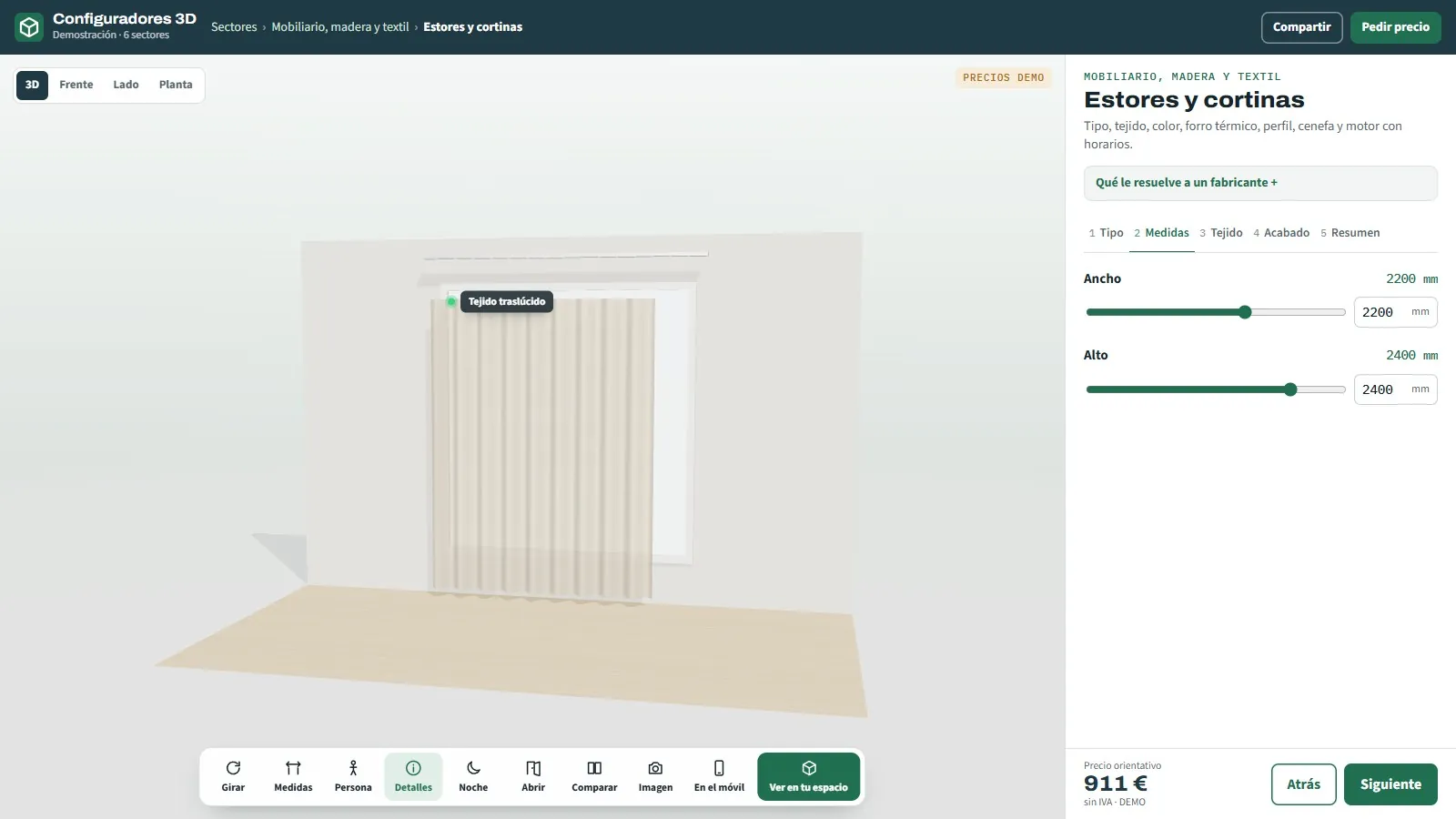
Curtain in 3D with 2200 × 2400 mm dimension labels and the 5.28 m² area calculated over the window
Answers · Sizes and gathers calculated wrong

Area and fabric needed, calculated as the size is entered

The adviser types in the width and height of the window and the configurator works out the area and the fabric needed; in your version, with your own gathering coefficients for the wave curtain. The dimensions appear on the 3D and are written into the PDF, with no notebook and no figures to write up the next day.

Dimensions and calculation of area and fabric
Blind configurator panel with wave curtain type, translucent fabric, white headrail, pelmet and motor with schedules
Answers · The motor almost never gets sold

The motor is offered with its price, not as an expense

Motorisation with schedules and voice control is just another option, with its indicative price beside it. The customer switches it on, sees how much it adds and decides on it along with the rest of the order, just like the pelmet that hides the mechanism or the thermal lining. Nobody has to bring it up at the end of the visit.

Options with an indicative price
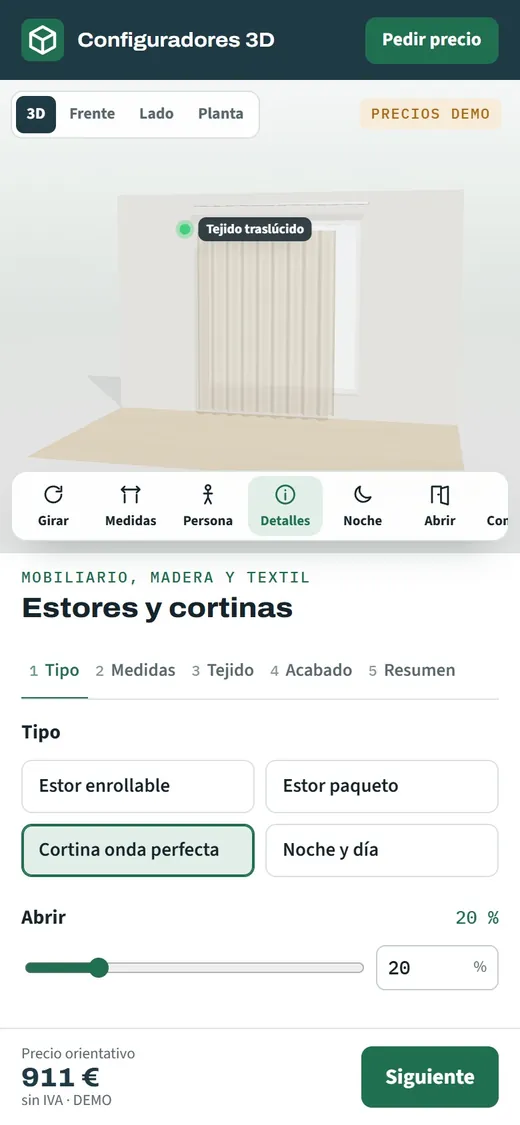
Blinds and curtains configurator open on a phone with the curtain in 3D and the indicative price of the configuration
Answers · Quotes that arrive late

The price comes out during the visit, not two days later

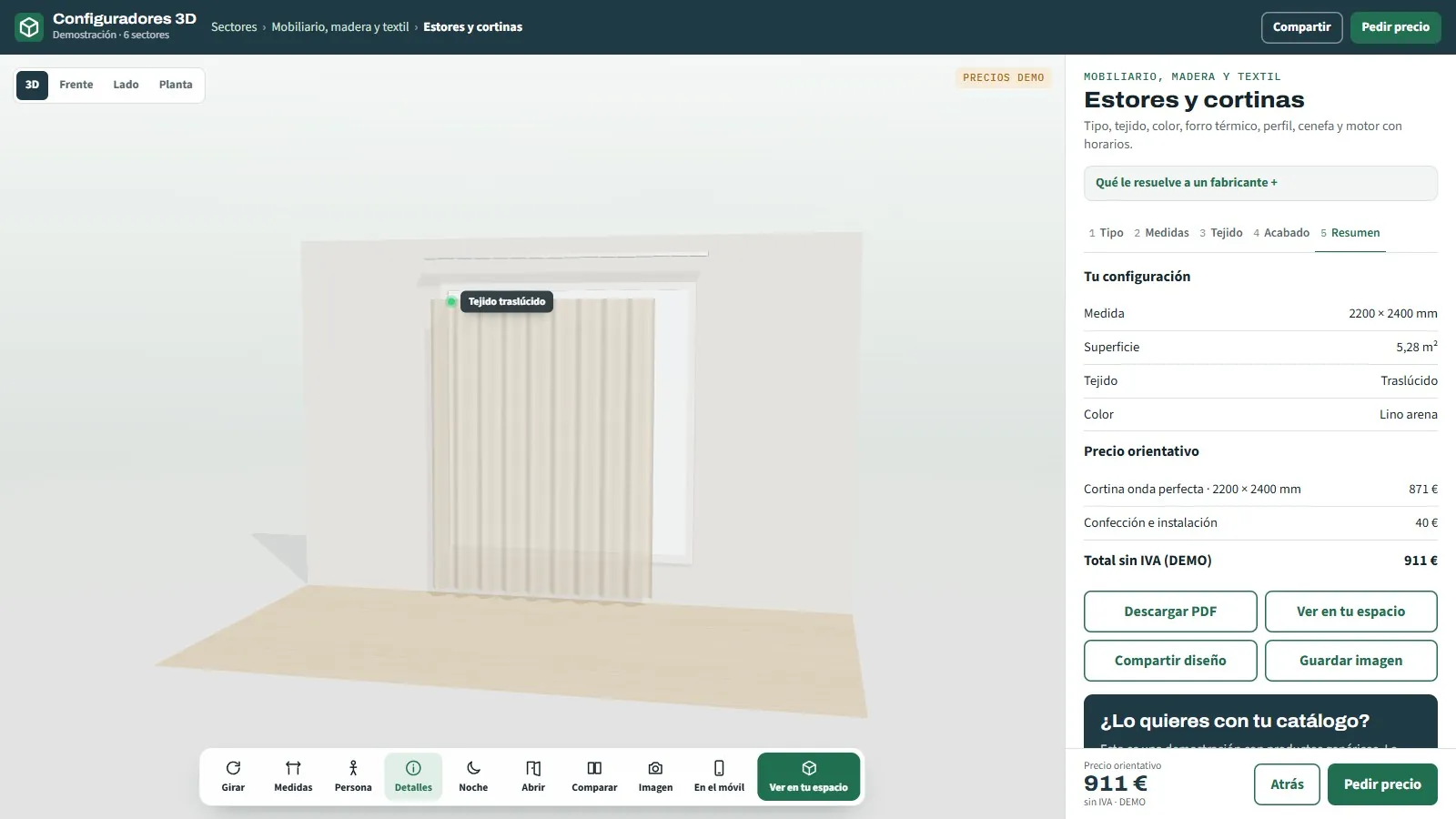
With your price list inside, the indicative price updates with every change of type, fabric, headrail or extras. The adviser leaves the PDF with the configuration and the price before going, and the customer opens it on their phone with a QR code to look at it calmly that same evening.

Indicative price and PDF
Blind order sheet with type, 2200 × 2400 mm size, fabric, colour, headrail, pelmet and identical units
Answers · Repeat orders for offices and whole homes

Fourteen identical blinds in one order with no mistakes

The blind is configured once and the identical units are entered, up to 30. The order sheet comes out with type, size, fabric, colour, headrail, pelmet and motor, with their quantities, ready for the workroom or to go into your ERP without being typed again.

Identical units and an order sheet
— TRY IT NOW

Try it
for
yourselves.

Choose “Wave curtain”, switch the fabric from translucent to blackout, press “Open” and “Close” and then watch how the area changes as you move the width.

An open demo, with no registration, with example products and prices. It is designed for manufacturers, dealers and installers: private customers are welcome to try it, but we do not sell the product.

— INVESTMENT AND NEXT STEP

How many visits end in “I will let you know”?

We run a test visit with you, from the measurement to the price, with fabrics and a price list like yours.

From €6,500

Most projects for manufacturers fall between €14,500 and €35,000, depending on the catalogue, the manufacturing rules and the integrations. Maintenance and hosting from €190 a month. We start from a base that already works: you are not paying for development from scratch.

  • What is includedThe configurator with your products, your rules and your price list, embedded in your website and in your dealers' sites, with training for the sales team.
  • TimeframeBetween 3 and 16 weeks depending on the scope; the exact date goes in the proposal.
  • Payment terms40% to start, 40% with the test version and 20% at go-live.

Would you rather talk it through? Call 662 061 421 or write to grup3d@grup3d.es.

— FREQUENTLY ASKED QUESTIONS

What we
get asked.

There are more short answers in frequently asked questions about 3D configurators and who we are in 3D configurator company.

Can we use our own fabrics and collections?

Yes. The demo uses three fabric types and seven example colours. In your configurator it is your collections and your rules: maximum sizes per blind type, which fabrics take a thermal lining or which headrails exist for each system. That way the customer cannot configure anything your workroom does not make.

Does it work out the fabric for the gathering of a wave curtain?

Yes. From the width and the height it works out the area and the fabric needed, and in your version the wave gathering is calculated with your own making-up coefficients. That way the figure matches the one your workroom already uses and the quote comes out with the real fabric, not a notebook estimate.

How much does a blinds and curtains configurator cost?

It varies with how many systems, fabrics and collections have to be loaded, how detailed your making-up rules are and whether you want an area for other installers or a link to your management software. As a reference: developments start from €6,500 for a visual configurator of one product family; most projects for manufacturers fall between €14,500 and €35,000, depending on the catalogue, the rules and the integrations, plus maintenance from €190 a month. We look at your price list and send you the fixed figure in writing, with no commitment.

How is the motor with schedules shown?

As just another option on the blind: it is switched on, appears with its indicative price and is written into the order sheet. The customer sees how much it adds at the very moment they are deciding fabric and colour, instead of hearing about it verbally at the end of the visit, when they are already thinking about the total.

Can the customer use it without us visiting their home?

Yes. From your website or with a QR code they open the configurator on their phone, with nothing to install, try types and fabrics, see the blind on their window in augmented reality and ask you for a quote with their configuration. You go out to measure already knowing what they want, and the visit is there to confirm, not to start from scratch.

Does it work for offices and projects with many windows?

Yes. One blind is configured and the identical units are entered, from 1 to 30 in the demo. The order sheet comes out with all the units and their specifications, and the customer can compare up to three options — pearl grey screen against graphite blackout, for example — with the differences highlighted before approving the project.