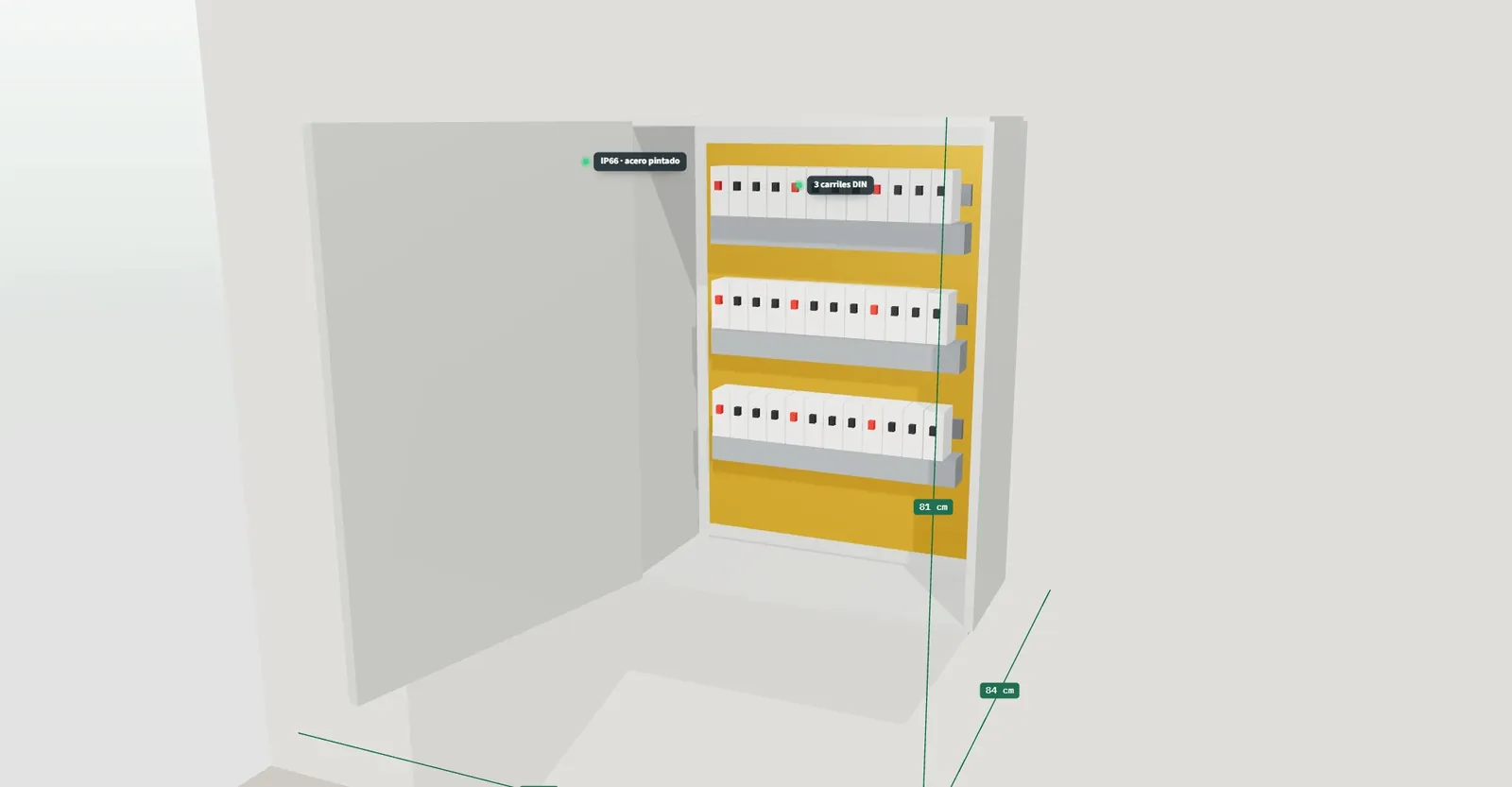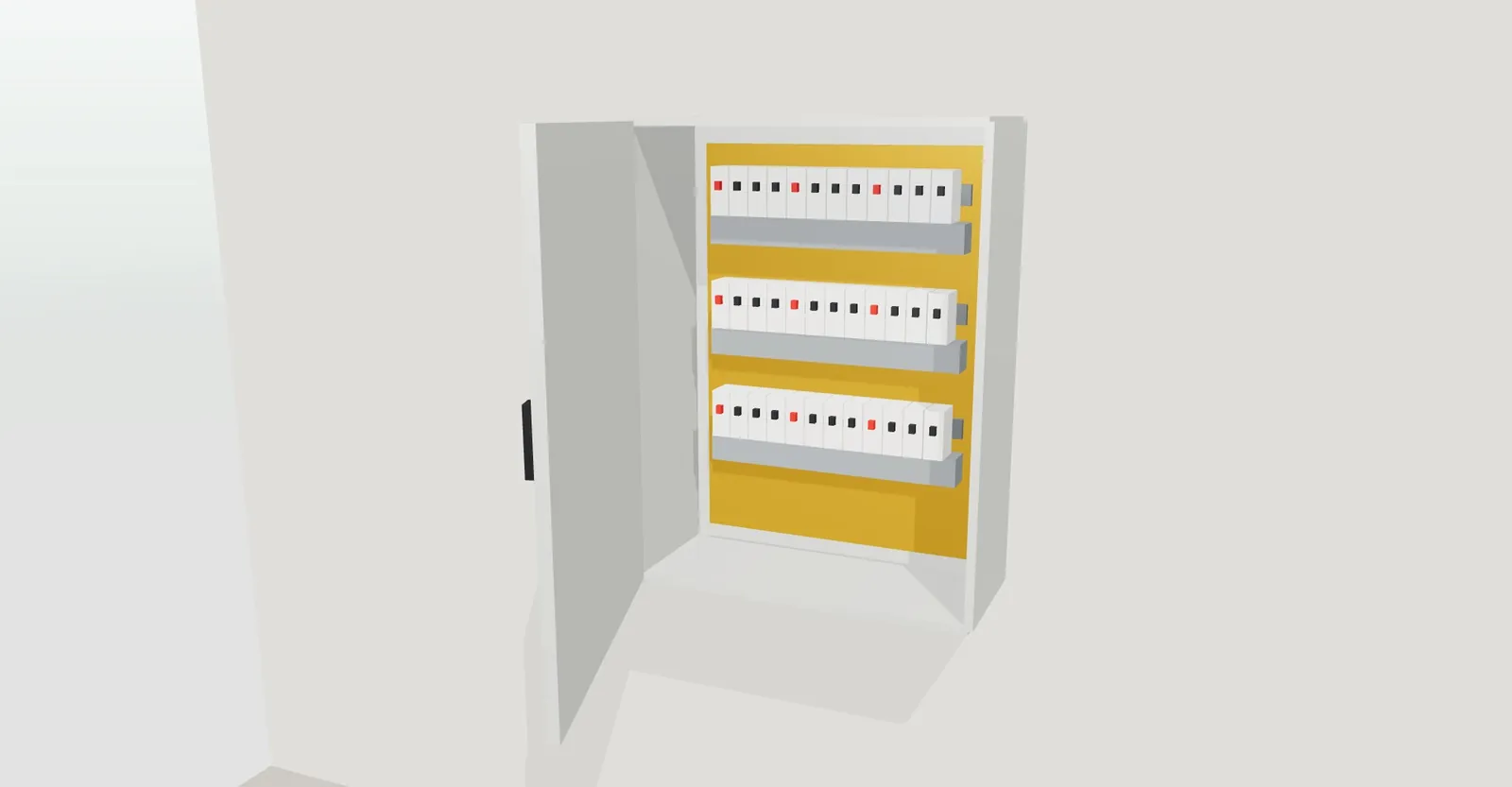
Steel electrical enclosure in 3D with the door open, mounting plate and three rows of DIN rail
LIGHTING, ELECTRICAL AND ENERGY · OPEN DEMO
— FOR ENCLOSURE MANUFACTURERS

3D configurator
for electrical
enclosures made to measure.

A 600 × 800 arrives when the panel builder asked for an 800 × 600, with a solid door instead of a window and no mounting plate. Everyone wrote down what they understood: the order went through three phone calls and an email before reaching you, and the panel is due out on Friday.

— WHAT HAPPENS TO YOU

An order that goes
through three phone calls
before it reaches you

Your factory turns out wall and floor-standing electrical enclosures in painted steel, stainless steel and polyester. Almost all of it is sold through electrical wholesalers, who in turn serve panel builders, industrial installers and integrators. Your catalogue has hundreds of combinations of size, depth, material, protection, door, lock and accessories, and each one has an eight or ten-character reference that almost nobody knows by heart.

On Monday, a panel builder is assembling the panel for a pumping station that will sit outdoors. He calls the wholesaler and asks for “an 800 by 600 for outdoors, with a plate, three rails and a key lock”. The counter staff write it down, look it up in your PDF catalogue and email it to you with whichever reference seems right. Nobody mentions the canopy or the ventilation, and nobody asks about the midday sun on the steel.

On Thursday an enclosure 600 high by 800 wide arrives at his workshop, with IP55 instead of IP66 and no mounting plate. The panel was due out on Friday. The wholesaler asks for an urgent swap, you prepare another one, the transport gets charged twice and the first one comes back to your warehouse with a dent in one corner. And on the next job, the panel builder will ask for another brand “just in case”.

— WHERE THE SALE LEAKS AWAY

The bottlenecks
you will recognise
straight away.

“I said 800 by 600, not 600 by 800.”

Enclosure orders with size mistakes

Height by width, width by height, with or without depth: in a phone call or an email written in a hurry, the dimensions get crossed easily. And in an enclosure, twenty centimetres change where the plate goes, how many modules fit and whether it goes into the space planned for it. The mistake is found when the enclosure is already in the panel builder's workshop.

What it costs youAn urgent swap with double transport and an unhappy customer.
“And the plate? And the rails?”

Cut-outs and accessories that get forgotten

The enclosure gets ordered and the rest is taken for granted: mounting plate, rows of DIN rail, ventilation with a filter, plinth, type of lock. Every accessory is a separate reference and one missing item is enough to stop the panel builder starting. Then comes a separate order for a plate, with its own preparation and its own delivery.

What it costs youA panel standing still waiting for a part worth a few euros.

“It is for outdoors, is this one all right?”

Outdoor panels badly protected

A painted steel enclosure with IP55, by the sea and with no canopy or ventilation, is not the best choice. The panel builder knows that, but whoever places the order does not always, and the wholesaler's counter staff have no way of knowing where it will be installed. If nobody asks about the use, the basic option gets sold and the problem shows up with the first summer.

What it costs youComplaints about condensation or corrosion that were never manufacturing faults.

“Send me the data sheet, I am not sure it fits.”

Nobody knows how much fits inside

The panel builder needs to know how many DIN modules fit, how the door opens and how much room the plinth takes, and looks for it in a two-hundred-page PDF catalogue. If they cannot find it, they call the wholesaler. If the wholesaler cannot answer, they call you, and you have the answer but not the time to give it ten times a day.

What it costs youYour technical office acting as a catalogue search engine.

“Polyester or metal, which one do I use?”

The material gets chosen out of habit

Painted steel, stainless steel or polyester: each has its place depending on humidity, corrosive environments, knocks or the need for insulation. But at the wholesaler's counter people ask for the usual. If the buyer cannot see the options with their protection rating and their recommended use, they will never ask for the higher-value enclosure, even when it is exactly the one they need.

What it costs youThe enclosure that lasts longest never even gets offered.

— DO THE MATHS

What it costs you
today, with
your own numbers.

Count the enclosures that get swapped or returned because of an ordering mistake. This is an example: put in your own figures.

enclosures
€
months
YEARLY COST OF SWAPS CAUSED BY ORDERING MISTAKES 0

€ a year

The values are an example: replace them with yours. The calculation is a simple multiplication and does not come from any study.

— HOW IT IS SOLVED

Every bottleneck,
with its
answer.

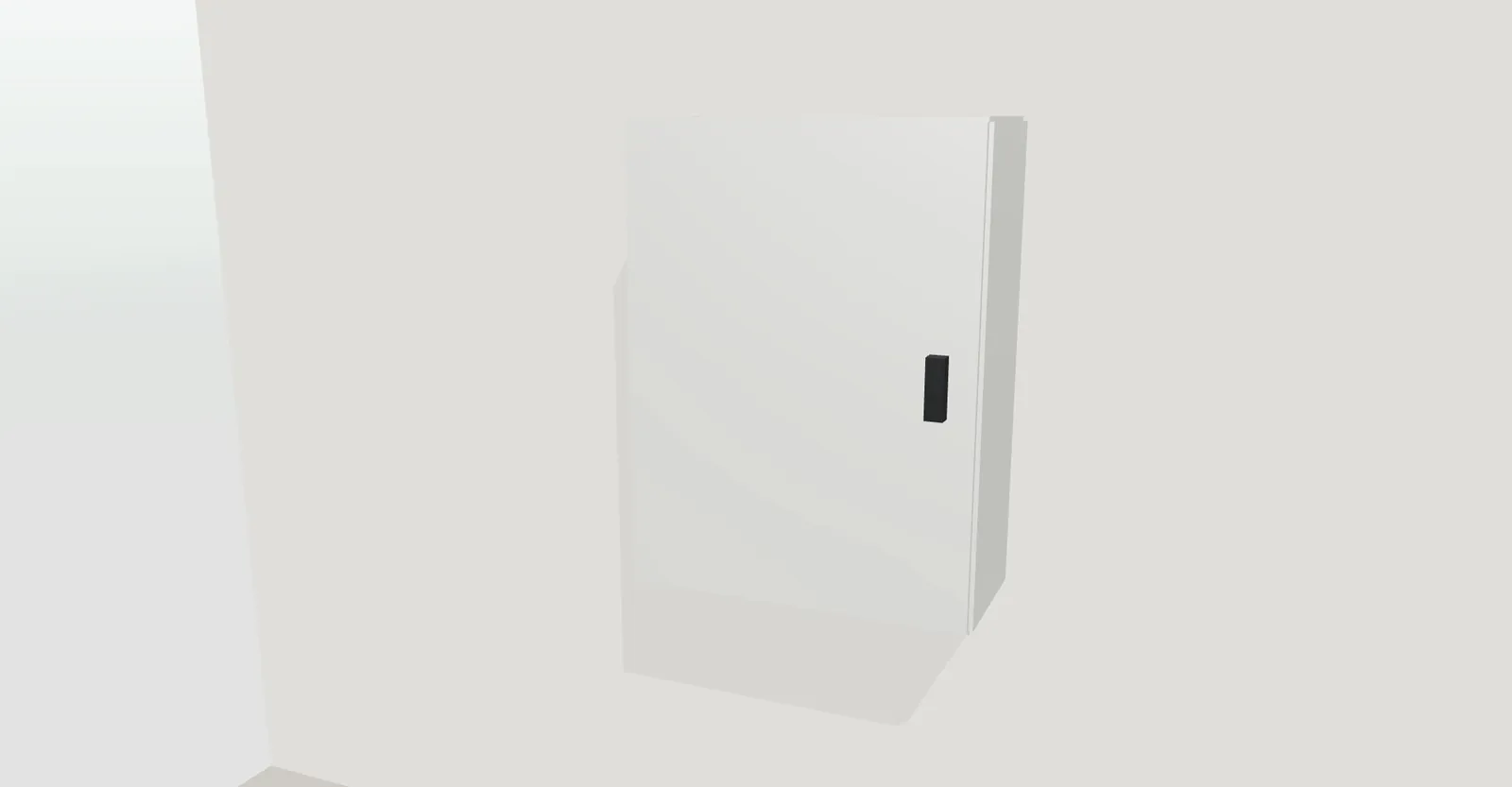
Painted steel electrical enclosure of 800 × 600 mm in 3D, wall mounted, with solid door, key lock and plinth
Answers · Enclosure orders with size mistakes

The size is seen before it is ordered

The height-by-width size is picked from the ones in the catalogue and the enclosure appears in 3D with its height, width and depth, next to a person for scale. It is very hard to confuse an 800 × 600 with a 600 × 800 when you have it in front of you, rotating it, with the dimensions marked.

The enclosure in 3D with its dimensions
Summary of the enclosure with size, IP66 protection, material, approximate DIN modules and an order sheet with references
Answers · Cut-outs and accessories that get forgotten

Everything that goes inside, on the order sheet

Mounting plate, rows of DIN rail, ventilation with a filter, plinth and a triangle, key or handle lock are all chosen in the same flow and come out on the order sheet with references and quantities. The wholesaler forwards it to you as it is and the factory does not have to interpret any email.

Factory order sheet
Electrical enclosure in 3D with detail labels for IP66 protection, material, lock and internal mounting plate
Answers · Outdoor panels badly protected

The outdoor panel goes out with its canopy

When the material and protection are chosen, the configurator shows the recommended use — for example outdoors or wet environments — and offers a canopy and climate control with a filtered fan or an air conditioner. The panel builder sees the right option at the moment of deciding, not after the first summer in the sun.

Protection, canopy and climate control
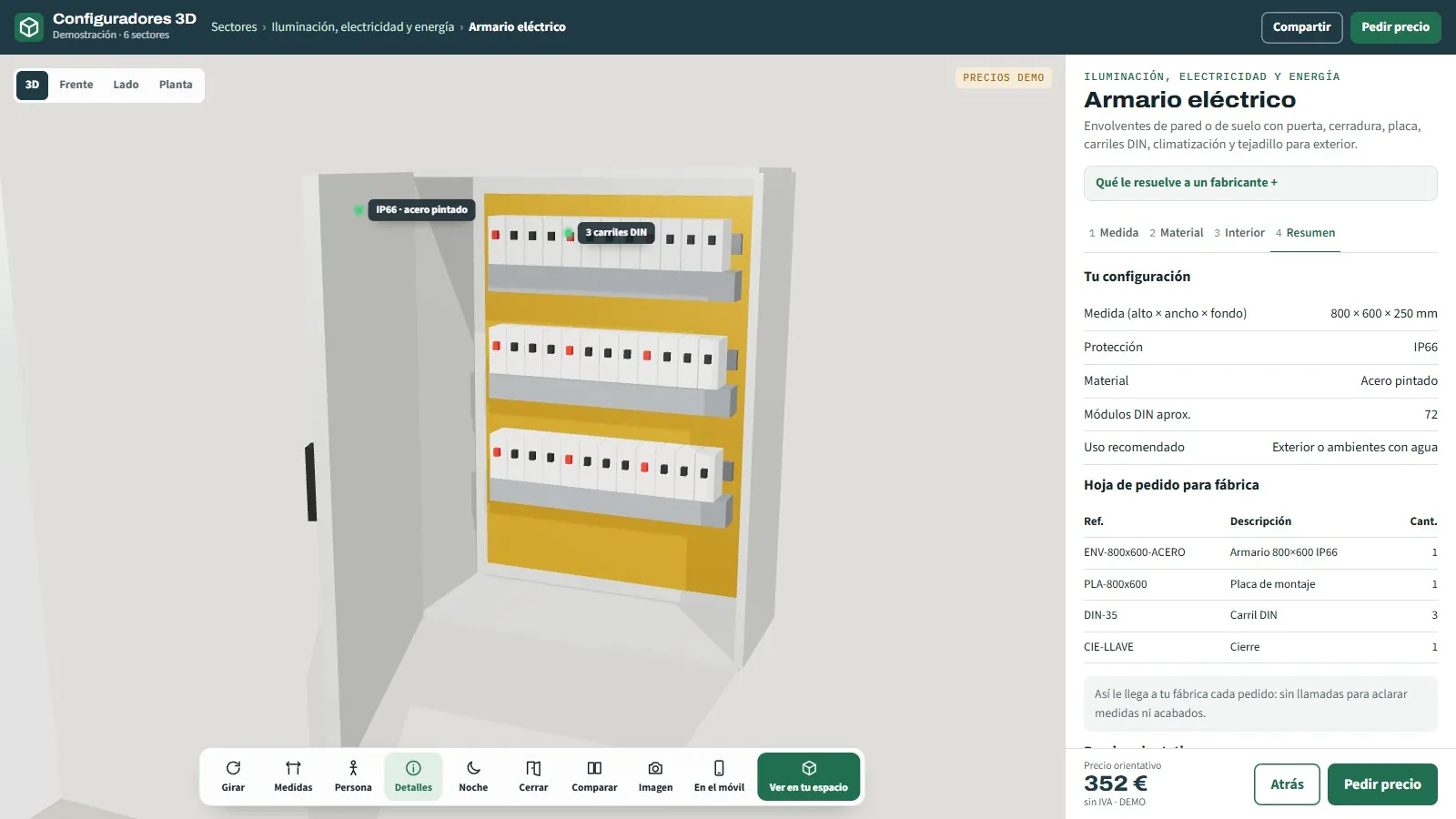
Electrical enclosure in 3D with the door open, mounting plate and three rows of DIN rail visible inside
Answers · Nobody knows how much fits inside

The door opens and you can see inside

The door opens in 3D and shows the plate, the rows of DIN rail and the window, if it has one. The approximate DIN modules are calculated. The panel builder opens it on their phone with a QR code from their workshop and settles the question without calling anyone.

Open and close the door in 3D
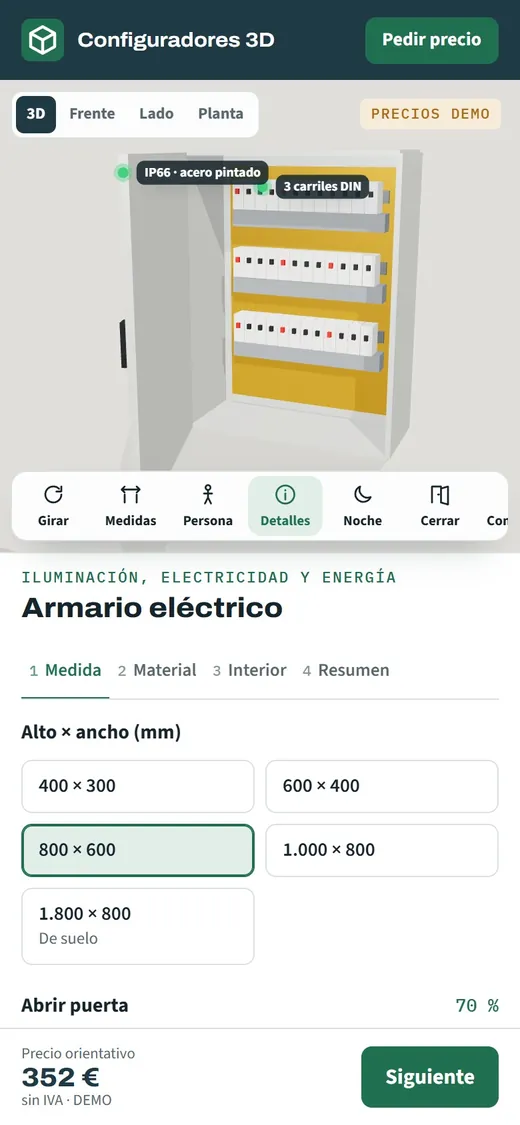
Electrical enclosure configurator on a mobile phone with the material, IP rating and door type selectors
Answers · The material gets chosen out of habit

The materials, side by side

Painted steel, stainless steel and polyester, or IP55 against IP66: the comparison tool shows up to three enclosures at once, with the differences highlighted and their indicative price. The wholesaler uses it at the counter, with the panel builder there, and decides by looking at the recommended use of each material.

Material and protection comparison
— TRY IT NOW

Try it
for
yourselves.

Pick the 800 × 600 in polyester, open the door fully and switch on the canopy and the ventilation: watch what changes on the order sheet.

An open demo, with no registration, with example products and prices. It is designed for manufacturers, dealers and installers: private customers are welcome to try it, but we do not sell the product.

— INVESTMENT AND NEXT STEP

Orders that arrive right first time

Send us your catalogue of enclosures and accessories and we will show you how your wholesalers and panel builders would use it, with your references on the order sheet.

From €6,500

Most projects for manufacturers fall between €14,500 and €35,000, depending on the catalogue, the manufacturing rules and the integrations. Maintenance and hosting from €190 a month. We start from a base that already works: you are not paying for development from scratch.

  • What is includedThe configurator with your products, your rules and your price list, embedded in your website and in your dealers' sites, with training for the sales team.
  • TimeframeBetween 3 and 16 weeks depending on the scope; the exact date goes in the proposal.
  • Payment terms40% to start, 40% with the test version and 20% at go-live.

Would you rather talk it through? Call 662 061 421 or write to grup3d@grup3d.es.

— FREQUENTLY ASKED QUESTIONS

What we
get asked.

There are more short answers in frequently asked questions about 3D configurators and who we are in 3D configurator company.

What can be configured on the electrical enclosure?

The height-by-width size, the material (painted steel, stainless steel or polyester), IP55 or IP66 protection, solid door or with a window, rows of DIN rail, ventilation with a filter, plinth, type of lock, climate control and a canopy for outdoor use. The door opens in 3D to see inside. In your version, with your real sizes, depths and accessories.

Does the order sheet come out with our references?

Yes. In the demo it comes out with example codes for the enclosure, the plate, the rails and the lock; in your version, with your references and quantities and with your rules: which accessories are compatible with each size and which combinations you do not make. If you want, it connects to your ERP so the order goes in without being typed again.

How much does an electrical enclosure configurator cost?

With enclosures, what weighs most is the compatibility rules: which plate, which rails and which accessories each size and depth take. Then it depends on the number of families, the wholesaler area and the connection to your ERP. Developments start from €6,500 for a visual configurator of one product family; most projects for manufacturers fall between €14,500 and €35,000, depending on the catalogue, the rules and the integrations, plus maintenance from €190 a month. Send us your catalogue and we will pin down the scope in the demo.

Does it help choose between IP55 and IP66?

It shows the recommended use for the protection and material chosen — for example outdoors or wet environments for IP66 — and offers a canopy and climate control where they make sense. The final decision still belongs to the panel builder or the designer, who knows the installation; what the configurator does is bring the question up at the moment of choosing, not once the enclosure is already on the wall.

Can electrical wholesalers use it?

Yes. Each wholesaler can work with their own brand and their own margin, use it at the counter with the panel builder there or send them the link, which opens on a phone with a QR code. The order reaches you with the full sheet, and enquiries coming in through your website can be assigned by area to each sales rep.

Does it work out how many DIN modules fit inside?

It gives an approximate number of DIN modules based on the size and the rows of rail chosen, enough to know whether the panel fits or whether it is worth going up to the next size. The final layout of the switchgear is still done by the panel builder with their schematic, but they know from the start how much room they have.