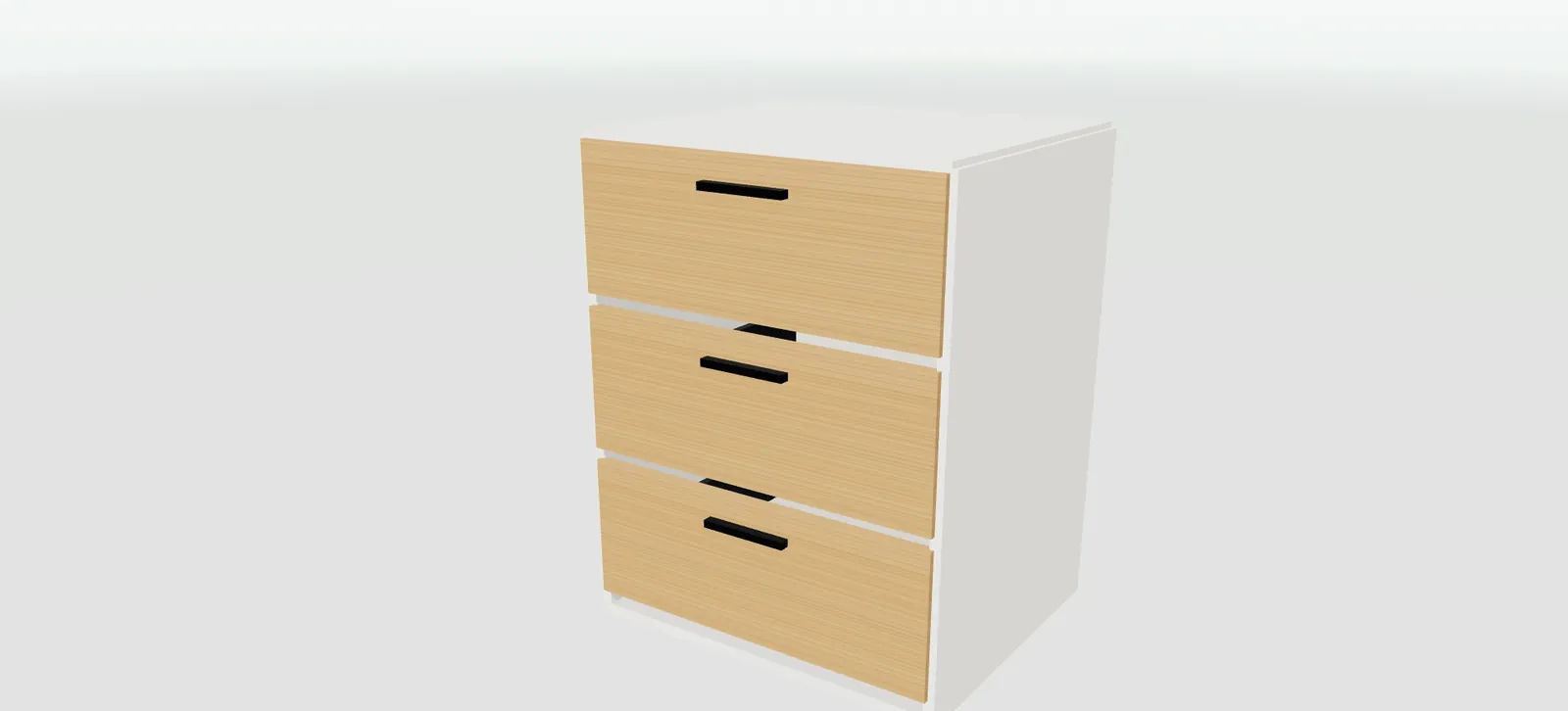
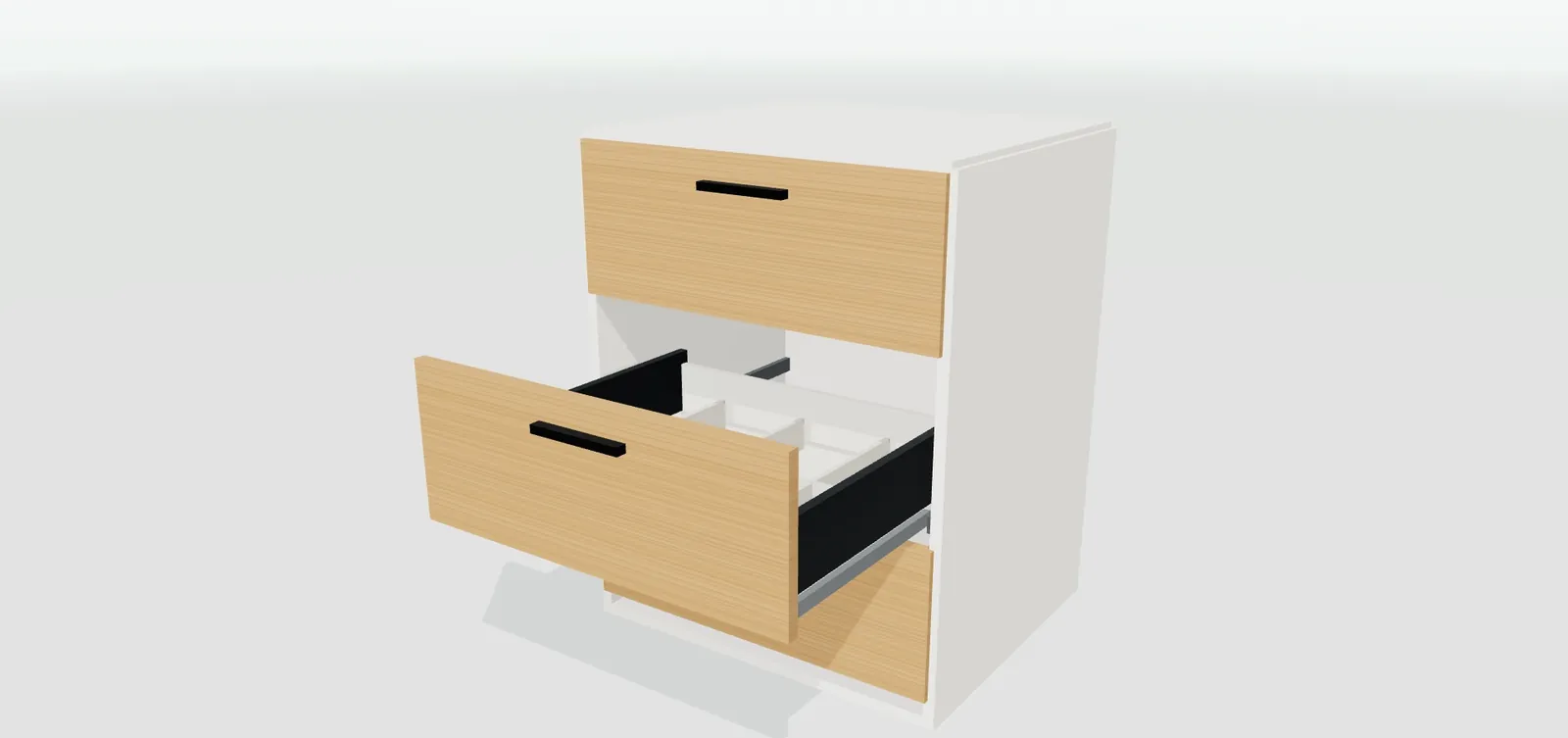
Drawer with concealed runners and anthracite sides open in 3D with the recommended runner calculated
FURNITURE, WOOD AND TEXTILES · OPEN DEMO
— FOR FITTINGS DISTRIBUTORS

3D configurator
for fittings
with every reference.

“A drawer 600 wide and 500 deep, for pans: which runner do I use?” The joiner calls from the job, your counter looks it up in the catalogue and the reference gets written down by ear. If one number changes, the runner does not fit and the order comes back to the warehouse.

— WHAT HAPPENS TO YOU

7:30 in the morning,
a queue at the counter
and the phone ringing

The warehouse opens and there are already four joiners waiting before heading off to site. One brings a photo of a broken drawer; another, a piece of paper saying “600 × 500, 50 kilos, soft close”. The counter staff know the catalogue, but it runs to hundreds of pages between concealed runners, drawer sides, sliding systems for wardrobes and cup hinges. While they look up which runner suits a 500 internal depth, the phone rings: a kitchen fitter who needs 50 identical sets first thing tomorrow.

On the phone everything goes by ear. The fitter says “450 runner” and the counter hears 400; he says medium sides and high ones get written down; nobody asks about the finish, so whatever was to hand goes out. The order is keyed in quickly, between one sale and the next, and picked in the warehouse from the printed sheet. Nobody is to blame: there are too many similar references and barely a minute for each customer.

The mistake shows up the next day on site: the runner does not fit the depth of the unit, the side does not match the front or the hinges open to 110 degrees when the door needed 165. The fitter goes back to the warehouse, the material is returned, a credit note is issued and another delivery is arranged. And the next time that joiner needs fittings, they might try another supplier who lets them choose on their own, without depending on a phone call.

— WHERE THE SALE LEAKS AWAY

The bottlenecks
you will recognise
straight away.

“Which runner do I use for a 500 depth?”

The joiner does not know which reference to order

The professional knows their furniture, not your catalogue. They know the width, the internal depth and what the drawer will carry, but not which runner length, which side height or which reference matches. Every doubt is settled at the counter or on the phone, with someone from your team searching through tables.

What it costs youYour staff acting as a reference search engine instead of selling.

“Send me the catalogue, I will look at it at home”

Catalogues hundreds of pages long

Concealed runners, wardrobe sliding systems, cup hinges, organisers, finishes: the catalogue has it all, but it runs to hundreds of pages and shows each fitting in a still photo. The joiner cannot see how the drawer comes out with the soft close or how the hinge looks at 165 degrees. They order what they already knew and never discover what is new.

What it costs youNew ranges stay in the catalogue and never reach the furniture.

“I said 450, not 400”

Phone orders with mistakes

Similar references, quantities of 50 units and sizes given from memory: a phone order is fertile ground for mistakes. One number changed means material that is useless, a return, a credit note and a second delivery. And the fitter loses a morning waiting for what should have arrived right first time.

What it costs youReturns, double deliveries and customers who try another supplier.

“Will this take a drawer full of pans?”

Loads and openings chosen by eye

Thirty, fifty or seventy kilos; a 110 or 165 degree opening; soft close or push to open. These decisions depend on how the unit will be used and, when they are made by eye, the complaints follow: drawers that sag, doors that clash, end customers who call the joiner and a joiner who calls you.

What it costs youComplaints that end up at your counter even when the fitting was fine.

“Give me a price for 50 sets with an organiser”

Without a price, the joiner cannot close their kitchen

The joiner wants to close their kitchen quote today, and for that they need the price of the fittings with their quantities. If it depends on someone in your office preparing an offer, they will wait hours or days. Meanwhile, they compare with whoever gives them the price straight away and get used to ordering from them.

What it costs youSales lost for not giving a price in time.

— DO THE MATHS

What it costs you
today, with
your own numbers.

Looking up references for other people is work too, even if it is not invoiced. Do the maths with your own counter figures.

enquiries
h
days
€
MONTHLY COST OF LOOKING UP REFERENCES BY PHONE AND AT THE COUNTER 0

€ a month

The values are an example: replace them with yours. The calculation is a simple multiplication and does not come from any study.

— HOW IT IS SOLVED

Every bottleneck,
with its
answer.

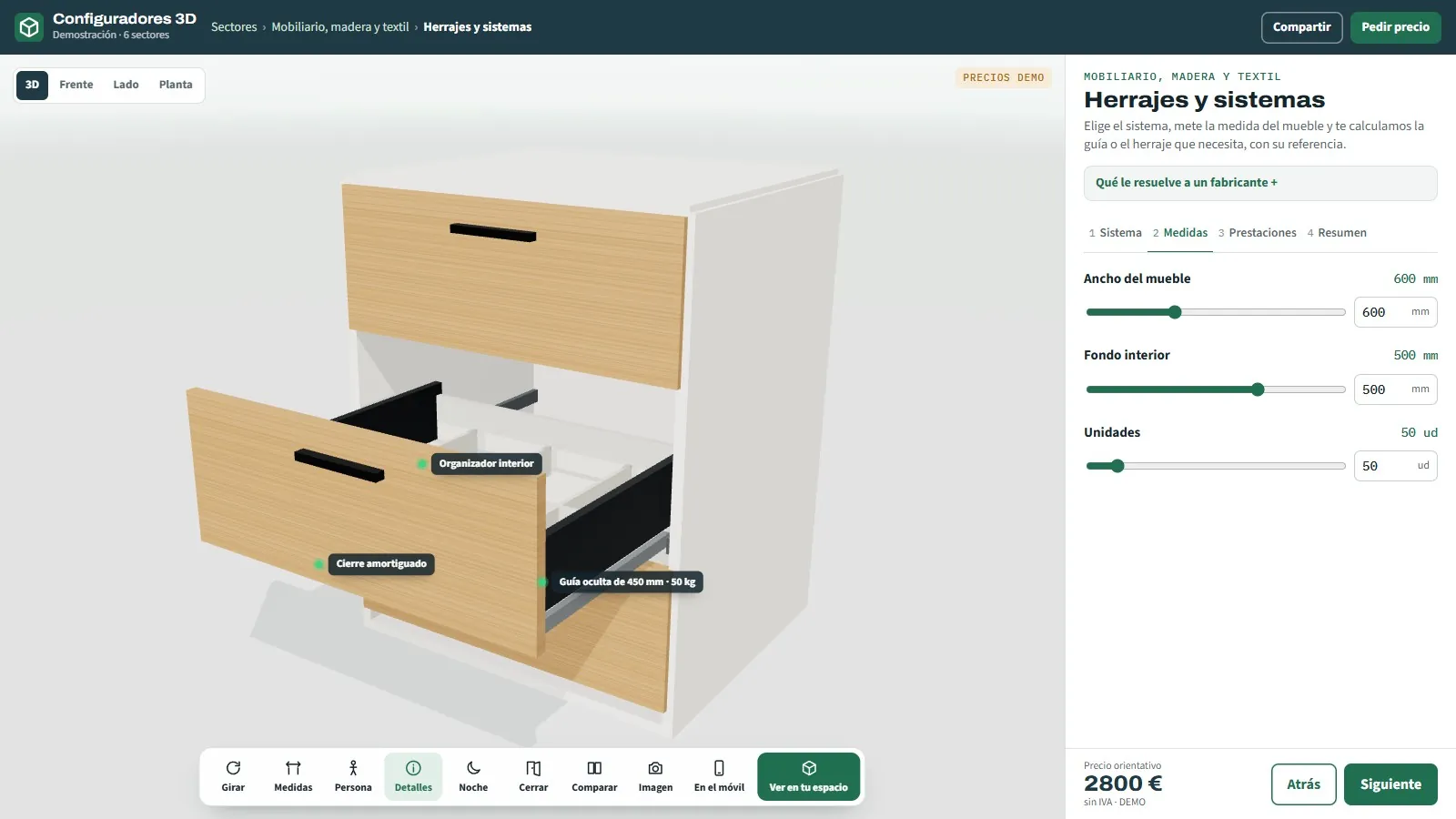
Fittings configurator panel with a 600 mm drawer, 500 mm internal depth, 50 kg load and the recommended runner
Answers · The joiner does not know which reference to order

They enter width, depth and load, and out comes the reference

The joiner picks the system, types in the width of the unit and the internal depth, sets the load and the configurator proposes the matching runner, with its length, the internal width of the drawer and the reference. With your compatibility rules underneath, no combination that does not exist can come out.

Runner calculation with its reference
Drawer with concealed runners and anthracite sides open in 3D, with the interior organiser in view
Answers · Catalogues hundreds of pages long

The fitting is seen working, not in a photo

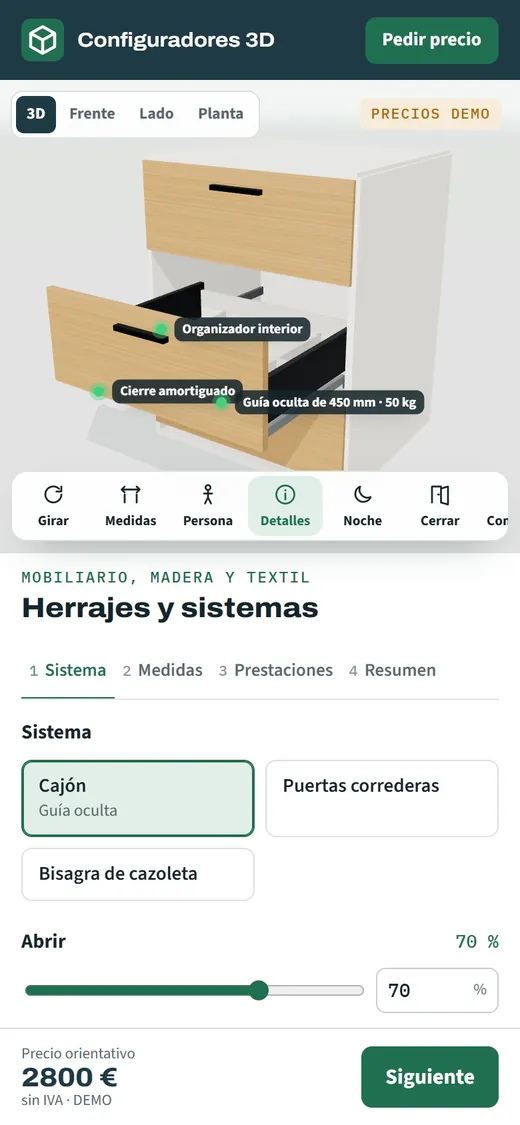
The drawer slides in and out in 3D, the sliding doors run and the hinge opens to 110 or 165 degrees. The joiner rotates the piece, sees the sides and the organiser inside and shows it to their customer on a phone. What was a photo in the catalogue is understood here by moving it.

Open and close in 3D
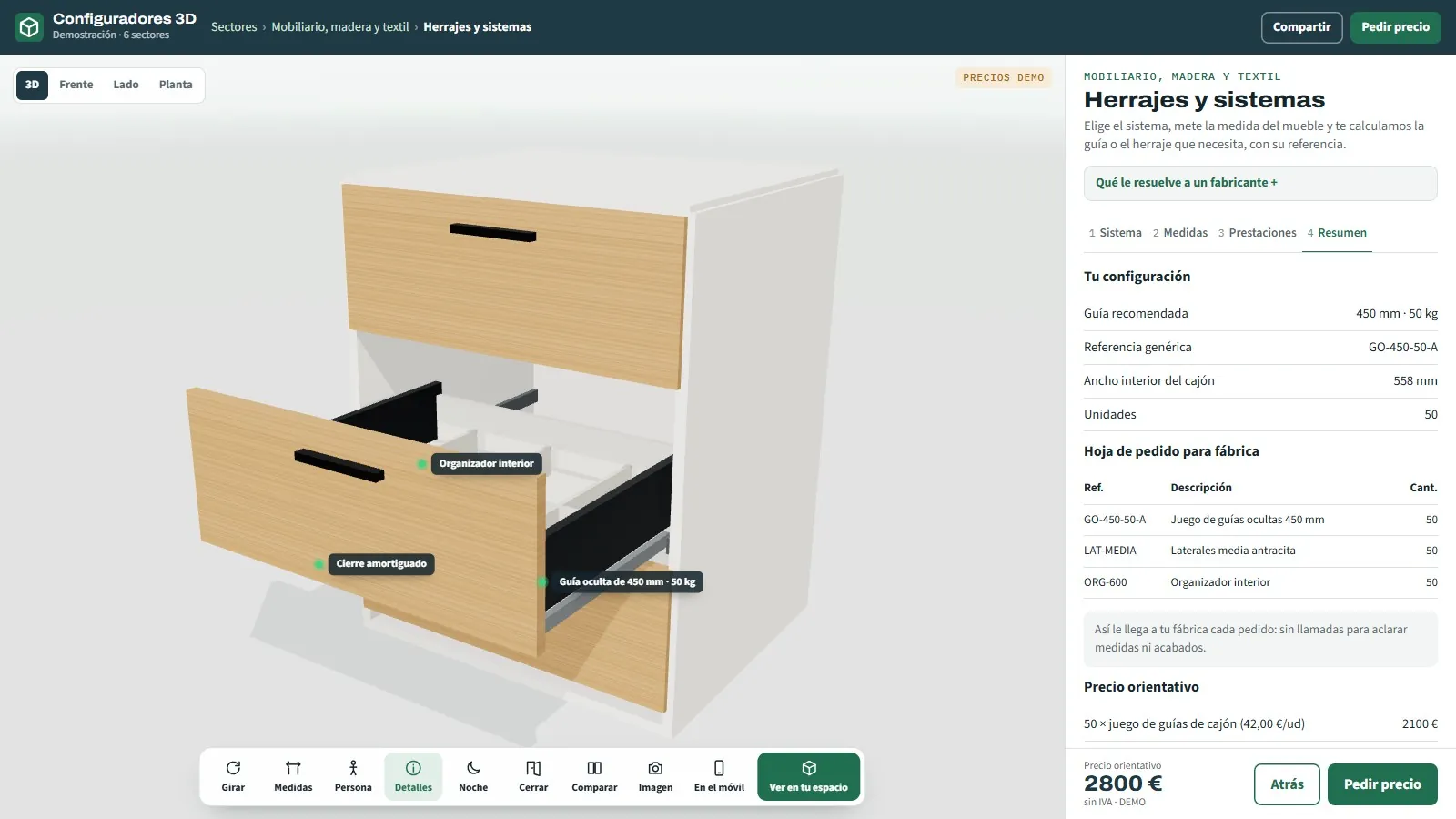
Fittings order sheet with 50 sets of 450 mm concealed runners, anthracite sides and interior organisers
Answers · Phone orders with mistakes

The order arrives written down, with references and quantities

At the end, every reference comes out on the order sheet with its quantity: sets of runners, sides with their height and finish, organisers. The joiner downloads the PDF and sends it to you; your warehouse picks it without interpreting what somebody understood over the phone. If you want, it goes straight into your ERP.

Order sheet with references
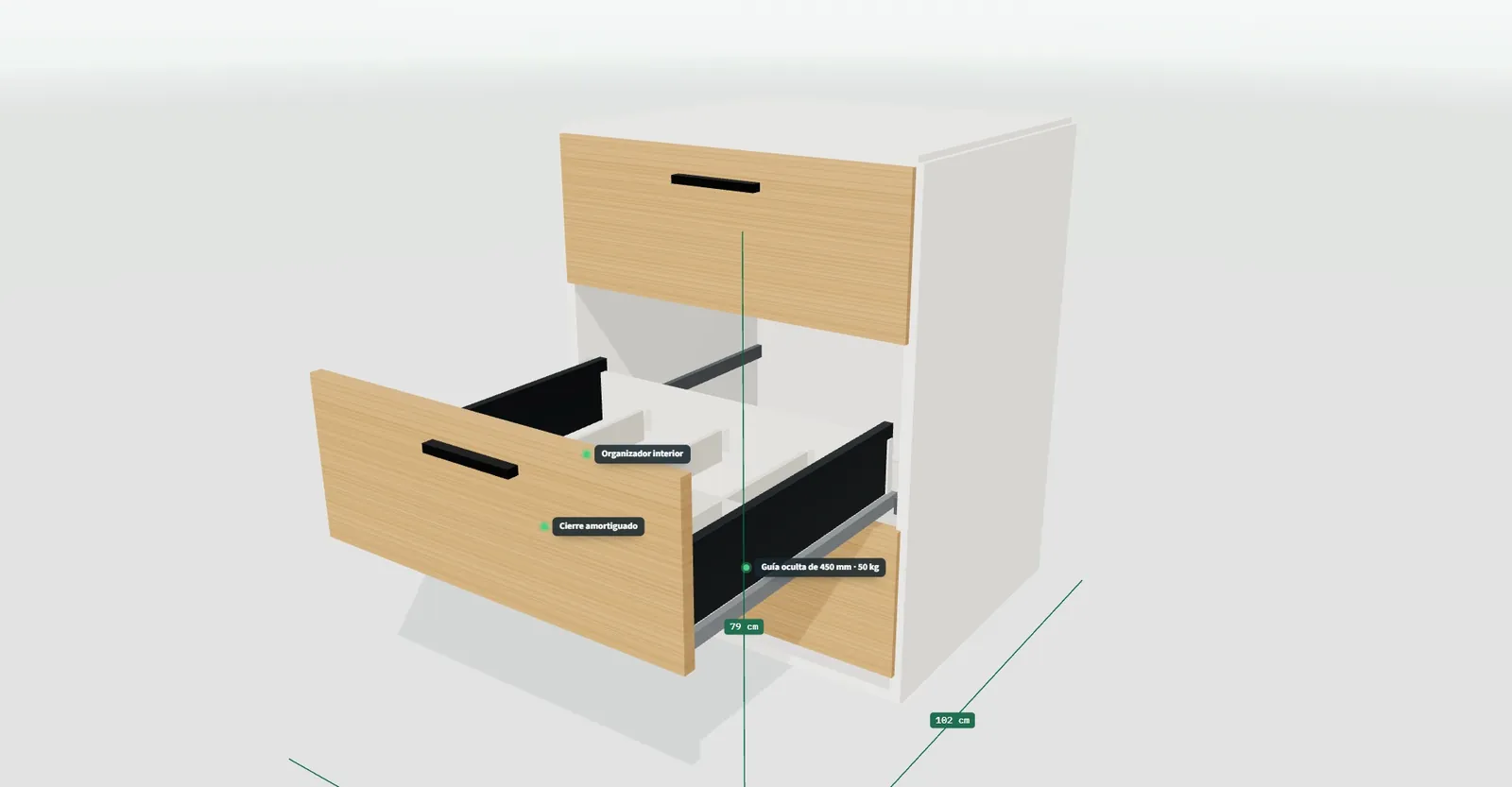
Drawer in 3D with labels showing the runner length, the permitted load and the internal width of the drawer
Answers · Loads and openings chosen by eye

Load and opening chosen with the unit in view

A load of 30, 50 or 70 kilos, opening angle, side height, soft close or push to open: every option changes the fitting in 3D and the reference proposed. The labels on the model explain what each thing is, with no need to call and ask.

Labels on the 3D
Fittings configurator on a phone with the drawer in 3D, the order quantities and the indicative price
Answers · Without a price, the joiner cannot close their kitchen

A price on the spot, with their trade rates

The joiner sees the indicative price of their order as they change the quantity, from 1 to 500. If you register them as a trade customer, they log into their area with your price list and their terms, and close their kitchen quote from site without waiting for your office.

Indicative price and a trade area
— TRY IT NOW

Try it
for
yourselves.

Choose “Drawer”, set 600 mm wide and 500 internal depth, change the load to 70 kg and watch how the recommended runner changes.

An open demo, with no registration, with example products and prices. It is designed for manufacturers, dealers and installers: private customers are welcome to try it, but we do not sell the product.

— INVESTMENT AND NEXT STEP

How many references get dictated over the phone every day?

With your runner and hinge tables in front of us, we show you how a joiner would find their reference on their own, without calling the counter.

From €6,500

Most projects for manufacturers fall between €14,500 and €35,000, depending on the catalogue, the manufacturing rules and the integrations. Maintenance and hosting from €190 a month. We start from a base that already works: you are not paying for development from scratch.

  • What is includedThe configurator with your products, your rules and your price list, embedded in your website and in your dealers' sites, with training for the sales team.
  • TimeframeBetween 3 and 16 weeks depending on the scope; the exact date goes in the proposal.
  • Payment terms40% to start, 40% with the test version and 20% at go-live.

Would you rather talk it through? Call 662 061 421 or write to grup3d@grup3d.es.
— FREQUENTLY ASKED QUESTIONS

What we
get asked.

There are more short answers in frequently asked questions about 3D configurators and who we are in 3D configurator company.

Can it work out the runner with our tables and our real references?

Yes, that is exactly what the bespoke development does. The demo uses generic references; in yours we load your tables of lengths, loads, side heights and finishes, with the compatibility rules your counter already applies. The result is your catalogue reference, the same one the warehouse picks.

Which fitting systems can be configured?

The demo includes a drawer with concealed runners, sliding doors for wardrobes and a cup hinge, with load, opening angle, side height, organiser, soft close, push to open and finish. With your catalogue we add the systems you sell, as long as they have clear size and compatibility rules.

How much does a fittings configurator cost for a distributor?

In a fittings configurator what weighs most is the tables: how many systems and references there are and how many compatibility rules connect them. It also matters whether you want it linked to your ERP. As a guide: developments start from €6,500 for a visual configurator of one product family; most projects for manufacturers fall between €14,500 and €35,000, depending on the catalogue, the rules and the integrations, plus maintenance from €190 a month. After reviewing your catalogue and seeing how your counter works, we send you the final figure in a written proposal.

Can joiners use it from site?

Yes, from a phone and with no app to download: a QR code stuck on the counter, on the rep's van or on your website is enough. The joiner measures the unit on site, enters the sizes, downloads the PDF with the order sheet and sends it to you from there.

Does it work for furniture manufacturers buying in volume?

Yes. Quantities run from 1 to 500 per configuration and the order sheet comes out with quantities per reference. A manufacturer preparing a batch of fifty identical units defines the drawer once and gets the sets of runners, sides and organisers counted for the whole batch.

Will we know who configured each order?

Yes. Every time a professional asks for a price or downloads the PDF, you receive their contact details along with the system, the sizes, the specifications and the quantities. If you have sales reps by area, each contact goes to the right one, and if you use a CRM it can go into it without being copied by hand.