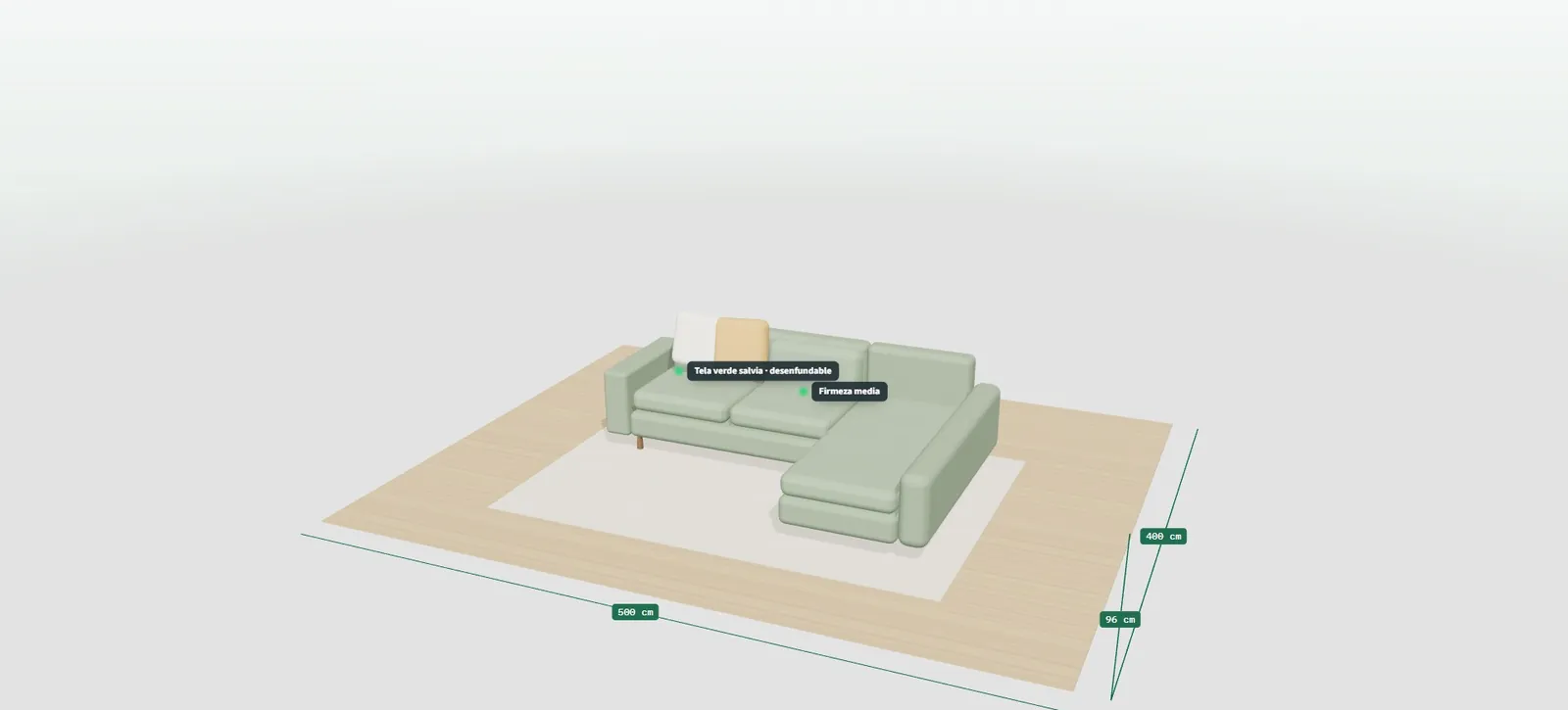
Detail of the 3D model of a modular sofa in the sofa configurator of the Grup3D demo, with the stitching and the fabric in view
GUIDE · MODELLING · FILES · FINISHES · PRICE PER PART · REUSE
— GUIDE FOR MANUFACTURERS · 2026

3D product modelling
for a configurator
what gets modelled and what it costs.

Every configurator starts with a 3D model of the product, but not the engineering one: a light one, made for the browser, that moves smoothly on the phone and shows what sells. Which files work as a starting point, which parts get modelled and which generate themselves from their dimensions, how true-to-life materials are made, what each part and each finish costs and what else the model is good for once it is done.

— WHAT YOU START FROM

What you start from
and how much each thing speeds it up.

Starting from clean 3D files speeds up the modelling; rebuilding every part from a photo or a scanned drawing adds hours.

BEST

3D files from design or from the supplier

The model from the design software used to manufacture, or the 3D files that suppliers of fittings, motors and components provide. They are cleaned, simplified and prepared for the web: the geometry is the real one.

GOOD

Dimensioned drawings

Elevation, plan and section in DWG or PDF with dimensions. Each part is modelled from the drawing; it takes longer than adapting a 3D file, but the result is exact.

WORKS

Photos and samples

Photos from several angles and the main dimensions, or a physical sample. The part is rebuilt by eye with the dimensions given; it is what adds the most hours and needs the most revisions.

With a sample of the 3D or the drawings and the price list, the modelling and finishes item is closed with figures, not estimates. What else is needed, in what a manufacturer needs for a 3D configurator.

— WHAT GETS MODELLED

What gets modelled part by part
and what is generated from dimensions.

The difference sets the price: what is generated from dimensions is not paid for per reference.

— MODELLED PART BY PART
  • Anything with a shape of its own: a handle, a profile, a headboard, a sofa module, a door panel, a light fitting, a motor. Every part of yours that has to be built in 3D, at €30 to €120 per part, or more if it is complex.
  • Anything that opens or moves: the sash that opens, the storage base that lifts, the drawer that slides out, with its movement.
  • Anything seen up close: stitching, edging, machining, the detail that sets your product apart on screen.
— GENERATED FROM DIMENSIONS
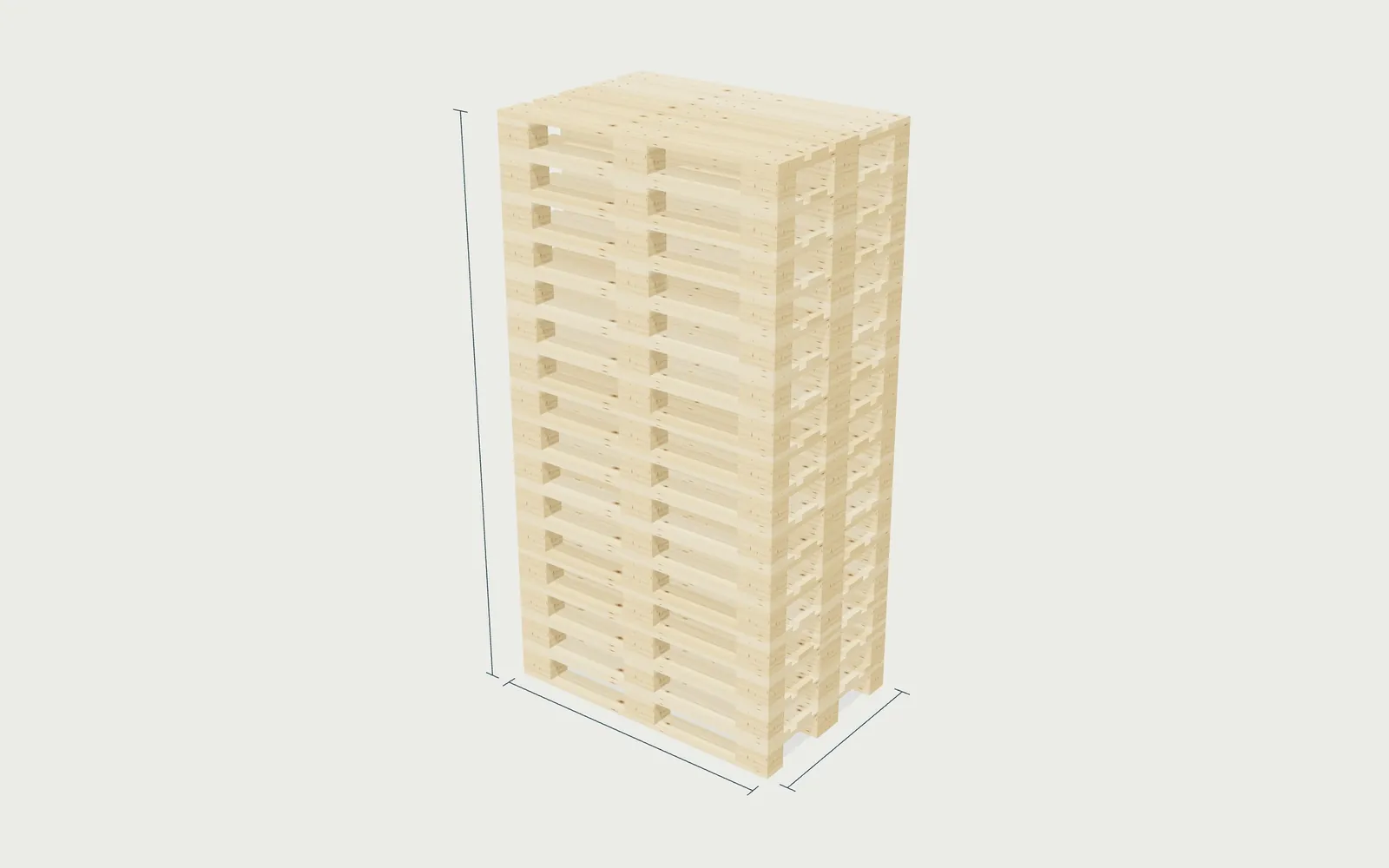
  • Anything that is a rule and some dimensions: a 1,200 × 800 pallet with its blocks, a 60 cm wide wardrobe module with its shelves, a 4-level shelving bay, a 1,400 × 1,200 window with its profiles. It is programmed once and every reference comes out.
  • Anything repeated at another size: the same profile at 1,200 or at 2,400, the same frame with 3 or 6 levels.
  • Result: if the product is generated from its dimensions, there is no modelling to pay for each reference. Hundreds of pallet or module references are not hundreds of parts.
Stack of pallets generated from dimensions in the 3D pallet catalogue of the Grup3D demo
The pallet demo: each reference is generated from its dimensions and its blocks; they are not modelled one by one.
— MATERIALS

Materials and finishes
true to life.

A finish in 3D is not a colour: it is how it reflects light, how the grain repeats and how it looks up close.

  1. 01

    From the photo or the sample to the material

    Every colour, wood, fabric or texture is built from a flat, well-lit photo, or from a physical sample, with its reference. Gloss, relief and repetition are adjusted so that oak does not look like plastic and velvet does not look like cardboard. At €30 to €120 per finish, or more.

  2. 02

    Only the ones you are going to show

    Materials are priced separately and per finish: that way you pay only for the ones you are going to show. A range of 40 decors can start with the 12 that sell most and grow later.

  3. 03

    In families, with their surcharge

    Fabrics in families with their surcharge, decors with their matching edging, colours per series. The finish is seen on the whole product, not in a little square, and carries its reference to the order sheet.

  4. 04

    Changing the range without touching the design

    Finishes are loaded with a template and updated from the panel: a decor that leaves the catalogue is deactivated and a new one is added with its photo and its reference. See board decor configurator.

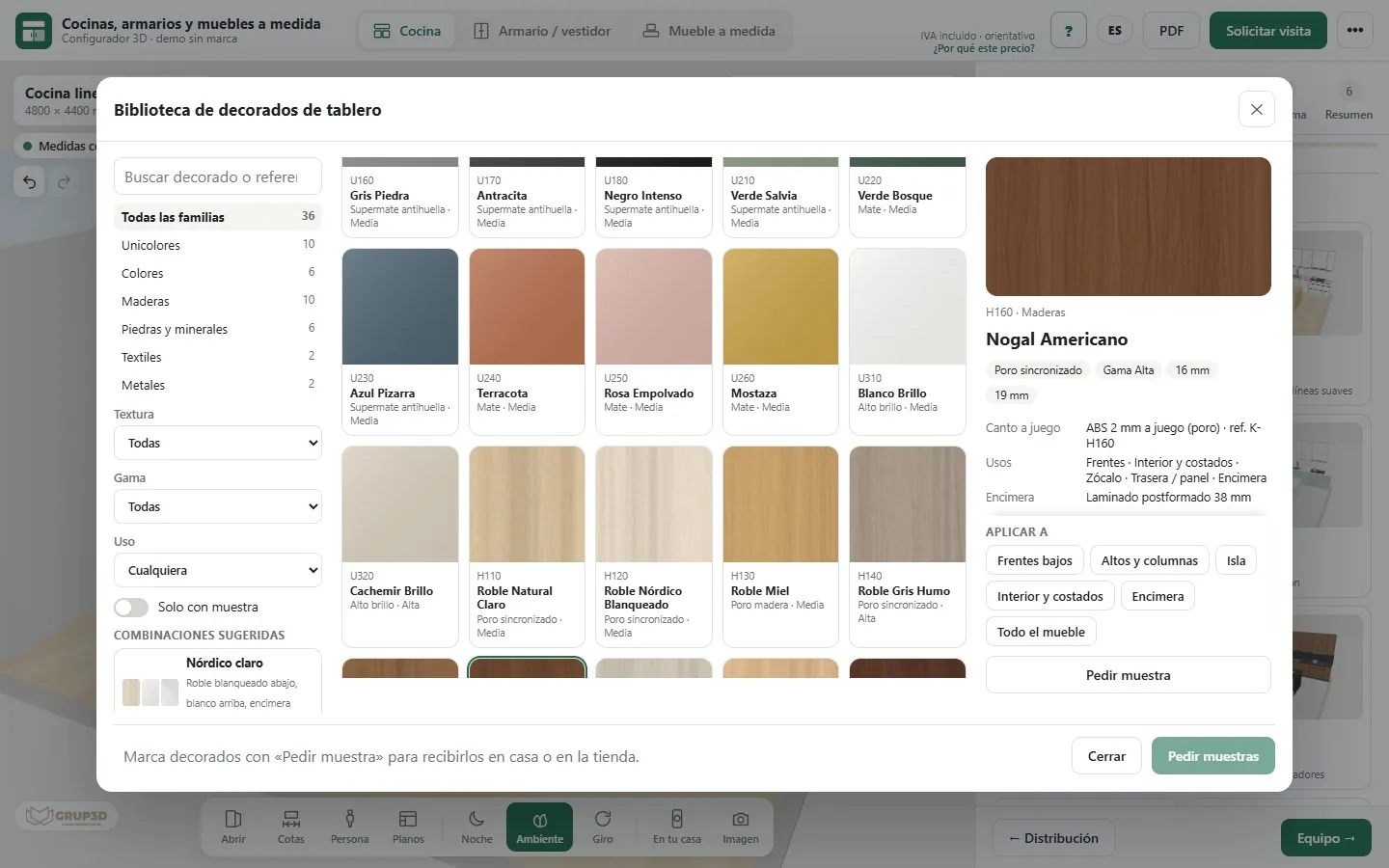
Decor library of the 3D board decor configurator from the demo, with the families and the references
The finishes library in the decor demo: families, references and matching edging. Our own textures, as samples.
— WHAT ELSE IT IS FOR

One model,
four uses.

What is paid for once for the configurator serves for everything else.

01 · CONFIGURATOR AND VIEWER

On the website and on the product page

The configurator on the website and the viewer on each product page use the same model. See 3D product viewer for your website.

02 · PRODUCT RENDERS

Photos of every combination

Images of the product in every finish and in a setting for the catalogue, the website and social media, with no photo shoot and no samples manufactured. See product rendering.

03 · AUGMENTED REALITY

At real size, in the customer's home

The same model opens on the phone at real size on the wall, the terrace or the parking space, with no app to install.

04 · ANIMATION AND VIDEO

How it is assembled and how it works

The assembly or operation animation for the trade fair, the training of the network and the product page starts from the same model. See 3D industrial video.

Development starts from €6,500 for a visual configurator of one product family; most manufacturer projects fall between €14,500 and €35,000, depending on catalogue, rules and integrations, plus maintenance from €190/month. 3D modelling and materials or finishes are priced separately, per product: at €30 to €120 per part or finish, or more if the part is complex. The configurator files and the 3D models are handed over: they are yours.

— FREQUENTLY ASKED QUESTIONS

What we get asked
about modelling.

There are more short answers in frequently asked questions about 3D configurators and who we are in 3D configurator company.

Is 3D modelling included in the price of the configurator?

No. 3D modelling and materials or finishes are priced separately, per product: at €30 to €120 per part or finish, or more if the part is complex. If the product is generated from its dimensions, like pallets or kitchen and wardrobe modules, there is no modelling to pay for each reference.

Which files do we have to provide for the modelling?

Ideally, the 3D files from the design software or from the component suppliers; if not, dimensioned drawings in DWG or PDF; and if not, photos from several angles with the main dimensions or a physical sample. The cleaner the starting point, the fewer hours and the fewer revisions.

Is the factory model used on the website?

No. The engineering model weighs hundreds of times more than a browser can handle; it is used as a reference and a light model is built that loads fast and moves smoothly on the phone, with detail where it is seen and without it where it is not.

Do the finishes look like the real ones?

Yes, when they are built from a flat, well-lit photo or a physical sample, adjusting gloss, relief and repetition. In the demos the textures are our own, as samples; in your configurator go yours, with their reference and their family.

Can we add finishes or parts later?

Yes. Finishes are loaded with a template and updated from the panel; new parts are modelled and priced per part when they are needed. The usual thing is to start with what sells most and grow.

Who owns the 3D models at the end?

You do. The bespoke development belongs to the manufacturer who pays for it, and the configurator files and the 3D models are handed over; they also serve for the viewer, the product renders, augmented reality and the animation. See who owns the configurator's code and the price of a 3D configurator.

— OPEN DEMO

Try it now
or see it with
your range.

Take a close look at the modelling in the demos: the sofa's stitching, the decor's edging, the window's fitting, the pallet generated from dimensions. No sign-up, with sample products, at configurador.grup3d.es/demo.

With your files in front of you? Send us a sample of the 3D or the drawings of one product and the list of finishes, and in a 20-minute video call we will tell you what gets modelled, what is generated from dimensions and what it would cost. No commitment.

Would you rather talk it through? Call us on 662 061 421 or write to grup3d@grup3d.es.