Order errors
Parts made again per year because of handing, size or colour noted down wrong, times what it costs to make, deliver and fit each one. Example: 12 × €350 = €4,200. See reducing order errors in the factory.
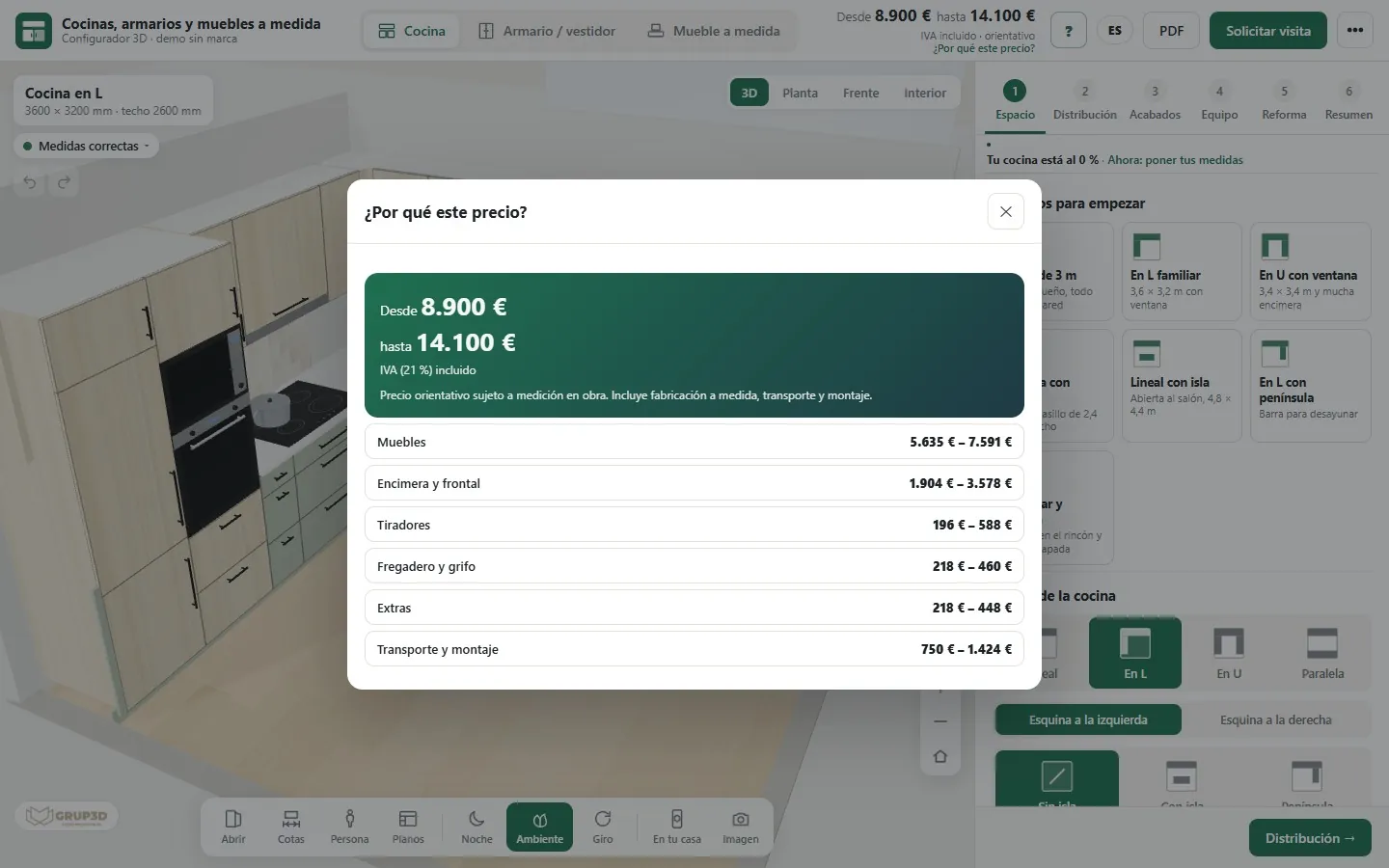
The account for a 3D configurator has two columns and almost nobody fills in both. In the cost column go the development, the modelling of your parts, the maintenance and your hours. In the return column, what almost nobody writes down: the parts no longer made twice, the technical-office hours no longer spent on quotes that never close, the extras that sell because they are seen and the requests that arrive with the configuration done. Here are both columns with sample figures, so you can put in your own.
Five lines. The last two never appear in any proposal and they count too.
| Line | Example | What it is |
|---|---|---|
| Development | €14,500 | Configurator with rules, price, PDF, order sheet and panel |
| 3D modelling and finishes | €2,640 | 20 parts and 24 finishes at €60 each; €30 to €120 per part or finish |
| Maintenance, first year | €2,280 | €190/month: hosting, updates, panel and support |
| Your hours | 30 h | Rules meetings, price list in the template, version reviews, training |
| What does not get done meanwhile | — | The time the team spends on the project instead of on something else |
| Total first year | €19,420 + 30 h | From the second year on: the maintenance |
Development starts from €6,500 for a visual configurator of one product family; most manufacturer projects fall between €14,500 and €35,000, depending on catalogue, rules and integrations, plus maintenance from €190/month. The three levels, in the price of a 3D configurator.
Six lines. Each one has a figure you already know or can work out in an afternoon.
Parts made again per year because of handing, size or colour noted down wrong, times what it costs to make, deliver and fit each one. Example: 12 × €350 = €4,200. See reducing order errors in the factory.
Orders per month with one part missing (end caps, clips, anchors), times what it costs to prepare and ship what was missing. Example: 6 × €40 × 12 = €2,880.
Quotes per week times the time each one takes, minus the ones that close. Example: 15 quotes × 40 minutes × 48 weeks = 480 hours a year, of which the configurator does the first version. At €25/hour: €12,000.
Roller shutter, motor, LED strip, side enclosure, tall headboard: the extra that is seen in 3D gets ordered more than the one on a list. Measure it with the average order value before and after. Example: 300 orders × €1,200 × 5% = €18,000.
Requests per month with sizes, finishes and an indicative price, versus “send me information” with no data. What changes is the closing rate and the time per request. See generating leads with a 3D configurator.
The images of every combination come out of the same 3D model, with no photo shoot and no manufactured samples; and the calls to the factory for a figure (outside dimension, weight, which power supply) are answered by the configurator. See product rendering.
With the figures above. Do not take our word for it: fill in the six lines with your own.
| Line | First year | Each following year |
|---|---|---|
| Cost (development, modelling, maintenance) | €19,420 | €2,280 |
| 01 · Parts not made twice | €4,200 | €4,200 |
| 02 · Shipments of what was missing | €2,880 | €2,880 |
| 03 · Technical-office hours | €12,000 | €12,000 |
| 04 · Extras that are seen | €18,000 | €18,000 |
| Total return | €37,080 | €37,080 |
| Difference | +€17,660 | +€34,800 |
If your figures are half those in the example, the account still works out in the first year. If they are a quarter, it works out in the second. What never works out is a configurator that is not used: that is why training the team and the links from the website and the network are part of the project, not separate.
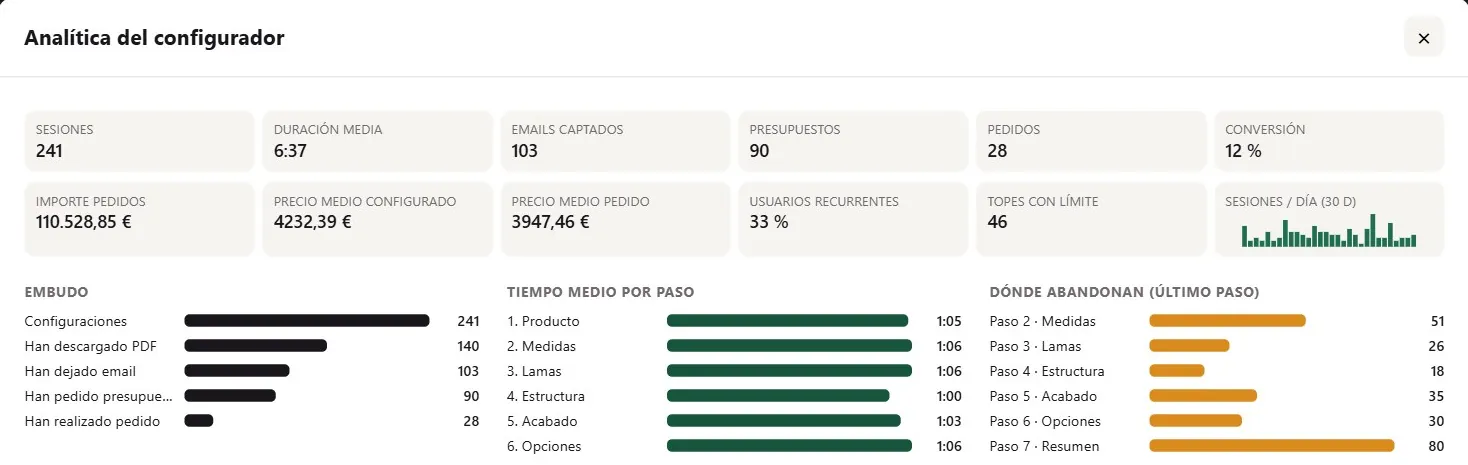
Five figures that come out of the panel and your office, without setting up anything else.
From the panel. Compare them with the previous year's website enquiries and their closing rate.
For three months, note down how many parts get repeated and how many orders go out incomplete. It is the figure most often forgotten and the one that hurts most.
Before: the time to draw, calculate and write. After: the time to review what the configurator already did.
From your management software: the average amount and which extras each order carries, before and after the configurator.
From the configurator analytics: most opened families, abandoned steps, finishes nobody asks for, sizes outside the limits. Useful for the price list and the catalogue, not just for the account. See benefits of a 3D configurator and what to measure in each one.
There are more short answers in frequently asked questions about 3D configurators and who we are in 3D configurator company.
It depends on your figures, but with the lines that weigh most (parts not made twice, technical-office hours on quotes and extras that sell because they are seen) the sample account works out in the first year and, with half those figures, it still does. With a quarter, in the second year.
What stops costing: the parts no longer repeated because of an order noted down wrong, the shipments of what was missing and the technical-office hours on quotes that never close. Then, what it sells extra: the extras seen in 3D and the requests that arrive with the configuration done.
For three months, note down how many parts get made again and how many orders go out with something missing, and multiply by what it costs to make, deliver and fit each one. They are usually more than they seem, because half of them get fixed without anyone writing them down.
The 3D modelling and finishes of your parts (€30 to €120 per part or finish, or more), maintenance from €190/month and your hours: rules meetings, price list in the template, version reviews and training. About 30 hours in a normal project.
Yes. The panel gives the requests and the configurator analytics; your management software gives the average order value and the extras per order; and orders with errors are counted by hand for three months. With those five figures the account gets filled in.
Development starts from €6,500 for a visual configurator of one product family; most manufacturer projects fall between €14,500 and €35,000, depending on catalogue, rules and integrations, plus maintenance from €190/month. Details in the price of a 3D configurator.
See in the pergola demo the analytics used to measure what gets configured and what gets ordered, with sample data and no sign-up, at configurador.grup3d.es/demo.
Want the account with your figures? Tell us how many quotes you do a week, how many you close and how many parts you repeat a year, and in a 20-minute video call we will fill it in together. No commitment.
Would you rather talk it through? Call us on 662 061 421 or write to grup3d@grup3d.es.
Ten benefits of a 3D configurator for a manufacturer and what to measure in each one: visits, order errors, extras sold, technical office and leads.
Read →The six most expensive order errors in made-to-measure product (handing, size, colour, missing part, rule, retyped order) and how a configurator avoids them.
Read →The index with one card per configurator, filtered by sector, with their open demos.
Read →For manufacturers and for those who sell without a factory: what we do, how, and at what price.
Read →Price, code, cutting lists, online shop, mobile, AI and every sector.
Read →The three levels, what each one includes and what is priced separately.
Read →