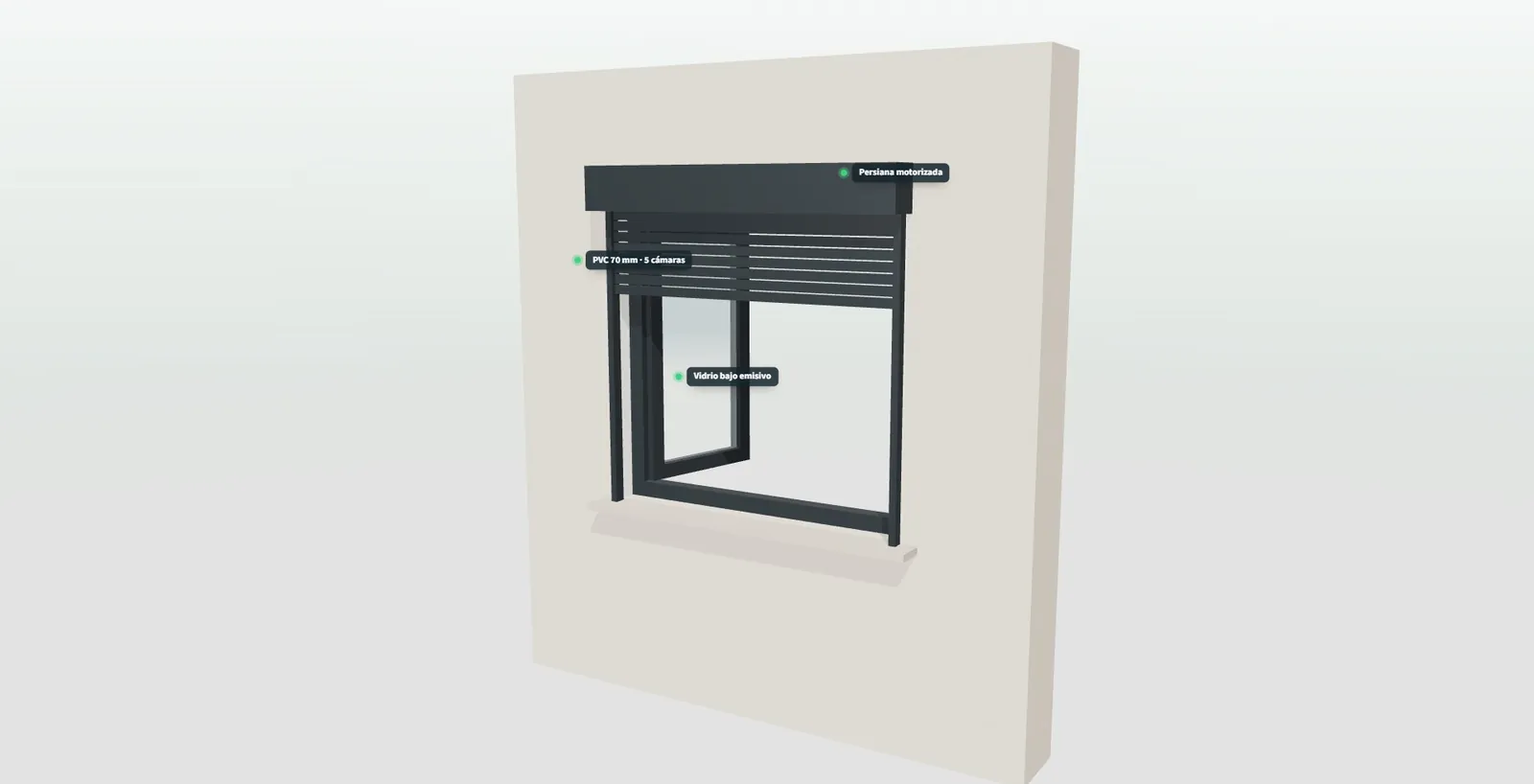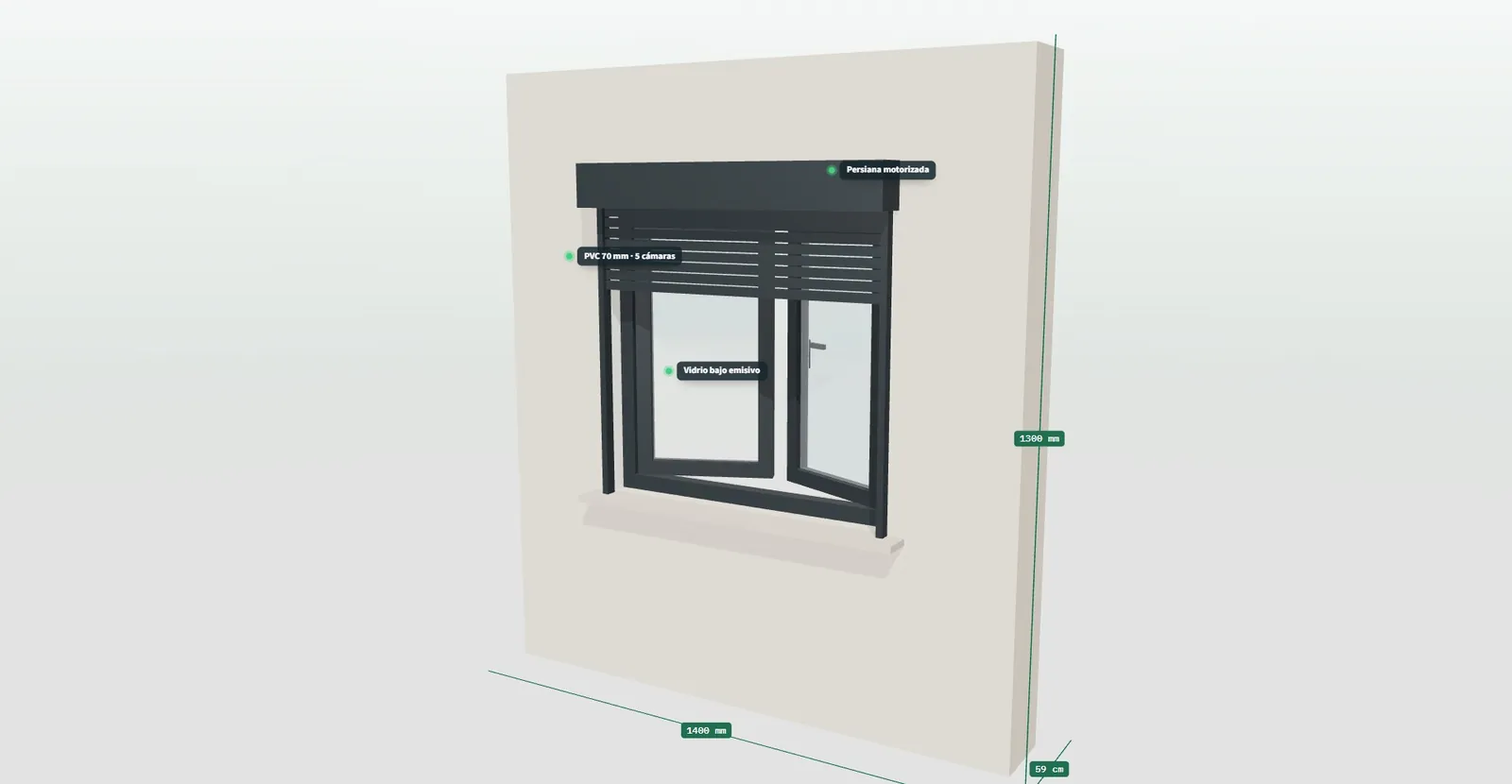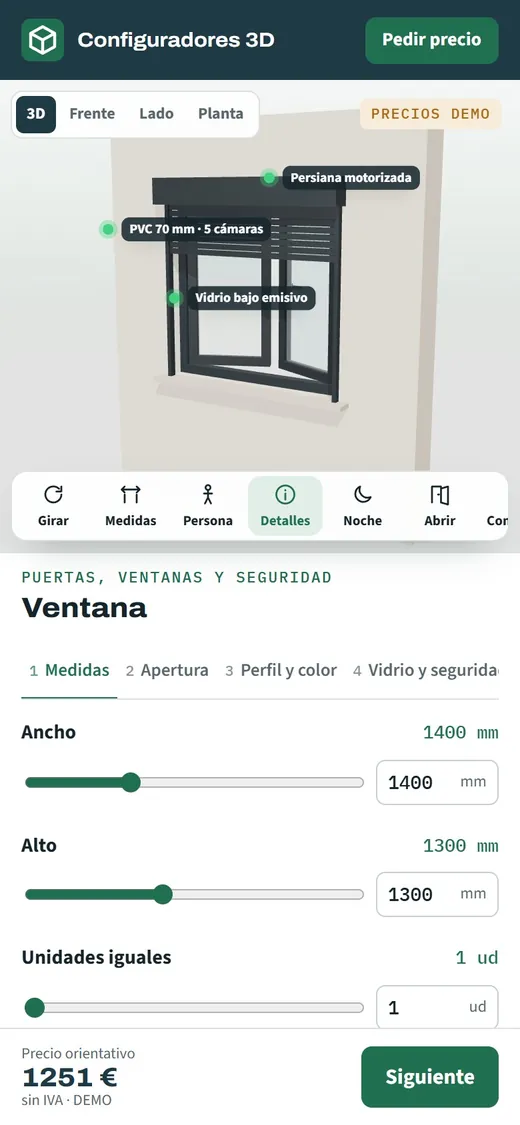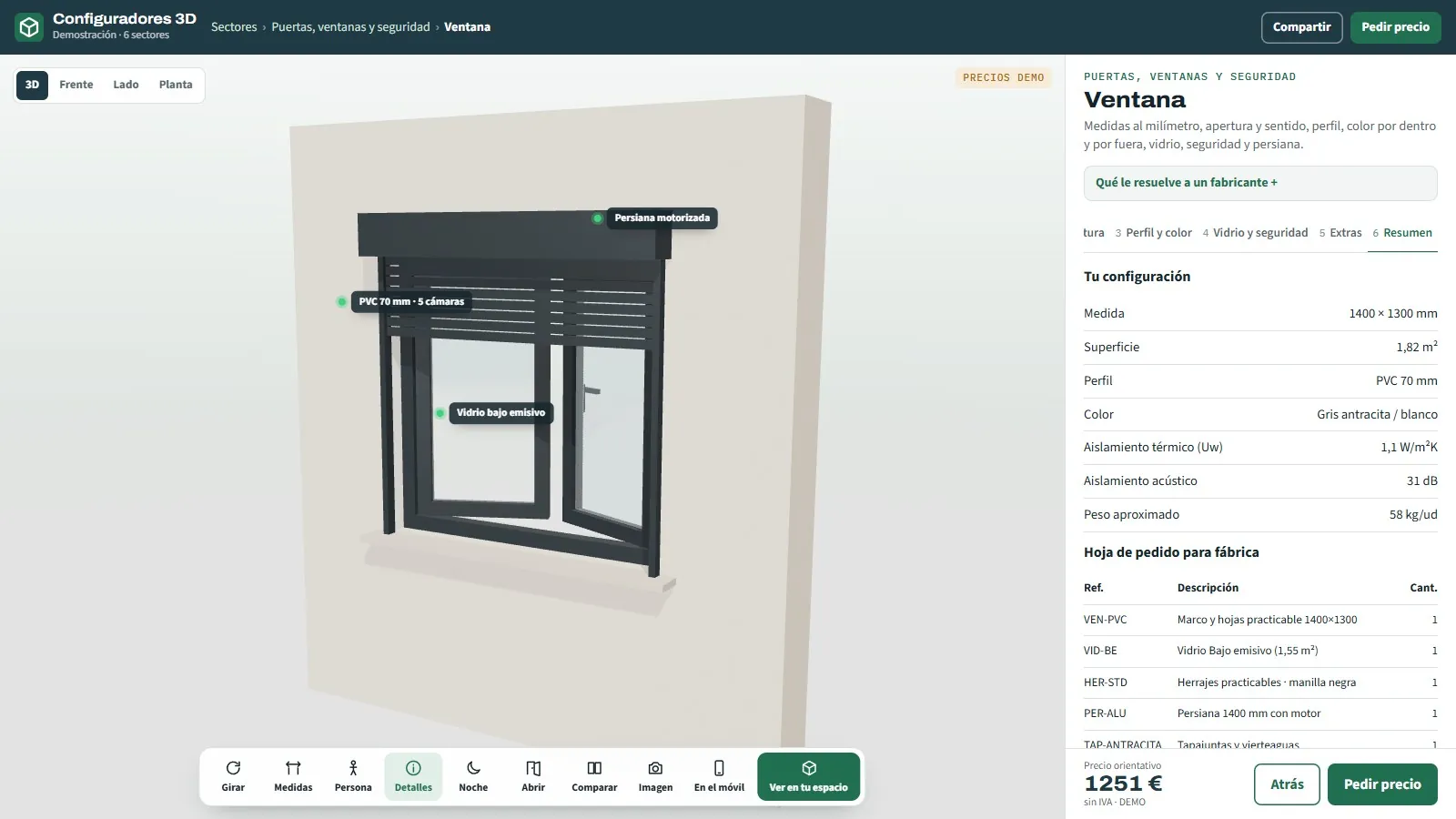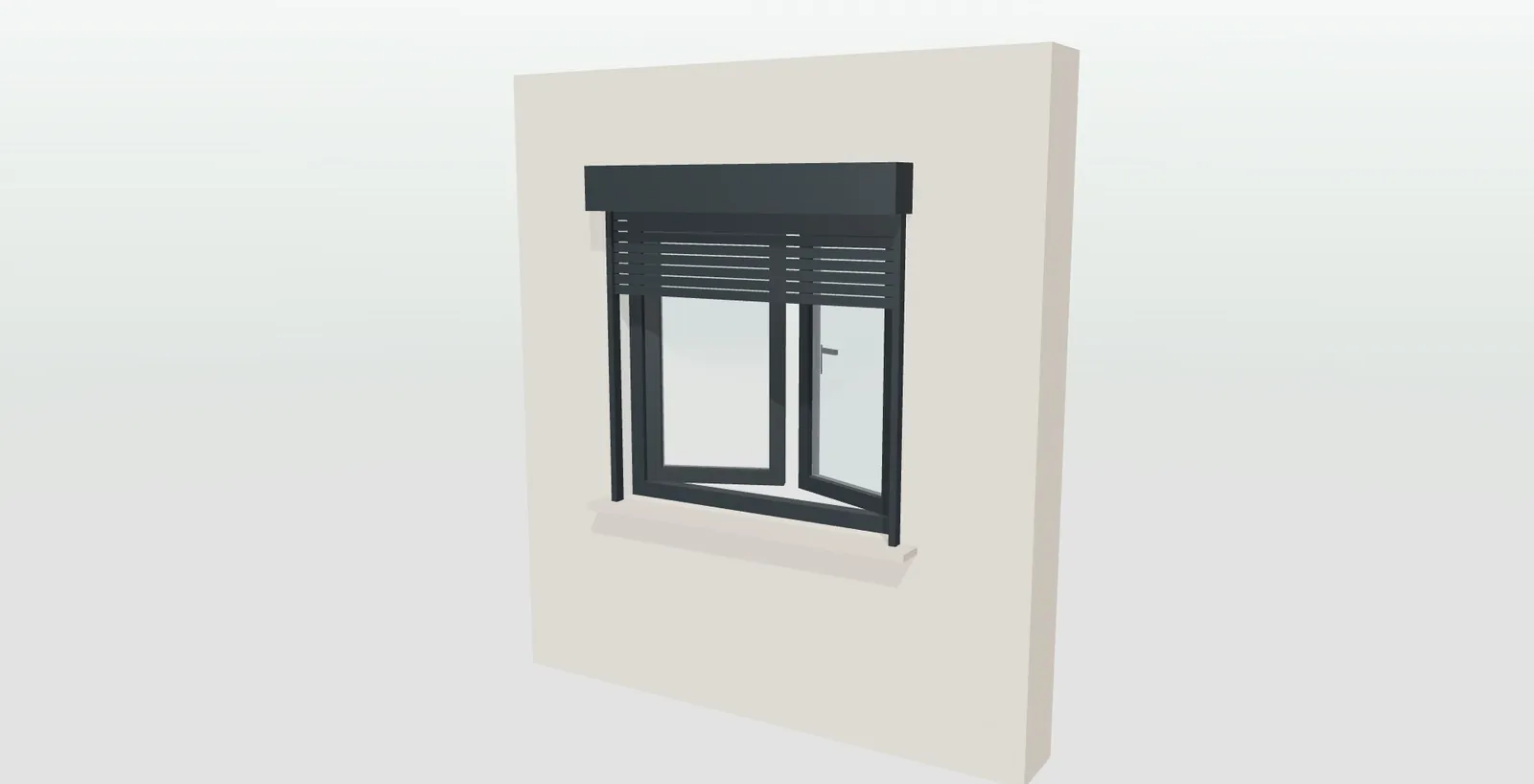
Anthracite grey PVC window with a motorised blind and dimensions in the 3D window configurator
DOORS, WINDOWS AND SECURITY · OPEN DEMO
— MANUFACTURERS AND THEIR DEALER NETWORK

3D configurator
for windows
made for manufacturers.

Your dealers send orders as photos of hand sketches, with the opening direction half written and the glazing not mentioned at all. The technical office loses the morning asking questions and the window that comes out wrong gets made twice. There is another way: let the dealer send you the window already seen, measured and with every option chosen.

— WHAT HAPPENS TO YOU

Tuesday, 8:40.
Seventeen orders
and not one of them complete.

The technical office opens the inbox and the company WhatsApp. Seventeen dealer orders have come in since Friday. Some are photos of a sketch on squared paper; others a quick message: “2 tilt-and-turn left 120 × 140 anthracite, blind with motor”. Nobody says whether left is seen from inside or from outside, whether the interior is white, or which glazing the end customer wants. Before anything goes to production, someone has to call every installer, who at that hour is up on scaffolding and does not answer.

Your network has thirty-five dealers, four profile ranges and six opening types. The price list has room for every combination, but the installer's head has room for three: the two-leaf casement in white, the sliding one and, if the customer insists, anthracite. High-efficiency PVC, acoustic glazing or wood-aluminium stay in the catalogue, because explaining them in the customer's kitchen costs more than selling them. And when the private customer asks for a price, the dealer asks you and waits.

On Thursday, the coastal dealer's order leaves the factory. The following Monday, on site, the leaf opens the wrong way because the “left” on the sketch was seen from the street. Nobody lied: each of them looked at it from a different place. But the window goes back, is taken out, is made again, and the end customer spends two weeks with a sheet of plastic in the opening. And everyone in the technical office knows it will not be the last time.

— WHERE THE SALE LEAKS AWAY

The bottlenecks
you will recognise
straight away.

“Give me a price for a 120 × 140, the customer is in a hurry”

Quotes that take days

The dealer has the customer in front of them and asks you for a price with one dimension and little else. Your office has to ask about opening type, profile, colour, glazing and blind before calculating anything. Between calls and the work queue, the quote goes out two or three days later, when the customer has already asked two competitors.

What it costs youThe job goes to whoever answers first, not to whoever manufactures best.
“Left, looking from the street”

The opening direction written down wrong

Left and right depend on where you are looking from. If the sketch does not say, the window can be perfect in size and open the wrong way. The same goes for the interior colour, the handle or the side of the blind box: small details discovered when the installer is already on site with the window in their hands.

What it costs youA window manufactured, transported and fitted twice.

“Around here we always sell the usual white one”

The full range never reaches the customer

You have an 82 mm profile, aluminium with a thermal break, wood-aluminium and six different glazing options. The dealer shows a colour sample on a card and a catalogue that is no longer updated. If the private customer cannot see the difference between low-emissivity and acoustic glazing, they choose on price and end up with the basic option.

What it costs youThe ranges with the best margin stay in the catalogue.

“And what if we make it sliding? And in oak?”

Every change is another quote

The end customer hesitates between tilt-and-turn and sliding, between anthracite and oak, with or without a motorised blind. Every doubt goes back to the dealer, who comes back to you, and you redo the calculation. Three versions of the same window occupy the technical office like three different orders, even though only one gets made.

What it costs youHours of technical office time that never get invoiced.

“I will send it on WhatsApp, the template will not open for me”

Orders that have to be typed in again

Every dealer sends orders their own way: a photo, an email, a voice note or an old template. Someone in your office types them into the production sheet by hand, window by window, with the references for frame, glazing, hardware and blind. Any figure copied wrong reaches the saw exactly as it is.

What it costs youMistakes nobody made on purpose, paid for by the factory.

— DO THE MATHS

What it costs you
today, with
your own numbers.

Put in your own numbers. The example is a medium-sized manufacturer with a dealer network; replace each value with yours.

orders
h
€
MONTHLY COST OF CLARIFYING AND TYPING ORDERS BY HAND 0

€ a month

The values are an example: replace them with yours. The calculation is a simple multiplication and does not come from any study.

— HOW IT IS SOLVED

Every bottleneck,
with its
answer.

Window configurator screen with sizes, opening type, profile and an indicative price recalculated live
Answers · Quotes that take days

The dealer gives the price with the customer there

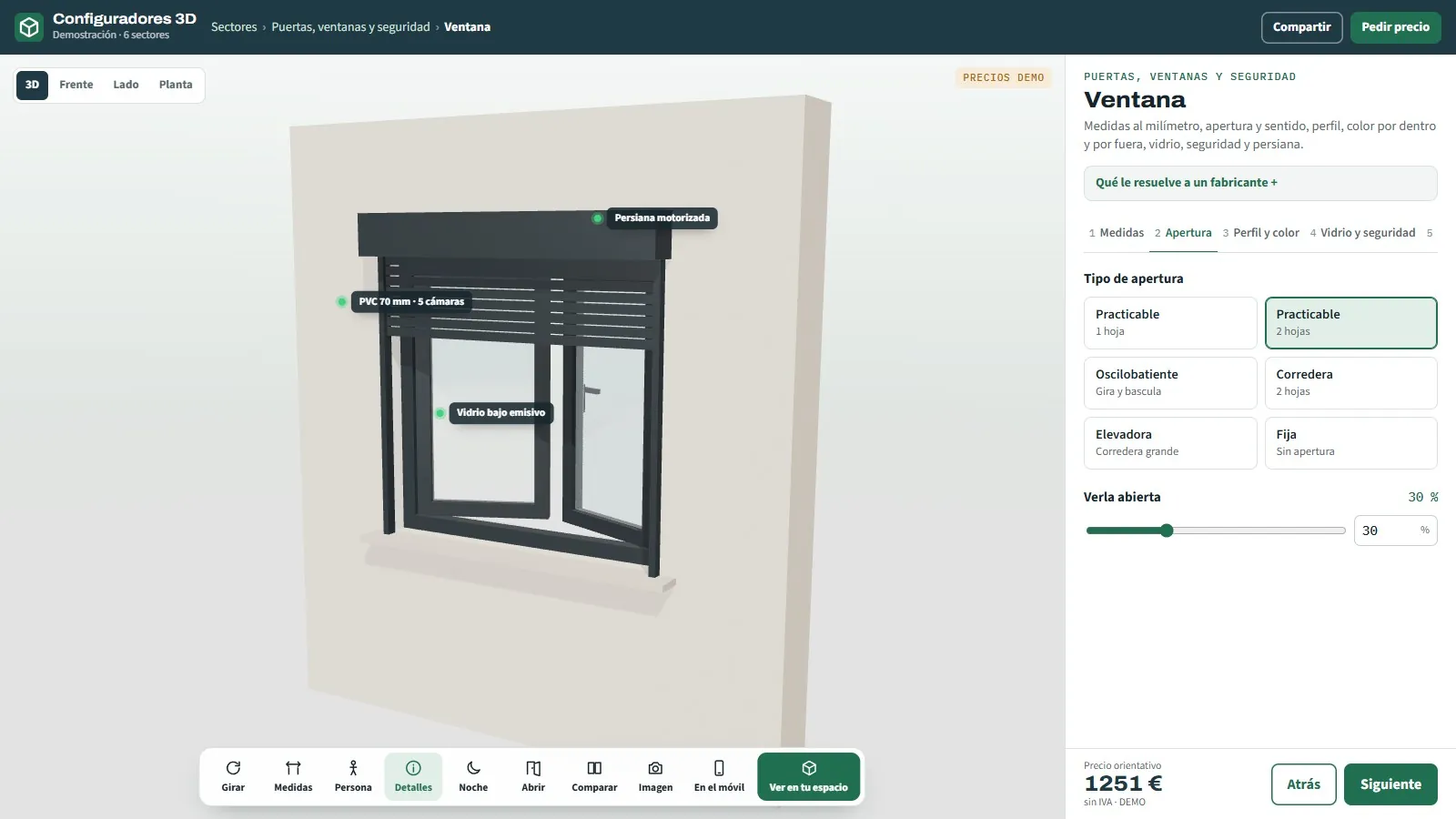
The dealer enters width and height to the millimetre, chooses opening type, profile, colour and glazing, and sees an indicative price that recalculates with every change. With your price list and your dealer discounts behind it, the customer leaves the shop with a figure and an image, not with “I will call you”.

An instant indicative price with your price list
Two-leaf casement window open in 3D with the hinges visible to check the opening direction
Answers · The opening direction written down wrong

The opening direction is seen before it is made

The window opens and closes in 3D with a button. The direction is chosen looking from inside, with the hinges in view, and that is how it goes into the order. If the customer rotates the window and looks at it from the street, they see exactly what the installer will see when fitting it.

Open and close in 3D with the direction locked in
Close-up of the window in 3D with labels explaining the profile, the low-emissivity glazing and the blind with its box
Answers · The full range never reaches the customer

Your whole range fits on the dealer's tablet

The private customer sees what they are paying for and stops choosing on price alone. The four profile ranges, the seven exterior colours with a white interior, the six glazing options, the RC2 security hardware and the motorised blind all appear with their price. On the window itself, a label explains what each type of glazing brings, without the installer having to know the data sheet by heart.

Labels and details on the window in 3D
Window configurator open on a phone to compare several versions of the same window at home
Answers · Every change is another quote

Three versions, one single enquiry

The customer saves the tilt-and-turn in anthracite, the sliding one in oak and the version with a motorised blind, and compares them side by side with the differences highlighted: price, insulation, weight. They decide at home, with the QR code on their phone, without your office redoing a single calculation.

A comparison tool for up to three options
Summary of the configured window with the factory order sheet, references for frame, glazing, hardware and blind
Answers · Orders that have to be typed in again

The order arrives ready for production

At the end it produces the factory order sheet with references and quantities: frame and leaves, glazing with its surface area, hardware and handle, blind with motor, trims and sill. It can follow your manufacturing rules and go into your ERP, instead of going through someone's keyboard.

Factory order sheet
— TRY IT NOW

Try it
for
yourselves.

Pick a two-leaf casement, change the hinge side, press Open and rotate the window to see it from the street.

An open demo, with no registration, with example products and prices. It is designed for manufacturers, dealers and installers: private customers are welcome to try it, but we do not sell the product.

— INVESTMENT AND NEXT STEP

Bring your ranges and your price list

In 20 minutes we show you the demo with a window similar to yours and look at what it would take for your dealers to order with it.

From €6,500

Most projects for manufacturers fall between €14,500 and €35,000, depending on the catalogue, the manufacturing rules and the integrations. Maintenance and hosting from €190 a month. We start from a base that already works: you are not paying for development from scratch.

  • What is includedThe configurator with your products, your rules and your price list, embedded in your website and in your dealers' sites, with training for the sales team.
  • TimeframeBetween 3 and 16 weeks depending on the scope; the exact date goes in the proposal.
  • Payment terms40% to start, 40% with the test version and 20% at go-live.

Would you rather talk it through? Call 662 061 421 or write to grup3d@grup3d.es.

— FREQUENTLY ASKED QUESTIONS

What we
get asked.

There are more short answers in frequently asked questions about 3D configurators and who we are in 3D configurator company.

Can we load our own profile ranges, colours and glazing?

Yes. The demo uses a generic example range; in the bespoke development we load your ranges, your opening types, your colour chart and your glazing, with the combinations you actually manufacture. If a range does not allow a lift-and-slide or a colour only exists in one range, the configurator will not let anyone choose it.

Does it respect the maximum and minimum manufacturing sizes?

Yes, your manufacturing rules are programmed in: minimum and maximum sizes by opening type and range, maximum weight per leaf, when a reinforcement is needed or when a slider has to become a lift-and-slide. If the dealer asks for something that cannot be made, they see it on screen before sending it.

Can each dealer work with their own prices?

We can set up a dealer area where each one logs in with their own account, works with their discount and their margin and, if you want, presents the window to their customer under their own brand. Contacts coming from your website can also be assigned to the dealer for each area.

How much does a 3D window configurator cost?

Developments start from €6,500 for a visual configurator of one product family; most projects for manufacturers fall between €14,500 and €35,000, depending on the catalogue, the rules and the integrations, plus maintenance from €190 a month. With windows, what moves the figure most is the number of ranges and opening types, the manufacturing rules that have to be programmed, the dealer area and the connection to your ERP. The most practical thing is to see the demo with your range in front of you and close the scope with concrete numbers, with no surprises later.

Can the customer see the window in their own home?

Yes. From their phone, with the QR code, they can place it at real size on their wall in augmented reality, with no app to install. They can also save an image or the PDF of their configuration to show at home before deciding between sliding and tilt-and-turn.

Does it also work for balcony doors and large window walls?

The demo goes up to 3.5 metres wide and 2.5 metres high and includes the lift-and-slide for large openings. If you manufacture balcony doors, combined fixed lights or multi-leaf compositions, they are added in the bespoke development with your rules and your price list, like the rest of the range.