How many boxes do I need?
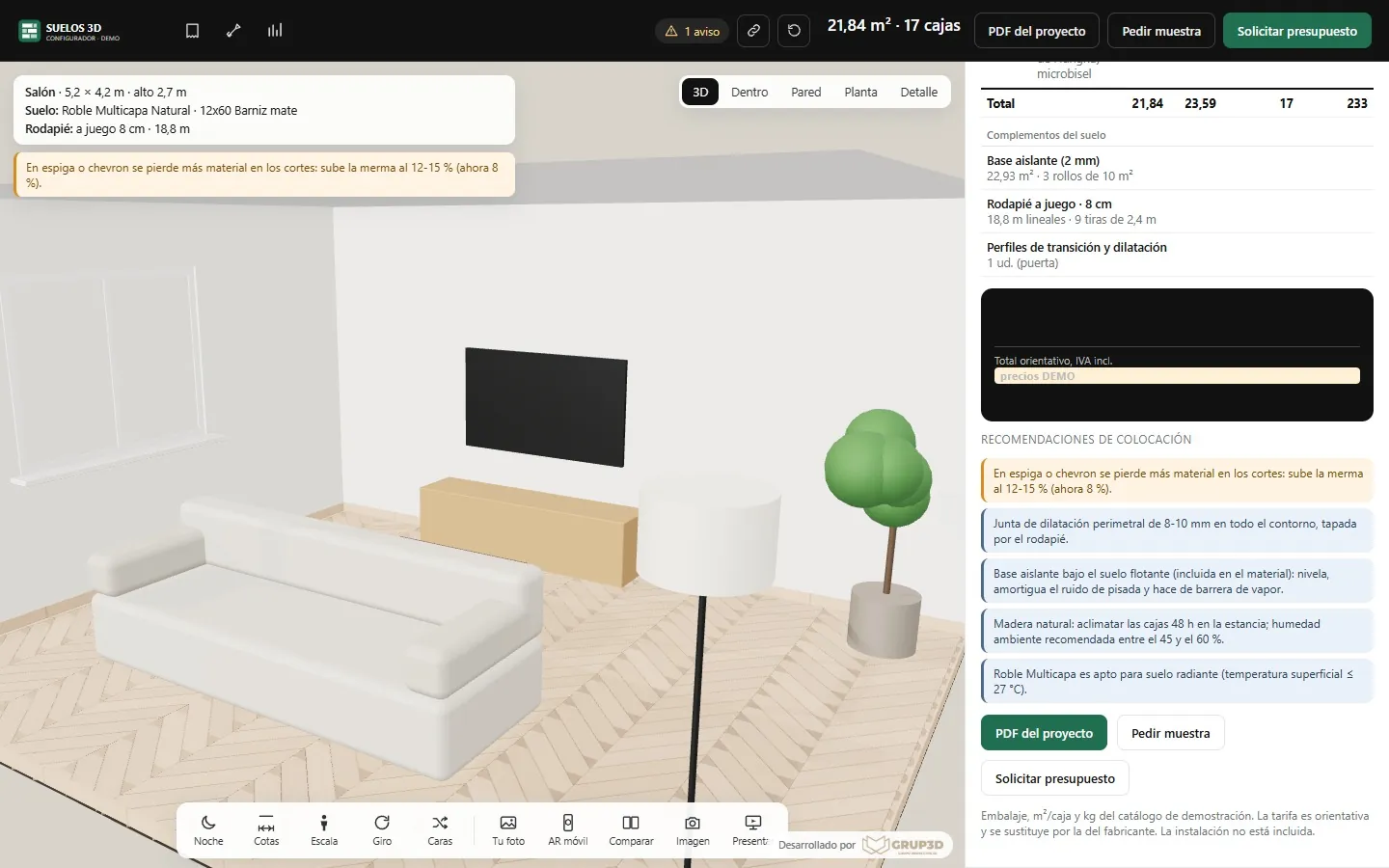
Room measurements, format and laying pattern: boxes with the wastage of each format, the tile or the plank seen laid, and the trim pieces. See tile configurator and how many boxes of tiles do I need.
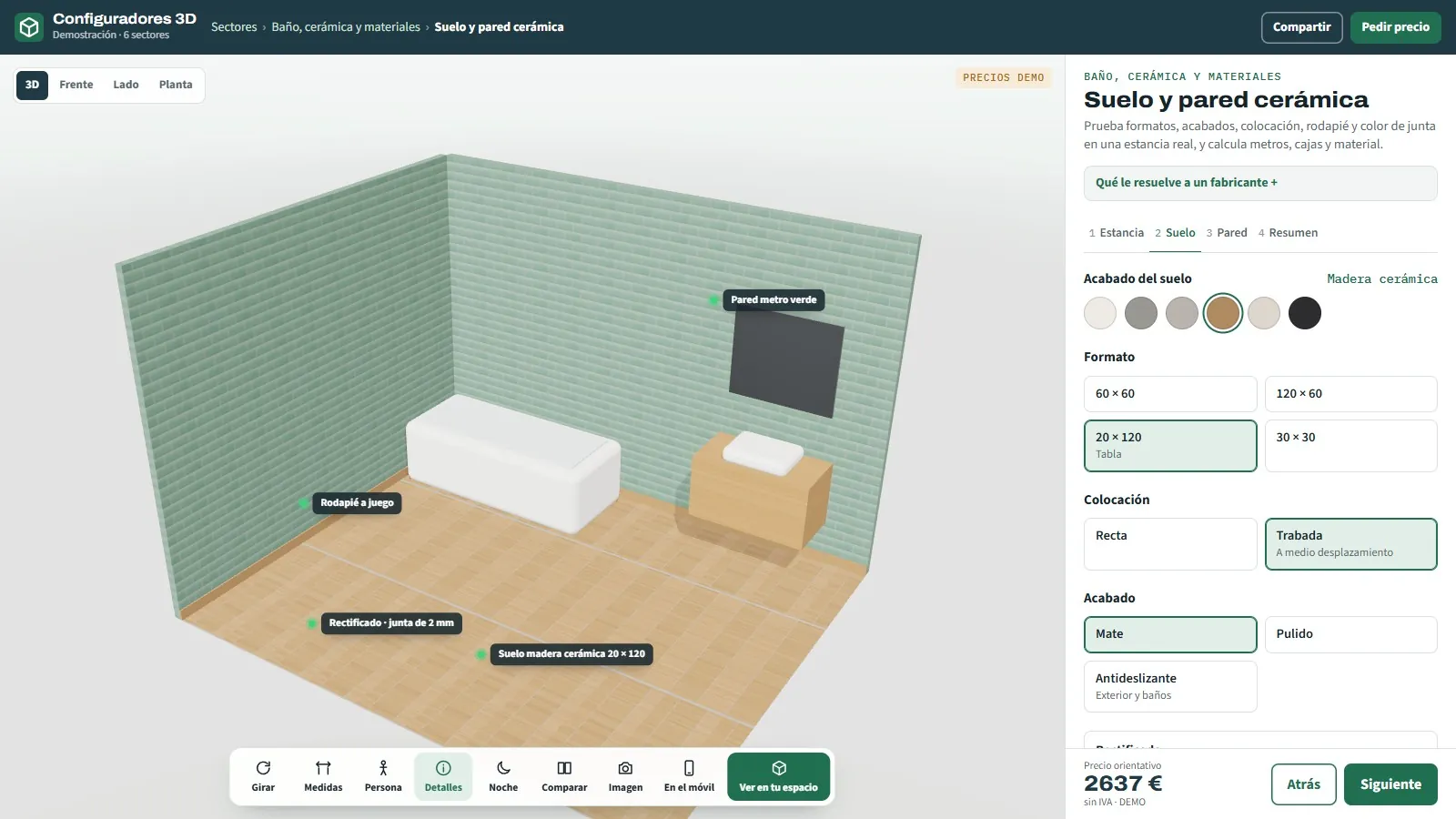
At a builders' merchant's counter, calculations go on all day: how many boxes of tiles for 14 square metres with wastage, how many litres of paint for two coats, which power supply for 8 metres of LED strip, how many panels for a €90 electricity bill. The counter staff work it out in their head, with the customer waiting and the phone ringing. A 3D configurator for merchants does those sums at the counter, on the website and on the installer's phone, with products from several manufacturers, the merchant's price list and its margin.
Every miscalculation is a customer's return trip or a spare box in their garage.
Saturday morning at a builders' merchant. A private customer brings the measurements of their bathroom in a photo on their phone; an installer wants to know which power supply the LED strip they are fitting in a kitchen needs; a couple asks how many panels they need to stop paying what they pay. The counter staff know how to do it, but they do it in their head, with the queue growing, and by the third enquiry they round up just in case.
With the configurator on the counter tablet, every question is a screen: the bathroom's square metres turn into boxes with the wastage of the chosen format and the tile is seen laid; the metres of strip give the power supply, the profiles, the end caps and the clips; the electricity bill and the roof give the panels, the production and the saving. The customer takes the PDF with everything and the merchant's indicative price, and the merchant takes the complete order.
And what the counter staff calculated for the person in front of them, the merchant's website calculates at night for the installer preparing tomorrow's job.
From the open demos, with sample products and prices. Each one answers the question asked at the merchant's.
Room measurements, format and laying pattern: boxes with the wastage of each format, the tile or the plank seen laid, and the trim pieces. See tile configurator and how many boxes of tiles do I need.
Wall and ceiling area, coats and the product's coverage: litres and tins, with the colour seen in the room. See paint colour simulator.
Metres and type of strip: the recommended power supply, the voltage-drop warning and the order with reels, profiles, end caps, clips and power supply. See which power supply an LED strip needs.
Bill, province, roof and battery: panels, production with public data, saving and payback, with the mounting structure in the price. See solar panel configurator.
Linear metres and system: posts, sections, glass panels and anchors by reference and quantity, with the minimum height as a rule. See how to calculate a railing.
Square metres, rooms, climate zone and orientation: the output, the unit (split, multi-split or ducted) and the consumption compared with an old one. See air conditioning configurator.
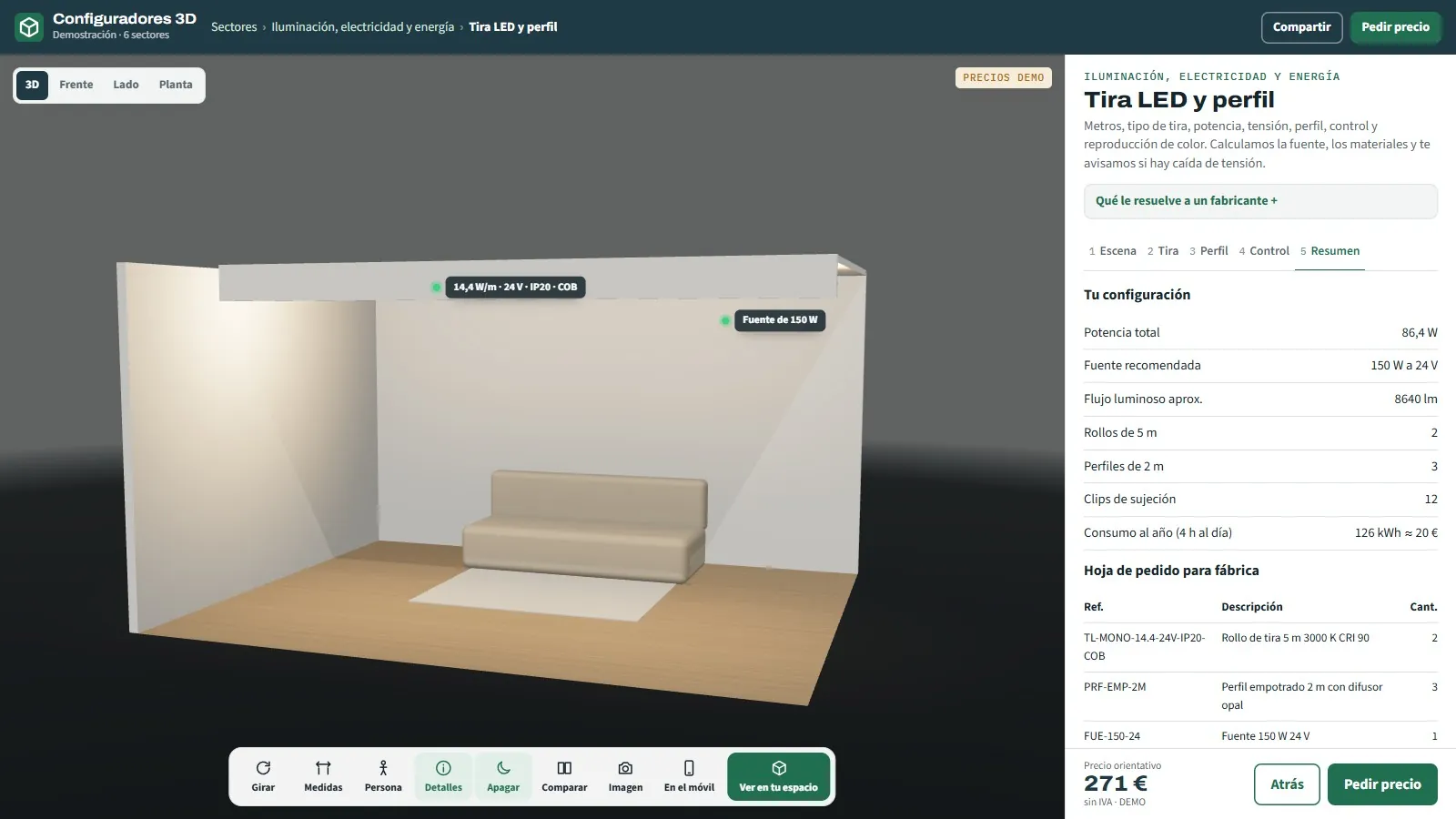
The merchant has no factory: it has forty. The configurator is built with each one's rules and the house price list.
The formats and wastage of each tile, the coverage of each paint, the strip types and their power supplies, the railing systems with their limits. What can be ordered and in what quantities is set by the manufacturer's catalogue; the configurator applies it.
The merchant's selling price, loaded from your template, with discounts per trade customer. The installer logs in with their code and sees their price; the private customer sees the shop price. See white-label 3D configurator for distributors.
The configurator, the PDF and the emails carry the merchant's brand; the manufacturer appears in the product reference, as on the delivery note. If a manufacturer changes, the reference table changes, not the configurator.
Every confirmed order generates the sheet with each manufacturer's references and quantities, ready to send or to import into the merchant's management software. See 3D configurator company for manufacturers and for those who sell without a factory.
The same configurator in the three places where the merchant sells.
The installer works out at night what they need, with their code and their price, and leaves the order ready to collect first thing. Requests from private customers are assigned to the nearest branch by postcode.
With nothing to install: the installer enters the measurements on site, sees the product in the space with augmented reality and sends the order to the merchant. See 3D configurator for installers.
Kiosk mode for the showroom, automatic demonstration and offline operation; the customer sees the tile or the floor laid in their room even if it is not in the showroom. See 3D configurator in the showroom.
Development starts from €6,500 for a visual configurator of one product family; most manufacturer projects fall between €14,500 and €35,000, depending on catalogue, rules and integrations, plus maintenance from €190/month. For a merchant, the price depends on how many families and manufacturers go in at the start; the usual thing is to start with the three that get asked about most at the counter.
There are more short answers in frequently asked questions about 3D configurators and who we are in 3D configurator company.
Yes. The configurator is built with the rules of the manufacturers you sell (formats, wastage, coverage, limits) and with your price list, your margin and your brand. The order comes out with each manufacturer's references, ready to send or import into your software.
Yes. Each family carries its manufacturer's rules and references; the price list is the merchant's. If a manufacturer changes, that family's reference table changes, not the configurator.
What is done in people's heads today: boxes of tiles or flooring with wastage, litres of paint by coats, the power supply and accessories for an LED strip, solar panels and their saving, the posts, glass panels and anchors of a railing, the output of an air conditioning unit. And it shows the product laid in the customer's room.
Yes. Each trade customer logs in with their code and sees their price with their discount, on the merchant's website, on the phone on site or at the counter. Requests are in their name and go to their branch.
Yes. It has kiosk mode for the showroom, automatic demonstration and offline operation; requests are stored and sent when the network returns.
Development starts from €6,500 for a visual configurator of one product family; most manufacturer projects fall between €14,500 and €35,000, depending on catalogue, rules and integrations, plus maintenance from €190/month. For a merchant it depends on how many families and manufacturers go in at the start. Details in the price of a 3D configurator.
Do the counter sums in the open demos: tiles, paint, LED strip, solar panels, railings and air conditioning, with sample products and prices and no sign-up, at configurador.grup3d.es/demo.
With your counter in front of you? Tell us which three questions come up most and from which manufacturers, and in a 20-minute video call you will see the configurator with those families and your sample price list. No commitment.
Would you rather talk it through? Call us on 662 061 421 or write to grup3d@grup3d.es.
3D configurator in the shop, the showroom and the trade fair: tablet with kiosk mode, automatic demonstration, offline use and the request assigned to the shop.
Read →White-label 3D configurator: the distributor puts it on their website with their logo and their margin; the manufacturer keeps the rules and the price list and receives the order.
Read →The index with one card per configurator, filtered by sector, with their open demos.
Read →For manufacturers and for those who sell without a factory: what we do, how, and at what price.
Read →Price, code, cutting lists, online shop, mobile, AI and every sector.
Read →The three levels, what each one includes and what is priced separately.
Read →