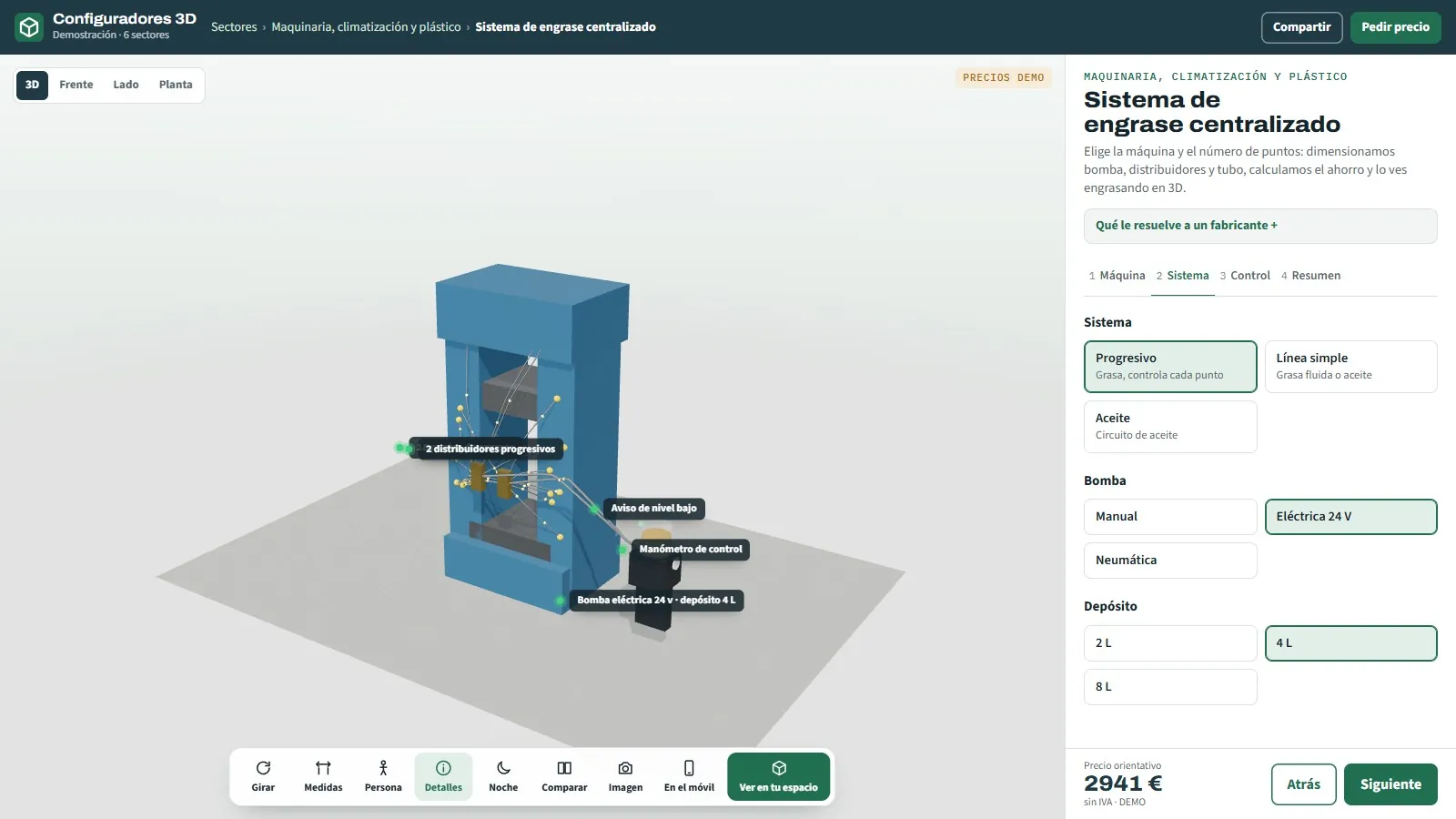
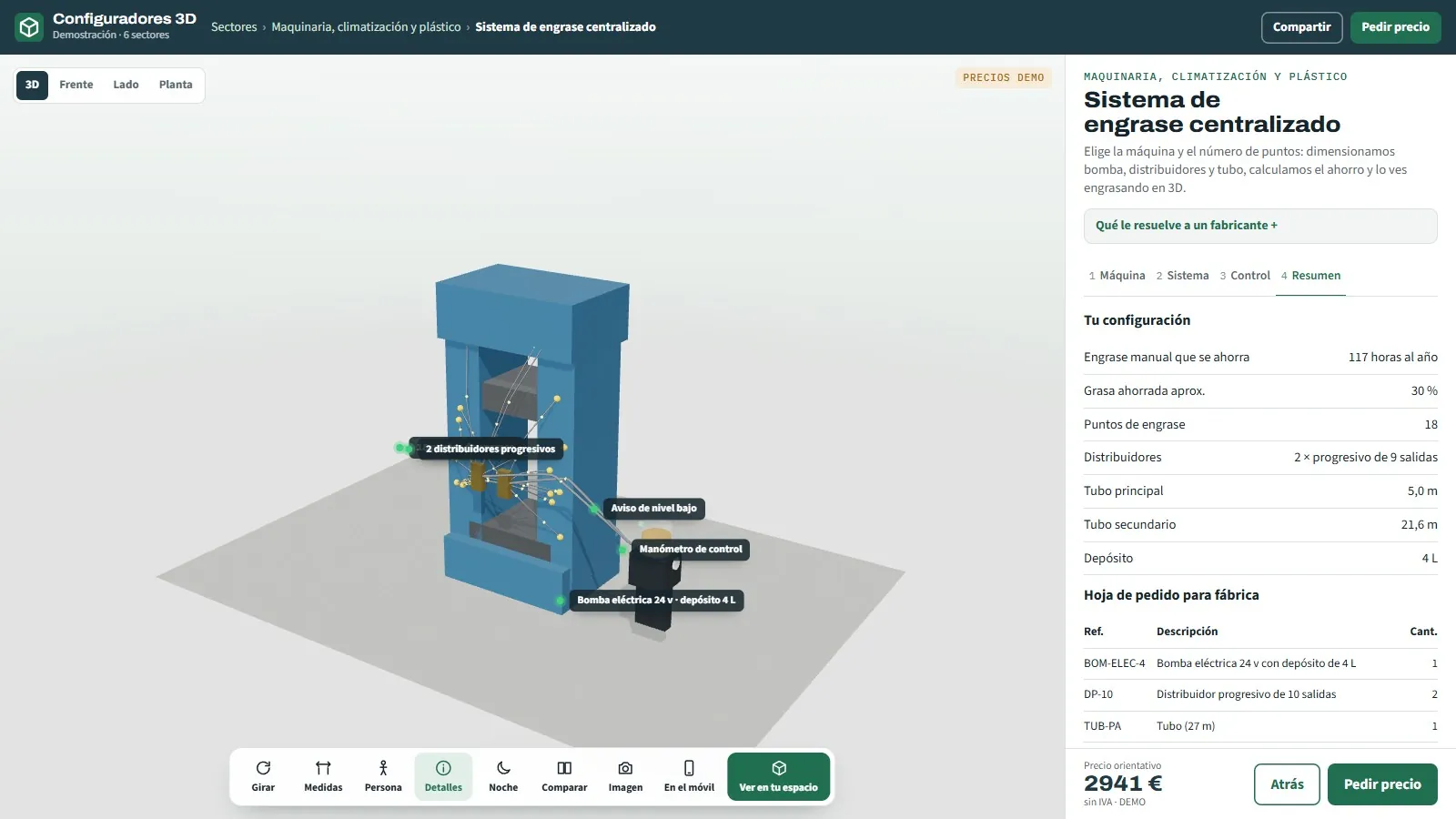
3D centralised lubrication configurator from the machinery and industry sector demo: a press in 3D with an electric pump, a reservoir and labelled progressive distributors, choice of system and pump, and an indicative price
MACHINERY · HVAC · LOGISTICS · PLASTICS · 7 OPEN DEMOS
— FOR MANUFACTURERS, DISTRIBUTORS AND INSTALLERS

3D configurator
for industrial and machinery
manufacturers.

“How much would it cost me to automate this press?” “How many pallets fit if I go up to six metres?” In this sector, before giving a price you have to calculate, and it is always the same engineer who calculates. With a 3D configurator, the customer or your network choose the equipment while seeing it in 3D, with its figures on the spot, and you receive the order sheet.

— WHAT HAPPENS TO YOU

Every offer
crosses the desk
of the same engineer.

Monday, half past eight. The lubrication systems manufacturer receives the photo of a press with eighteen grease points and a “how much would it cost me to automate it?”. The company that installs racking, the sketch of a 900 m² warehouse with the dimensions in biro. The conveyor workshop, a “conveyor for boxes, urgent” and a photo of the floor marked out with tape. And at the tank factory, a cooperative asks whether the 3,000-litre one fits through a 1.40 door.

The product changes; the bottleneck is the same. Before giving a price you have to calculate: split outlets between distributors, work out the capacity for a flat, count frames and beams, choose a motor, see how many pallets fit in a trailer. It is always the same person who does it, the same for the offer that will be signed as for the one nobody will answer.

The offer reaches purchasing as a technical document with a number at the bottom. Nobody sees the greasing hours that disappear or what the anti-collapse mesh is for, and a simpler, cheaper one wins. If it is signed, the bill of materials is copied by hand into the order: an 8-outlet distributor where a 10-outlet one should go, and the mistake travels in the lorry.

— THINGS YOU HEAR EVERY WEEK

How hard it is
to sell technical equipment
made to measure.

In the technical office, on the customer's shop floor and at the counter. Below, how it gets solved.

“I'll send you a photo of the machine and you tell me the price.”

Enquiries without the data to calculate

Points, shifts, rooms, load or speed are missing, and every figure is one more email. Meanwhile, the customer asks someone else for a price.

With the configuratorThe customer chooses points, metres, modules or speed, and it reaches you with all the data and the indicative price they have already seen.

“Every offer eats up an afternoon.”

Sizing by hand, offer after offer

Distributors and tubing, frames and beams, motor and drive: engineer work repeated in every offer, signed or not.

With the configuratorThe base calculation comes out on its own, with your rules: distributors and tubing, capacity, pallet positions, boxes per minute. The engineer checks; they do not start from scratch.

“And how does this reach each point?”

Equipment the customer cannot picture

You read the diagram at a glance; the person who signs sees lines and references. And what is not understood is not approved.

With the configuratorThey see it assembled in 3D and working: the grease reaching every point, the boxes moving along the conveyor. With labels on the pump, the distributors or the motor.

“Purchasing says there is a cheaper offer.”

The price is compared, not what it saves

Two offers on the table and only the final figure gets looked at. The savings appear in neither, and the simpler equipment wins.

With the configuratorNext to the price, the greasing hours saved per year, the consumption and the savings versus old equipment, or the boxes per minute. And up to three options side by side.

“Take off the guards, we'll be careful.”

Safety looks like an extra

Guards, mesh, emergency stops or bunds go into the offer as priced lines with no explanation. They are the first thing to be cut.

With the configuratorGuards, mesh, emergency stops or bunds are seen fitted and labelled. And a warning pops up if the racking goes over 7 metres or if a tank for diesel or chemicals has no bund.

“Will this fit through the door?”

The network calls the factory for a figure

The distributor has the customer in front of them, but not the external dimensions or the pallets that fit in a trailer. They call, and the order waits.

With the configuratorExternal dimensions of the tank next to a person, the loading area of the van, pallets per lorry. And at full size on their phone, with nothing to install.

“Fittings were missing and the distributor had 8 outlets.”

The bill of materials is copied by hand

From the spreadsheet to the order. A wrong beam or a dozen forgotten fittings are discovered with the fitter in the warehouse.

With the configuratorA factory order sheet with reference and quantity, taken from the same configuration the customer saw. The same for one van as for a whole fleet.
— THE JOURNEY TODAY

This is how
a technical offer travels
from the photo to the installation.

Five stops with email, phone and spreadsheet. Something is lost at every one.

  1. 01

    Enquiry

    A photo of the machine, the sketch of the warehouse or a call from a distributor. You lose: the figure nobody sent.

  2. 02

    Questions

    Emails and calls to complete points, loads, dimensions or uses. You lose: days, and sometimes the customer.

  3. 03

    Technical office

    Sizing with the spreadsheet and one person's judgement. You lose: hours on offers that never get signed.

  4. 04

    Purchasing

    A technical document with a price at the bottom, compared with a cheaper one. You lose: margin to match it.

  5. 05

    Installation or loading

    The bill of materials, copied from the calculation into the order. You lose: a second trip for what was missing.

— WHERE THE MARGIN GOES
  • On the offer that is not signed: engineer hours for someone who was only testing the water.
  • On the discount to match: against simpler equipment, because your savings could not be seen.
  • On what gets cut: safety and accessories nobody showed fitted.
  • On the second trip: the fitting, the anchor or the leg that was missing.
— AND YOUR BUYERS DO NOT HAVE IT EASY EITHER
  • They do not know which data they have to give you to get a price.
  • They have to convince purchasing with a document they do not understand.
  • They want the figure today; if it takes long, they ask someone else.

The problem is not your equipment. It is everything that happens between the customer's photo and the order sheet, right where a catalogue falls short (3D configurator vs PDF catalogue).

— DO THE MATHS

How hard it is
to calculate by hand,
with your own numbers.

Replace the example values with your own: hours on offers that never get signed and extra trips.

Assumed figures, just to see how the sum works out. They are not data from any company.
FigureExampleHow it is calculated
A · Technical offers you calculate per month20Signed or not
B · Engineer hours per offer4 hQuestions, calculation and changes
C · Offers that end in an order25 %One in four
D · Second trips per year for missing material4Fittings, anchors, a belt
E · Cost of each second trip€400Travel, hours and material
Hours per year on offers that never get signed720 hA × B × (100 − C) % × 12 months
Cost per year of second trips€1,600D × E
— WHAT CHANGES WITH A CONFIGURATOR

The same offer,
with the calculation
already done.

The same five stops, with a 3D industrial configurator on your website:

  1. 01

    Enquiry

    The customer configures on your website: points, metres, modules or capacity.

  2. 02

    Questions

    No longer needed: the data arrives with the configuration, and the customer takes away their PDF.

  3. 03

    Technical office

    Checks a base calculation made with your rules and adjusts it at the visit.

  4. 04

    Purchasing

    Sees the equipment working, what it saves and up to three options compared.

  5. 05

    Installation or loading

    What the order sheet says goes out, with its reference and its quantity.

To get started: what a 3D configurator is and product augmented reality.

— THE CONFIGURATORS FOR THIS SECTOR

Seven configurators,
the same bottleneck solved.

Each with its own page and open demo, with no registration, with example products and prices (for pallets, with no prices and indicative example loads).

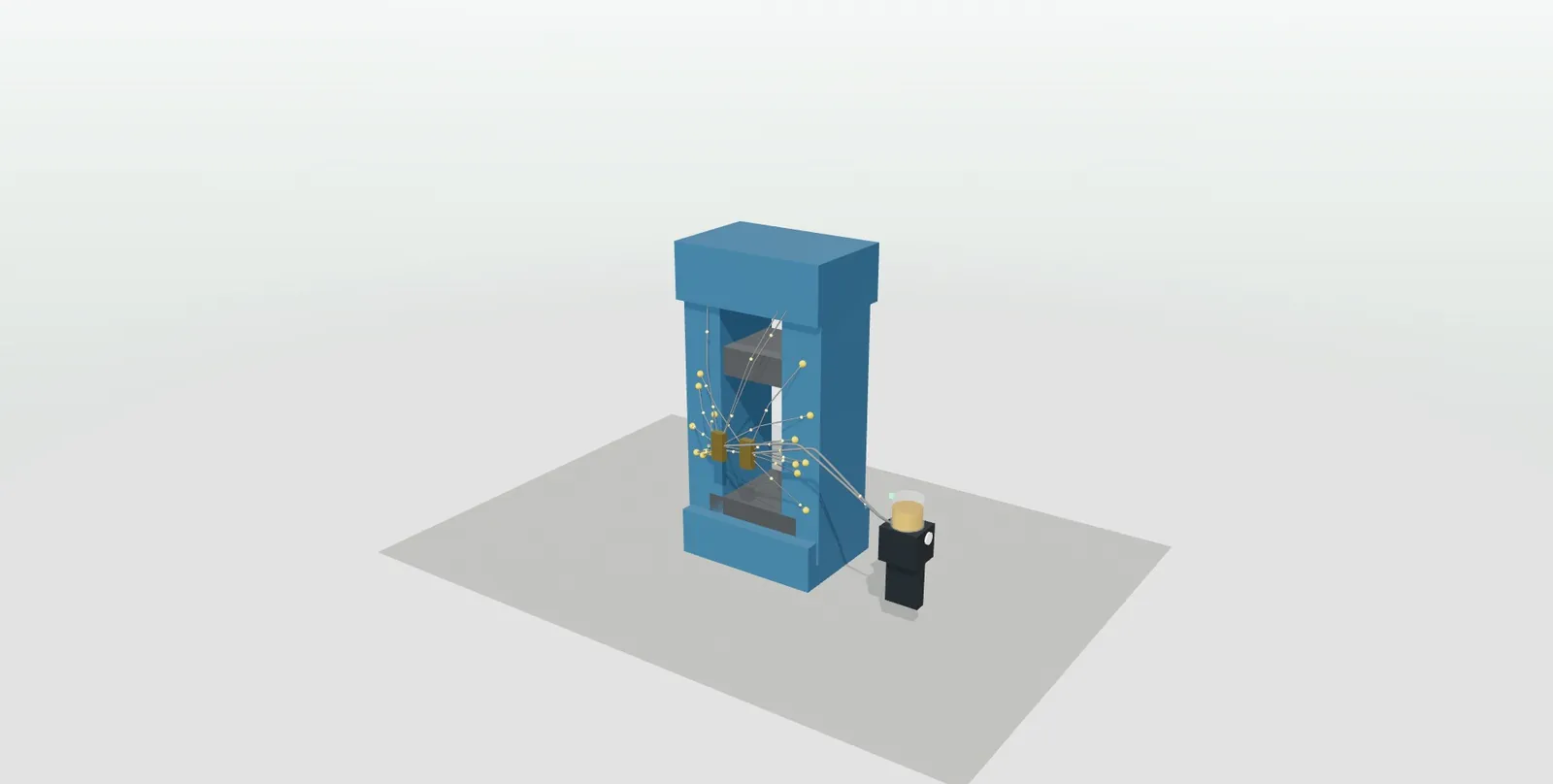
A press in 3D with a centralised lubrication system: pump with reservoir, two progressive distributors and tubing reaching every grease point

Centralised lubrication systems

Progressive, single-line or oil. Pump, distributors and tubing sized, annual savings and the grease flowing.

A house in 3D seen from above with ducted air conditioning, grilles in every room and the outdoor unit

Air conditioning

Split, multi-split or ducted. Square metres, rooms, climate zone and orientation: capacity, units, consumption and savings versus old equipment.

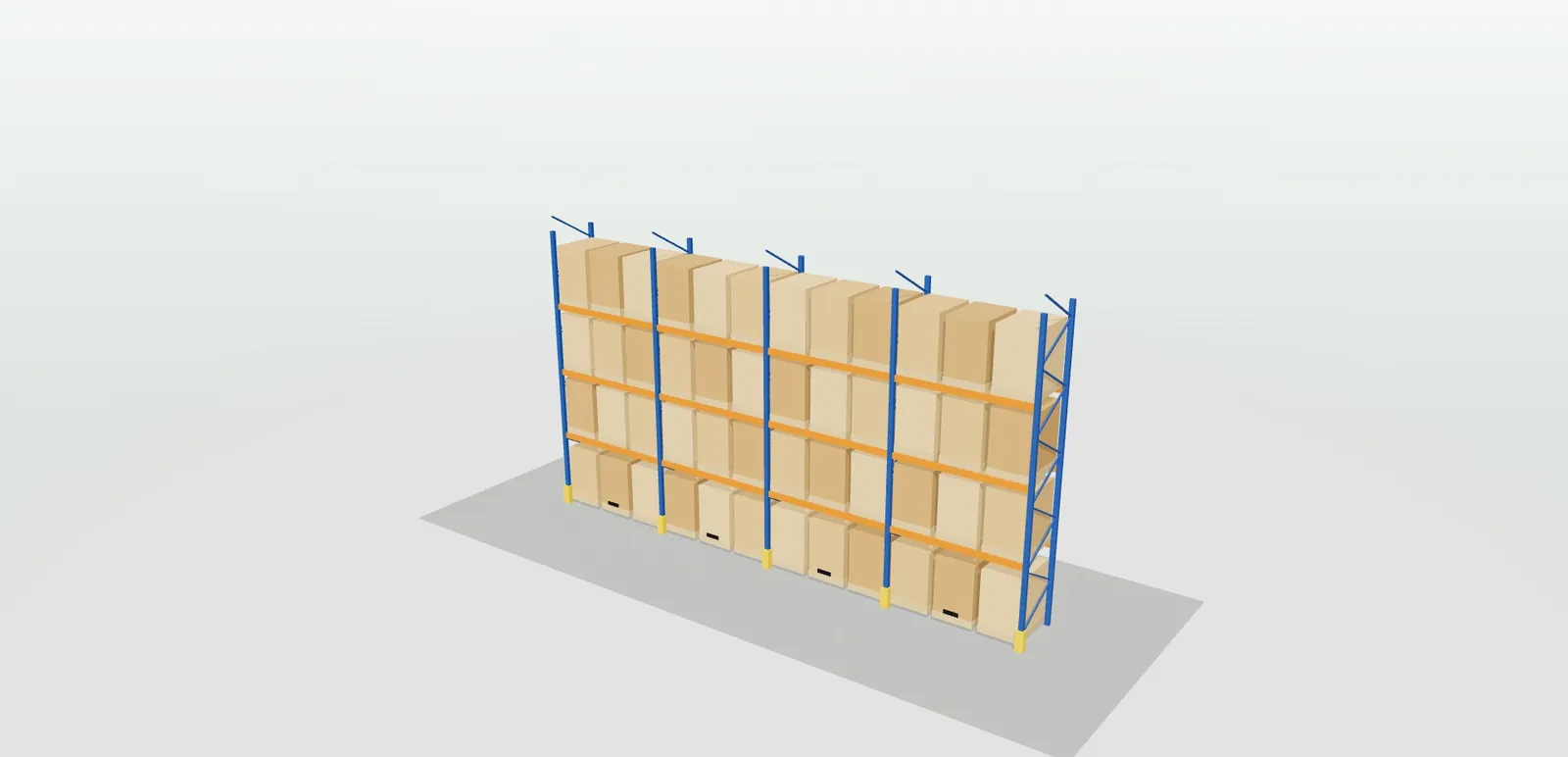
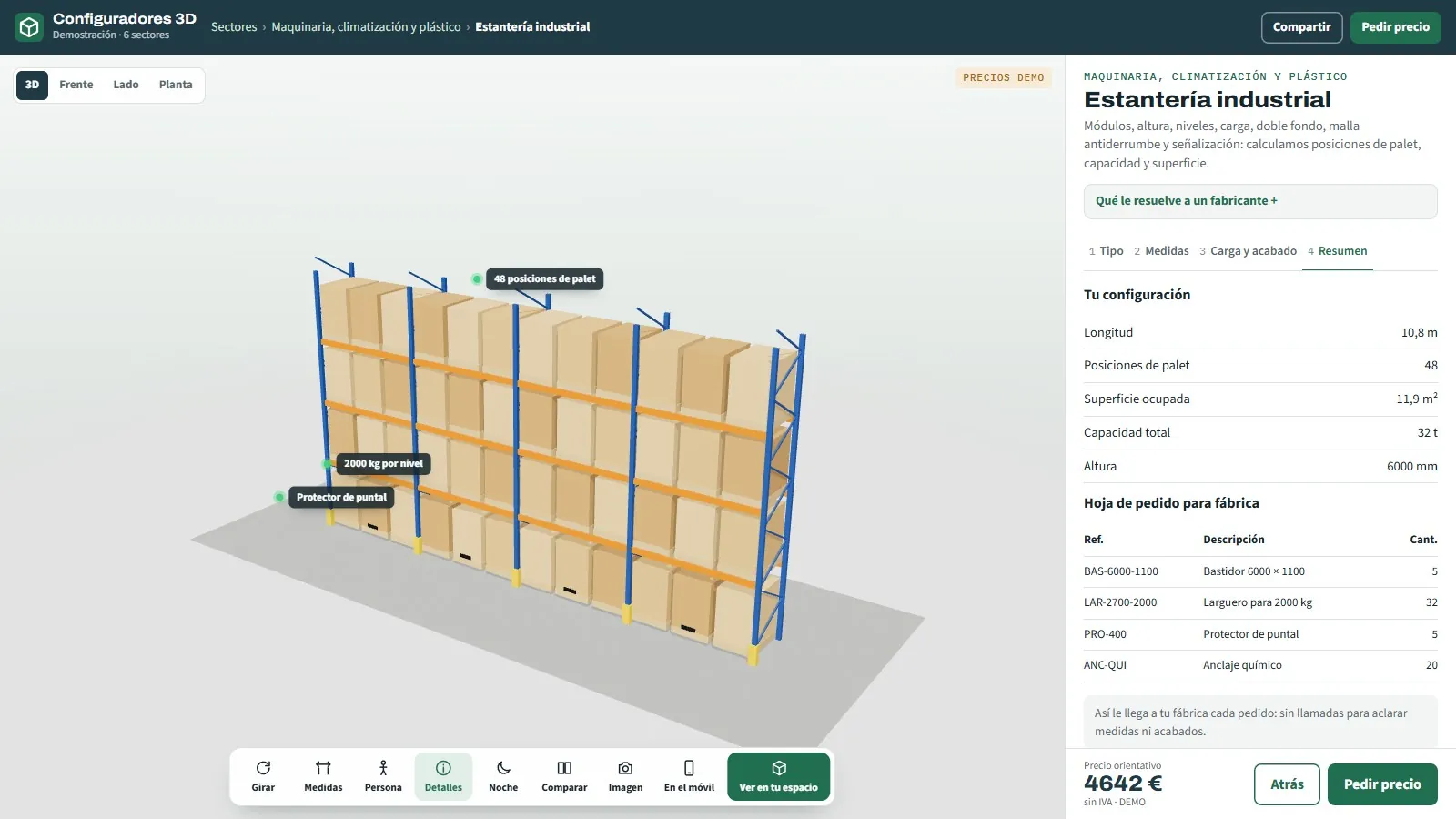
Pallet racking in 3D with blue frames, orange beams, upright protectors and goods on four levels

Industrial racking

Pallet, picking or cantilever. Bays, height, levels and load: pallet positions, capacity and floor area on the spot.

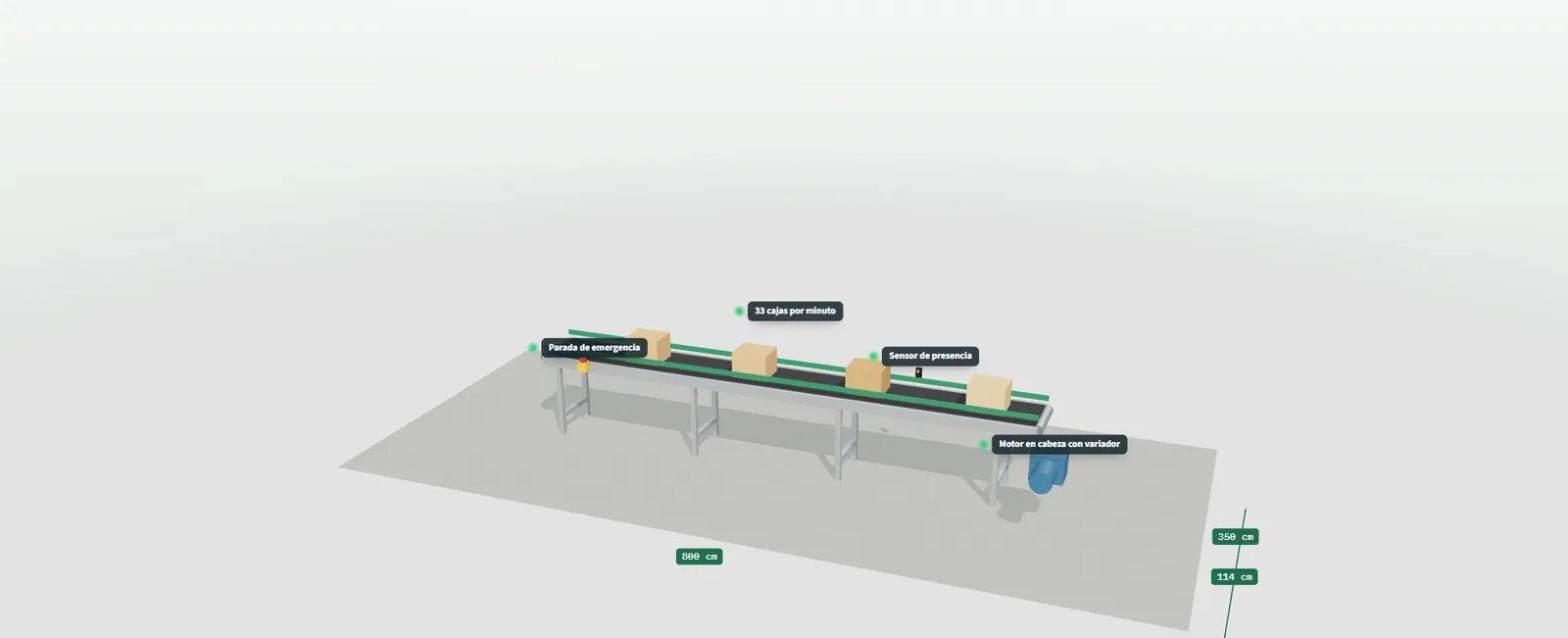
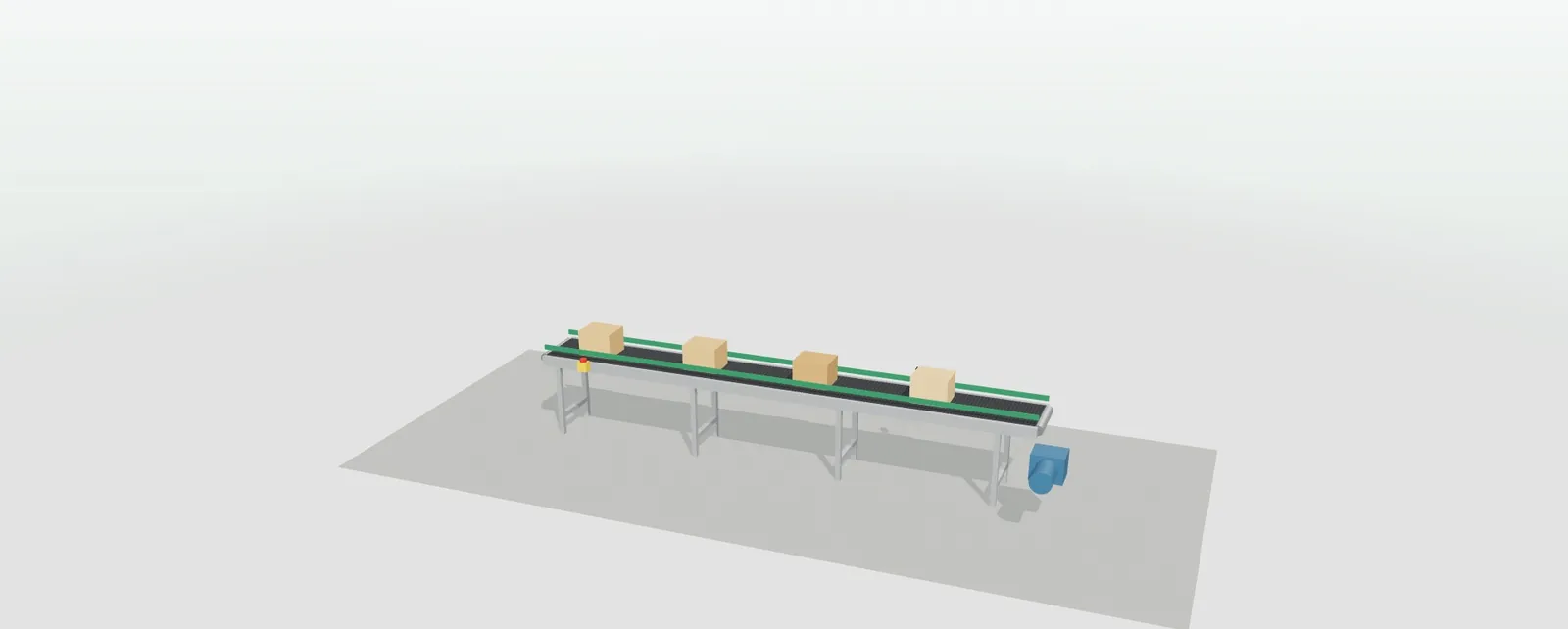
A belt conveyor in 3D with boxes, green side guides, legs and a head motor

Conveyor belts

Belt, roller or modular belt. Length, width, incline and speed, and the conveyor running with its boxes per minute.

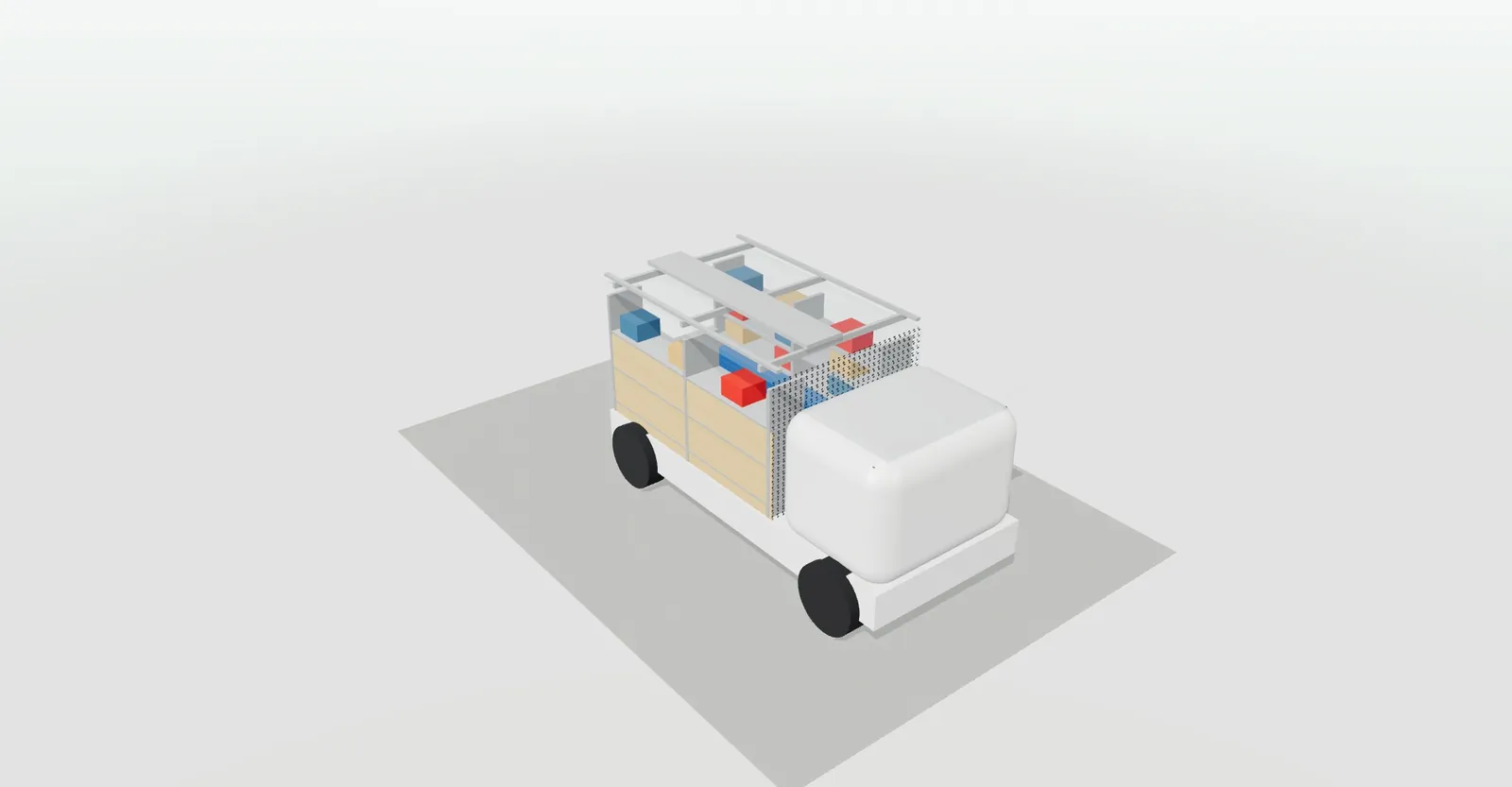
A van in 3D with the interior fitted with drawers and shelves, boxes on the shelves, a cab bulkhead and a roof rack with ladder carrier

Van equipment

Shelving, drawers, floor and roof rack. Each side fitted out and seen from inside, with the added weight.

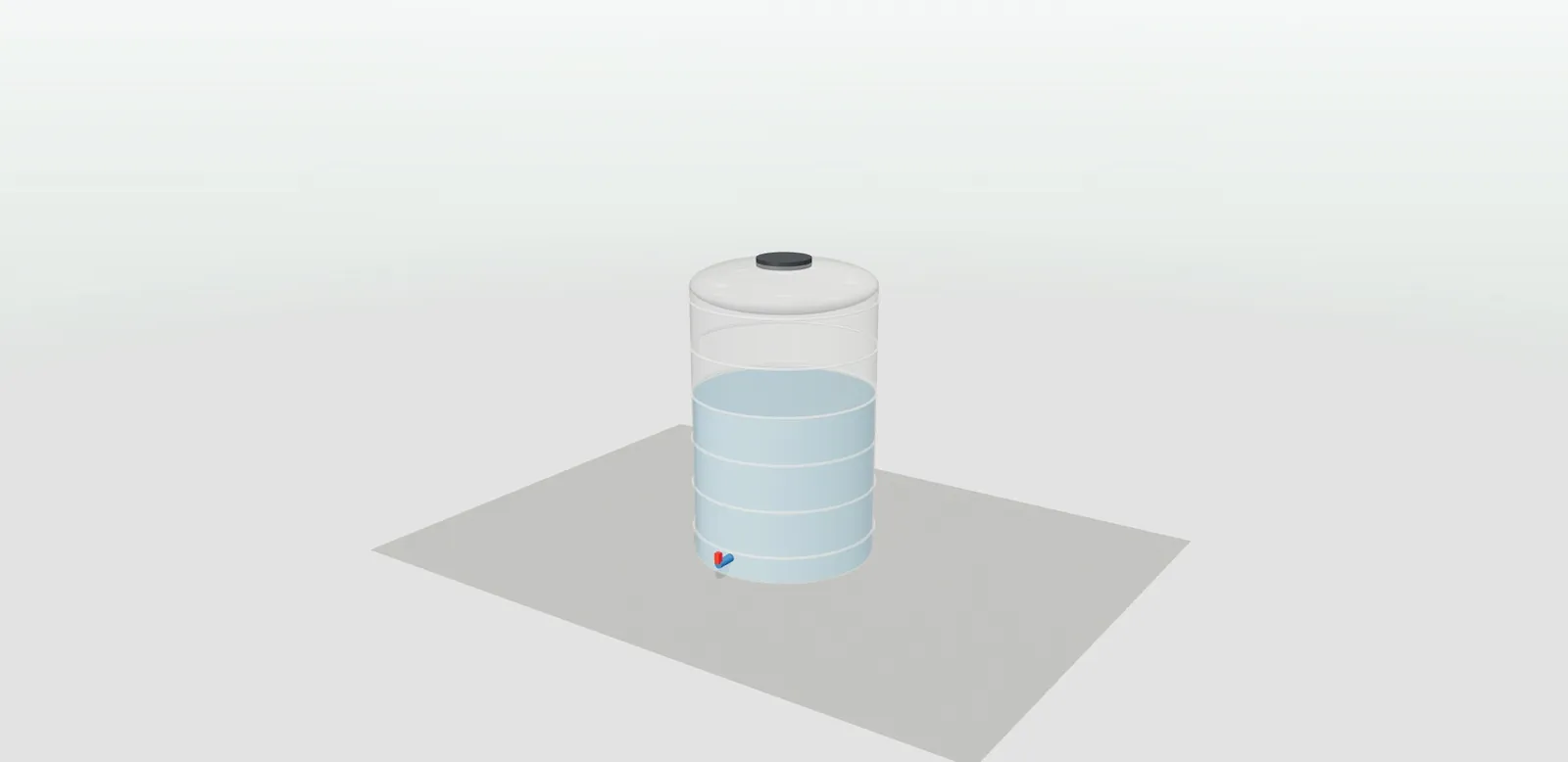
A vertical translucent plastic tank in 3D with a manhole, an outlet tap and the liquid level visible

Plastic tanks and containers

Vertical, horizontal or IBC container. Capacity, use, colour, bund and marking, with the external dimensions.

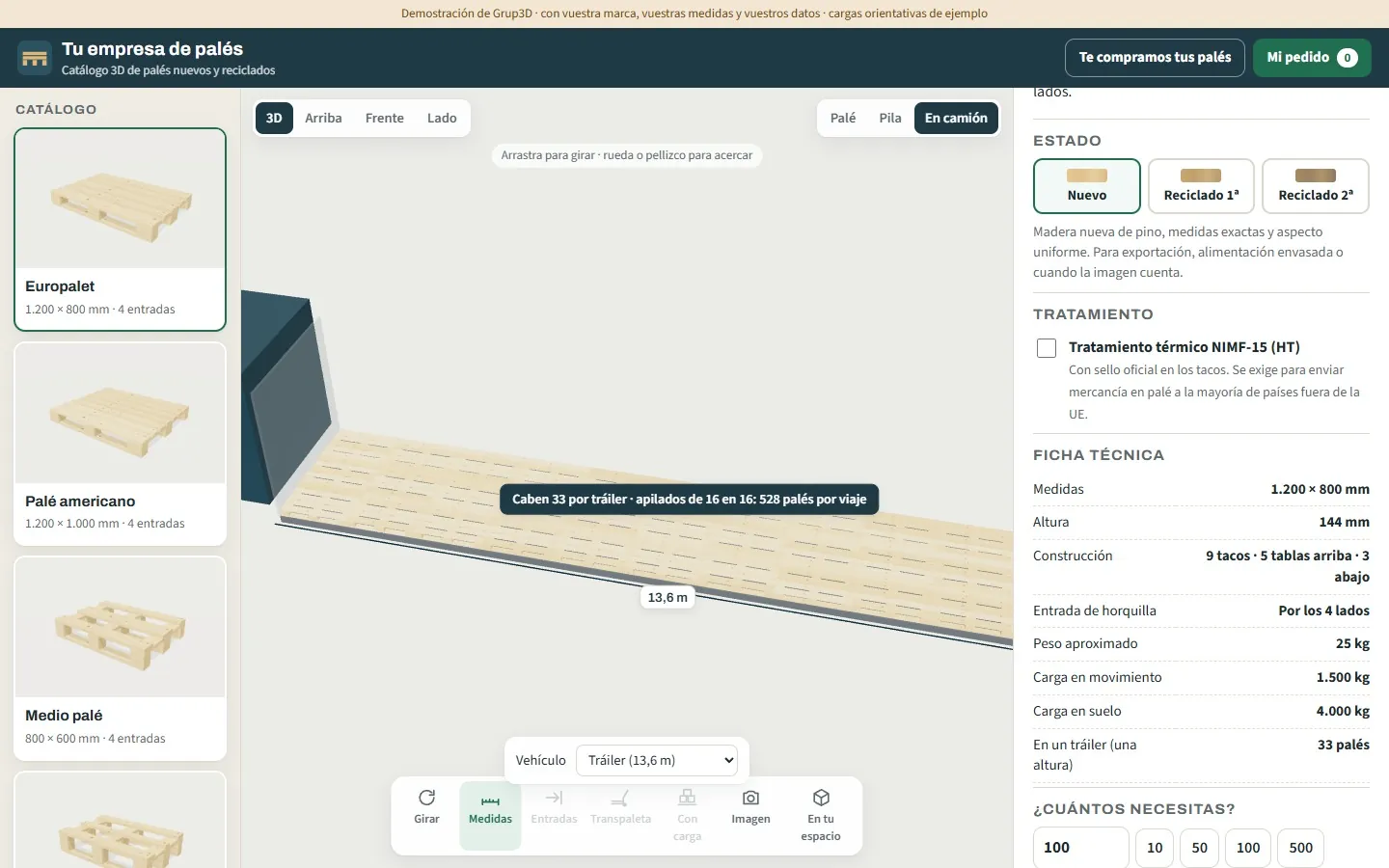
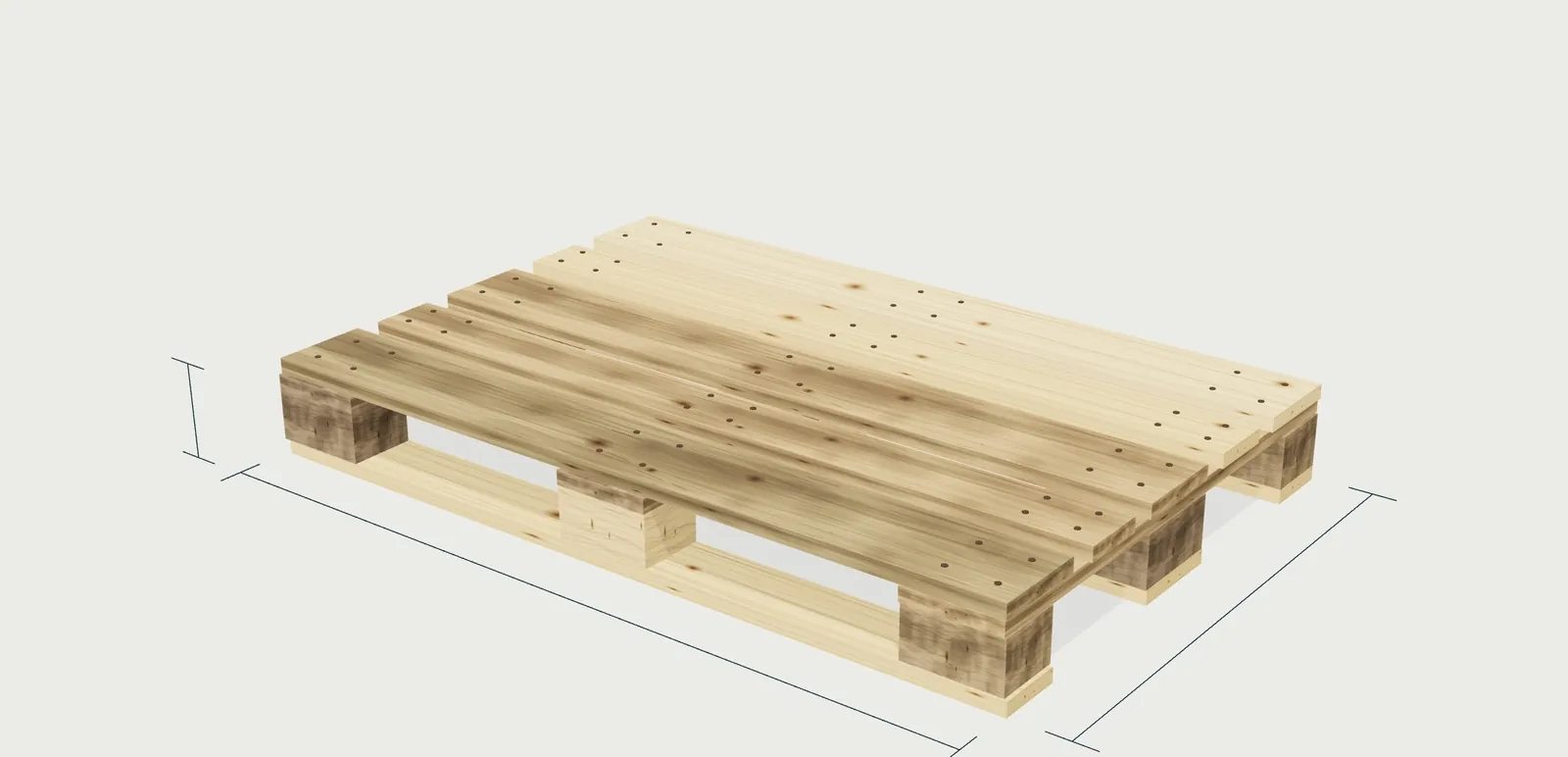
A wooden Euro pallet in 3D with its length, width and height dimensions in the 3D pallet catalogue

3D pallet catalogue

Six types, new and recycled. Fork entries, ISPM-15, stacking, lorry loading and an order with weight and trips.

There are separate pages for industrial doors, electrical enclosures and warehouse lighting. A video of your machine? 3D visualisation for industry.

— WHAT IT CONNECTS TO

What comes out
of each configuration
and where it goes.

What the base already does and what gets developed to order.

— WHAT THE BASE ALREADY DOES
  • Factory order sheet with reference, description and quantity of every component.
  • Configuration PDF with the image of the equipment, its data, the order sheet and the indicative price.
  • Enquiries with the customer's details and their configuration, in a dashboard with its status; email alert if you set up an account.
  • Link, image and QR code of every configuration.
  • For pallets: orders, collections and custom pallets to your inbox and the dashboard, where the data sheets are also edited.
— WHAT GETS DEVELOPED IN YOUR PROJECT
  • Your range, your sizing and load rules, and your price list.
  • An area for distributors, integrators or fitters, each with their margin and their brand.
  • Enquiries distributed by area, to whoever works there.
  • Connection to your ERP or your CRM, if you have them.
Summary of industrial racking in the configurator: length, pallet positions, floor area occupied, total capacity and a factory order sheet with frames, beams, upright protectors and anchors
The demo racking: pallet positions, capacity and factory order sheet. Example prices.
— HOW WE GET IT RUNNING

Four steps
with your range.

After studying your case we give you a fixed price, in writing, before starting.

  1. 01

    Your range

    What you really make or install: systems, sizes, kits and capacities.

  2. 02

    Your rules

    How you size, which loads and ranges you allow, which combinations are not possible and which accessory goes with each use.

  3. 03

    Price list and network

    Prices, distributor margins, areas and who receives each enquiry.

  4. 04

    Website and training

    On your website and on your network's websites, with training for the sales team.

— PRICE

A bespoke development,
at a fixed price.

We start from a base that already works: you do not pay for development from scratch.

— HOW MUCH IT COSTS

From €6,500

Developments start from €6,500 for a visual configurator of one product family; most projects for manufacturers fall between €14,500 and €35,000, depending on the catalogue, the rules and the integrations, plus maintenance from €190 a month.

  • Timeframe: between 3 and 16 weeks depending on the scope; the exact date goes in the proposal.
  • Payment terms: 40% to start, 40% with the test version and 20% at go-live.
  • The configurator is yours: it does not depend on a pay-per-use platform or on third-party licences.
— QUOTED SEPARATELY, PER PRODUCT
  • 3D modelling: pumps, equipment, kits or special parts, from €30 to €120 per part, or more.
  • Materials and finishes: every colour, sheet metal or plastic faithful to the real one, from €30 to €120 per finish, or more.
  • It is settled once we see your files. If you already have the models, they are just adapted.
  • 3D pallet catalogue: a fixed price after studying your case; the pallets are generated from their dimensions, without paying for the modelling of each one.

More detail at the price of a 3D configurator and in how much a 3D product configurator costs.

— FREQUENTLY ASKED QUESTIONS

What manufacturers in this sector
ask us.

What is a 3D industrial configurator?

A tool on your website where the customer, the distributor or your sales rep choose a piece of equipment in 3D while what is done by hand today gets calculated: distributors and tubing, pallet positions, boxes per minute or capacity. At the end, the PDF with the indicative price and the factory order sheet come out.

Which products in the sector can be configured?

The demos have seven: centralised lubrication, air conditioning, industrial racking, conveyor belts, van equipment, plastic tanks and pallets. Any other equipment whose options change the price or the calculation is studied and developed to order. The other sectors, at 3D configurators for manufacturers.

Does it replace our technical office?

No. It makes an indicative base calculation with your rules; your engineer checks it, confirms whatever is needed at the visit and signs off the final project. What changes is the starting point: a complete configuration instead of a photo and an email.

Can we add our own sizing and load rules?

Yes: which system you allow depending on the points or the lubricant, which pump goes in each case, which loads and heights you permit, the ranges of each conveyor or the kits for each van. What you do not make cannot be chosen.

Can our distributors, integrators and installers use it?

Yes. The project includes an area where each one logs in with their margin and their brand, configures with their customer in front of them and sends you the order sheet with your references.

Does it connect to our ERP or our CRM?

It is connected in the project, if you have them: it does not come ready-made, it is developed to order. In the meantime, every enquiry stays in the dashboard with its configuration and, with an email account set up, it also reaches you by email.

How does the 3D pallet catalogue work?

The pallets are generated from their dimensions, without modelling each one. The customer sees where the forks go in, ticks the ISPM-15 treatment, loads the lorry and sends you the order with the weight and the trips, or offers you their used pallets. More at the 3D pallet catalogue.

How much does a 3D industrial configurator cost?

Projects start from €6,500 for a visual configurator of one product family; most projects for manufacturers fall between €14,500 and €35,000, depending on catalogue, rules and integrations, plus maintenance from €190/month. Separately, per product, 3D modelling and materials, from €30 to €120 per part or finish (or more). Pallets, at a fixed price after studying the case.

— OPEN DEMO

Try it now
or see it with
your range.

All seven demos for the sector are open with no registration: six together, with example products and prices, at configurador.grup3d.es/demo, and the pallet one, with example loads, at configurador.grup3d.es/palets. On desktop, tablet and mobile.

With your range in front of us? Bring an offer you have already done by hand and in a 20-minute video call we will configure it together.

  • No commitment.
  • We reply from grup3d@grup3d.es.

Would you rather talk it through? Call us on 662 061 421 or write to grup3d@grup3d.es.